
Nvidia bets $150B on Taiwan as Trump's plan to make US an AI hub backfires
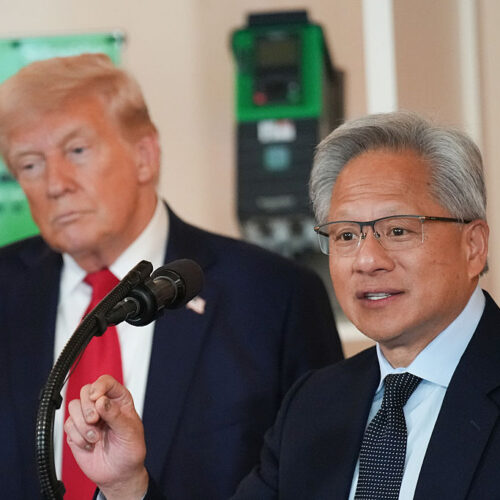
Nvidia Drops $150B Bomb on Taiwan, Trump’s US AI Empire Dreams Crumble
Nvidia CEO Jensen Huang didn’t mince words Wednesday when he unveiled a $150 billion commitment to expand operations across Taiwan. The move locks in the island nation as the beating heart of advanced AI chip production for the foreseeable future. Forget the rhetoric about American dominance. This is raw business logic slapping down political fantasy.
The Announcement That Shook DC
Huang stood in Taipei and outlined plans for new advanced packaging facilities, expanded R&D centers, and deeper integration with TSMC’s most advanced nodes. The investment spans five years and targets everything from Blackwell architecture scaling to next-gen AI accelerators. Nvidia already depends on TSMC for over 90 percent of its leading-edge wafers. This deal cements that dependency instead of shrinking it.
Company filings show Nvidia’s revenue from data center GPUs hit $87 billion last fiscal year. Nearly all of those chips trace back to Taiwanese fabs. Huang’s bet signals executives have run the numbers on US alternatives and found them wanting on cost, speed, and talent depth.
Trump’s CHIPS Push Hits Reality
Donald Trump’s second-term agenda promised to make America the undisputed AI superpower through tariffs, subsidies, and forced reshoring. The CHIPS and Science Act’s $52 billion in incentives were supposed to lure fabs home. Yet TSMC’s Arizona plant, already years behind schedule, produces only mature nodes so far. Advanced 2nm and 3nm work remains anchored in Taiwan.
Industry analysts point to three hard constraints: America lacks enough trained semiconductor engineers, electricity costs run 40 percent higher than Taiwan in key states, and water-intensive fabrication clashes with drought realities in Arizona and Texas. Trump’s team floated additional export controls on equipment to China, but those rules accelerated Beijing’s domestic push without slowing Nvidia’s Taiwan reliance.
One former Commerce Department official, speaking on background, called the policy “all stick and no carrot that actually works.” Companies vote with capital allocation, not press releases.
Why Taiwan Still Wins on Execution
TSMC’s Hsinchu Science Park operates at a density and speed no US site has matched. Yield rates on CoWoS advanced packaging sit above 95 percent in volume production. Nvidia’s new investment will add capacity for 50,000 wafers per month dedicated to AI inference chips by 2028.
Geographic clustering matters. Suppliers of photoresists, specialty gases, and ultra-pure water sit within a 30-minute drive. That ecosystem took three decades to build. Replicating it stateside would require not just money but time measured in election cycles, not product cycles.
Huang’s own comments cut through the noise: “We go where the physics and the people are.” Physics favors Taiwan’s fabs. People favor its engineering bench strength.
Geopolitical Math Nobody Wants to Admit
Beijing’s military drills around Taiwan have intensified, yet capital continues flowing in. Nvidia’s commitment dwarfs the $6.6 billion TSMC pledged for its US site. Risk models at major investors now price in a 15-20 percent probability of major disruption by 2027, but they still see higher expected returns from Taiwan capacity than from slower US builds.
Supply-chain diversification talk remains mostly theater. Intel’s foundry ambitions have produced repeated misses on process leadership. Samsung’s Texas expansion focuses on memory, not logic. No other player offers the combination of yield, speed, and AI-specific process tweaks that TSMC delivers for Nvidia.
Expert Voices Call It Straight
Dan Hutcheson, longtime semiconductor analyst at TechInsights, put numbers behind the decision. “Every extra month of delay in Arizona adds roughly $400 million in lost opportunity cost for an AI leader like Nvidia. Taiwan’s existing infrastructure erases that gap immediately.”
Former Google AI chief Fei-Fei Li noted the talent reality: “US universities graduate fewer than 1,000 PhDs per year in relevant semiconductor and device physics fields. Taiwan and South Korea together produce triple that number focused on fabrication.”
Even bullish reshoring advocates concede the timeline problem. A McKinsey projection released last month estimated full US self-sufficiency in leading-edge AI chips would require $400 billion and 12-15 years. Nvidia’s product roadmap operates on 18-month cycles.
Market and Policy Fallout
Wall Street reacted with typical short-term relief—Nvidia shares ticked up 3 percent on the news—but longer-term questions linger about concentration risk. Portfolio managers at three major index funds confirmed they have stress-tested models assuming 30 percent production loss from a Taiwan contingency.
Trump administration officials have signaled possible new incentives tied to “American-first” manufacturing milestones. Those incentives face the same math problem: subsidies cannot instantly create fabs or engineers. Meanwhile, European and Japanese chip programs have also fallen short of targets, reinforcing Taiwan’s position as the least-bad option.
Smaller AI startups feel the squeeze most acutely. They lack the scale to secure dedicated capacity anywhere else and now face tighter allocation as Nvidia locks in more of TSMC’s lines.
The Bottom Line on American AI Ambitions
Trump’s vision of an insulated US AI hub collides with immutable industrial realities. Capital follows capability, not campaign slogans. Nvidia’s $150 billion move is the clearest market verdict yet that Taiwan remains the indispensable node in the global AI stack.
Policy can influence the long arc, but it cannot override physics, talent pipelines, or decades of clustered expertise overnight. Every quarter that US fabs lag, the gap widens. Nvidia just made that math explicit.
By Jessica, Staff Writer
This article was produced with AI-assisted research and editorial support. Reporting is based on sources cited in the article.
What's Your Reaction?
 Like
1
Like
1
 Dislike
0
Dislike
0
 Love
0
Love
0
 Funny
0
Funny
0
 Wow
0
Wow
0
 Sad
0
Sad
0
 Angry
0
Angry
0

Editor-in-Chief at Global1.News. Atlanta-based journalist who cuts through the BS and tells it like it is. Lead anchor, host, and the voice you hear when the spin stops and the truth starts.












Comments (0)