
Kinshasa's Rapping Priest Reaches Youth With Hip-Hop Gospel
In the sprawling streets of Kinshasa, where nearly 17 million people navigate a daily struggle against poverty and where armed youth gangs known as "kulunas" terrorise neighbourhoods, one Catholic priest is fighting back — not with a Bible in hand, but with a microphone and a hip-hop beat. Father Jean-Pierre Mongambi, known across the Democratic Republic of Congo as the "rappin
In the sprawling streets of Kinshasa, where nearly 17 million people navigate a daily struggle against poverty and where armed youth gangs known as "kulunas" terrorise neighbourhoods, one Catholic priest is fighting back — not with a Bible in hand, but with a microphone and a hip-hop beat. Father Jean-Pierre Mongambi, known across the Democratic Republic of Congo as the "rapping priest," has made it his mission to bring young people back to the Church through the power of rap music.
Rapping Priest Brings Gospel to Kinshasa's Youth Through Hip-Hop
Dakar, Senegal — Father Jean-Pierre Mongambi, the 47-year-old Catholic priest of the Archdiocese of Kinshasa, stands on a makeshift stage in the Ngaliema neighbourhood wearing his black cassock and black cap. He launches into the Lingala refrain "Nayambi, nayambi" — "I believe" — while young people jump to the beat and clutch smartphones to record the moment. The crowd erupts when he declares his signature line, "Rap is not a sin." Three bodyguards watch over the stage in the poor district where kulunas gangs operate daily.
From Matonge to the Pulpit: A Priest's Hip-Hop Roots
Jean-Pierre Mongambi grew up in Matonge, Kinshasa's legendary round-the-clock music hub that pulses with soukous and rumba from dawn until late night. As a teenager he wrote songs inspired by Kris Kross and Dr. Dre, attempting to form a music group while also serving as a choirboy and practising breakdancing moves in neighbourhood courtyards. These early experiences shaped his understanding of rhythm and performance long before he entered the seminary.
A parish priest who reconciled his parents and prevented their separation drew Mongambi toward the Church. He later recalled thinking, "I'd like to be like that man — someone who brings families together." Ordained in 2011, he wrote his first hit song for Cardinal Laurent Monsengwo's birthday. The cardinal supported the project, financing studio recordings and music videos until his death in 2021.
Mongambi's path from Matonge streets to the priesthood illustrates how personal encounters with faith can redirect creative energy. His background as a former choirboy and breakdancer gave him credibility among Kinshasa youth who view the Church as distant from their daily realities. This foundation allowed him to blend hip-hop cadences with spiritual messages without losing authenticity.
The decision to rap rather than preach in traditional style emerged directly from these roots. Mongambi recognised that young people in Kinshasa respond to beats they already know from Matonge sound systems. His ordination in 2011 marked the moment when he began channelling that energy into ministry rather than secular performance.
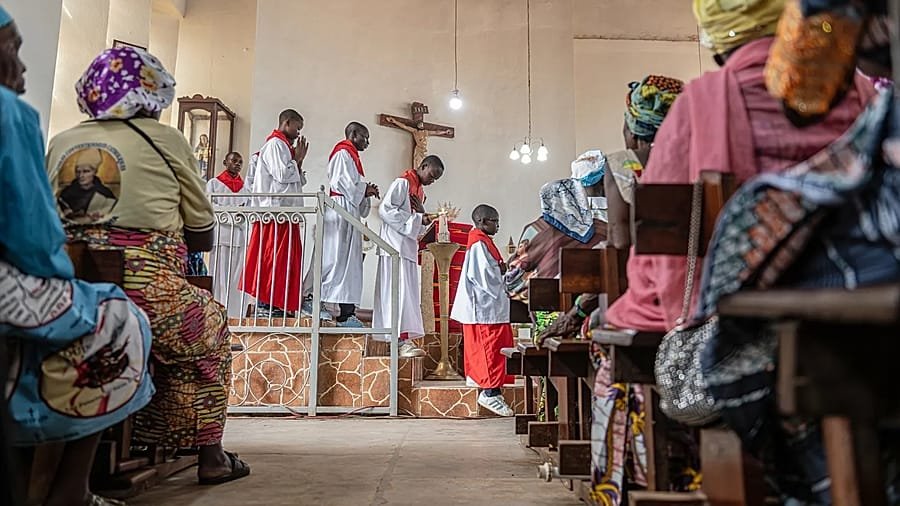
Rap as Evangelism: Reaching Lost Sheep Through Music
Mongambi bases his rap on psalms and prayers, insisting that "Rap is not contradictory with the Church. The essential thing is the message in the songs." Parish priest Augustin Mfwankama discovered him on social media and invited him to give a concert in his parish three years ago. Mfwankama stated, "It's a good method to use rap, rather than a Bible in hand, to draw them in."
Young people in Ngaliema and surrounding districts show little interest in traditional Church activities, preferring football, bars, or online betting. Kulunas gangs continue to plague the area, drawing in unemployed youth. To bring these lost sheep back, Mfwankama placed his hopes on the rapping priest's ability to meet them on familiar cultural ground.
French rapper Niska has publicly supported Mongambi's approach, signalling that the method resonates beyond Congolese borders. The priest performs in parish courtyards and neighbourhood tents, using Lingala lyrics that reference daily struggles while pointing toward faith. This strategy directly addresses the reality that nearly 70 percent of DRC's population lives below the poverty line.
Mongambi's method treats rap as a tool for evangelism rather than entertainment alone. By grounding lyrics in scripture, he maintains doctrinal integrity while adapting the delivery to contemporary tastes. The invitation from Augustin Mfwankama three years ago marked the first large-scale test of whether this fusion could succeed in Kinshasa's challenging environment.
Voices of Hope: How One Priest's Music Is Changing Lives
Chadrack Mayambi, 20 years old, lost his mother four months ago to illness. He said, "He gave me hope to live on this earth again. I was wondering what would become of me, but when I listened to his rap, it made me want to find my way back to the Church." Mayambi completed studies in electrical engineering yet remains unemployed, reflecting the situation of many young people in a country where nearly 70 percent live below the poverty line.
Mongambi rapped for Pope Francis during the pontiff's 2023 visit to the Democratic Republic of Congo, drawing a cheering crowd in Africa's most populous Roman Catholic nation. The performance occurred amid widespread poverty and gang violence, yet the response showed that music could cut through despair. Mayambi's story demonstrates how one song can redirect a young person's path when traditional outreach fails.
The rapping priest's concerts create spaces where youth feel seen rather than judged. In neighbourhoods terrorised by kulunas, his presence offers an alternative gathering point. Chadrack Mayambi's return to Church after his mother's death shows the personal impact of lyrics that speak directly to grief and uncertainty.
Mongambi continues to perform across Kinshasa, reaching young people who have disengaged from parish life. His 2023 performance before Pope Francis elevated the approach to international attention while remaining rooted in local realities. Stories like Mayambi's confirm that the method produces measurable returns in renewed faith commitment.
Digital Pulpit: Social Media and Modern Evangelism in Africa
Mongambi uses social media strategically, stating, "On social media, messages can go out directly and reach everywhere. Today's priests are capable of engaging with modernity in order to truly attract young people." His approach aligns with broader trends among African clergy who post online prayers, religious music, and spirituality discussions to maintain contact with dispersed congregations.
A Brut Afrique feature video lasting approximately 4.5 minutes gained over 54,000 views. Coverage from Italian agency ANSA and Congolese media Ouragan Cd further amplified his work. Reactions remain mixed, with some praising the innovation while others label it unserious or clownish, raising questions about how far the Church can adapt cultural forms without losing authenticity.
The digital strategy allows Mongambi to bypass traditional gatekeepers and speak directly to Kinshasa's smartphone-carrying youth. In a mega-city of nearly 17 million where physical church attendance has declined, online clips serve as entry points. The 54,000-plus views on the Brut Afrique video illustrate the reach possible when priests embrace platforms already popular among the target audience.
Debates within Congolese Catholic circles continue over whether rap performances dilute sacred traditions. Mongambi maintains that the message remains central regardless of delivery method. His social media presence provides ongoing evidence that direct digital engagement can sustain interest where older methods have lost traction.
A Senegalese Lens: Music as Ministry Across Francophone Africa
Mongambi's story resonates across Francophone Africa because Senegal has long witnessed musicians such as Youssou N'Dour and Baaba Maal blend spiritual themes with popular genres. The griot tradition positions musicians as cultural and spiritual messengers, a role that parallels the rapping priest's work in Kinshasa. Senegal's Saint-Louis Jazz Festival and Dakar Biennale regularly demonstrate how art and faith intersect in public spaces.
Similar experiments appear elsewhere on the continent, including hip-hop choirs in Lagos, gospel amapiano in Johannesburg, and traditional dance integrated into liturgy in Nairobi. These efforts reflect a shared recognition that African churches must adapt to retain young members in rapidly urbanising societies. Kinshasa's experience contributes concrete evidence that such adaptations can succeed even in difficult conditions.
The Senegalese perspective highlights continuity rather than rupture. Just as Youssou N'Dour moved between mbalax and gospel without contradiction, Mongambi treats rap as one more vessel for the same message. This approach strengthens cultural identity while expanding the Church's reach in Francophone Africa.
What the Future Holds for the Rapping Priest and Kinshasa's Youth
Mongambi's concerts continue in parish courtyards and neighbourhood tents across Kinshasa. His goal remains simple: to bring young people back to the Church. The Democratic Republic of Congo faces enormous challenges, including nearly 70 percent poverty, youth unemployment, and armed gang violence from kulunas. Yet the rapping priest's message centres on hope, resilience, and creative adaptation.
His best-known song's refrain tells future generations "Ing..." — a call to never give up. As long as young people in Kinshasa lose their way amid poverty and gang pressure, Jean-Pierre Mongambi will remain present, cassock on and microphone in hand. The 2023 performance for Pope Francis and ongoing social media activity suggest the ministry will expand rather than fade.
The rapping priest's work offers a model for other African clergy facing similar disengagement among youth. By meeting young people where they already gather — through beats, phones, and neighbourhood stages — he demonstrates that tradition and innovation can coexist. Kinshasa's response will determine whether this method becomes a lasting feature of Catholic ministry across the continent.
For communities across Africa watching Kinshasa's experiment, the message is clear: when traditional institutions fail to connect with young people, creative adaptation is not a compromise — it is survival. Mongambi's cassock and microphone represent a model that churches from Lagos to Nairobi could study as they confront similar challenges of youth disengagement in an era of rapid urbanisation and digital connection.
By Amara Diop, Staff WriterThis article was produced with AI-assisted research and editorial support. Reporting is based on sources cited in the article.
What's Your Reaction?
 Like
0
Like
0
 Dislike
0
Dislike
0
 Love
0
Love
0
 Funny
0
Funny
0
 Wow
0
Wow
0
 Sad
0
Sad
0
 Angry
0
Angry
0
West Africa/Sahel Correspondent at Global1.News. Dakar-based journalist covering politics, security, climate, and development across Francophone and Anglophone West Africa. Tells the stories of a region undergoing profound transformation.













Comments (0)