
June 2026 Is India's Fifth-Driest June Since 1901: IMD Explains 39.8% Rainfall Deficit
The India Meteorological Department has confirmed what millions of Indians already felt throughout June — the monsoon was not just delayed, it was drastically below normal. With 99.5 mm of rainfall recorded against 165.3 mm expected, June 2026 has become the fifth-driest June since record-keeping began in 1901, carrying a deficit of 39.8% that now threatens kharif sowing, water
The India Meteorological Department has confirmed what millions of Indians already felt throughout June — the monsoon was not just delayed, it was drastically below normal. With 99.5 mm of rainfall recorded against 165.3 mm expected, June 2026 has become the fifth-driest June since record-keeping began in 1901, carrying a deficit of 39.8% that now threatens kharif sowing, water reserves, and food prices across the country.
June 2026 Is India's Fifth-Driest June Since 1901: IMD Points to MJO, Missing Bay Systems, Typhoons, and El Niño
New Delhi, India – July 2, 2026 — The India Meteorological Department (IMD), operating under the Ministry of Earth Sciences, has identified four distinct atmospheric factors that combined to produce one of the weakest monsoon starts in more than a century. Director General Dr. Mrutyunjay Mohapatra confirmed that the 39.8% rainfall deficit — with 99.5 mm against the normal 165.3 mm — stems from a rare alignment of global and regional weather systems that suppressed cloud formation and disrupted moisture transport into the subcontinent.

The Four Drivers Behind the Driest June in a Decade
The biggest contributor was the Madden-Julian Oscillation, a large-scale pulse of clouds and rainfall that travels around the tropics every 30 to 60 days. During much of June, the MJO remained locked in phases 8 and 1 — phases that are considered unfavourable for monsoon activity over India. When the MJO occupies these phases, atmospheric conditions actively suppress cloud formation over the Indian Ocean, resulting in weaker rainfall across the subcontinent.
Compounding the MJO effect was the complete absence of low-pressure systems over the Bay of Bengal during June. These systems act as the monsoon's engine, drawing vast amounts of moisture inland and distributing rainfall across central and northern India. According to the IMD, not a single such system formed during the month — an unusually rare occurrence that significantly weakened the seasonal rains.
The IMD also pointed to unusually active typhoon activity over the western Pacific Ocean. While several tropical cyclones developed, most moved north-northwest instead of westward. This altered the atmospheric circulation patterns and reduced the likelihood of low-pressure systems forming over the Indian Ocean and Bay of Bengal. Finally, the emergence of El Niño in the equatorial Pacific Ocean — characterised by warmer-than-normal sea surface temperatures — further disrupted global wind patterns and weakened the monsoon circulation. Historically, many drought years in India have coincided with El Niño events.
July Forecast: Below-Normal Rainfall and Above-Normal Heat
The IMD's monthly outlook for July 2026 offers little immediate relief. Rainfall is expected to remain below 94% of the Long Period Average, with normal July precipitation pegged at 280.4 mm. Above-normal maximum and minimum temperatures are forecast across most of the country, with heatwave days expected to persist over east, central, and northwest India. The seasonal monsoon forecast has already been revised to 90% of the LPA, with a 60% probability of deficient rainfall for the entire season.
Early July may bring some respite as fresh low-pressure systems begin developing over the Bay of Bengal and the monsoon trough shifts closer to its normal position. IMD has indicated that western and northern India could see improved rainfall in the coming weeks, though the accumulated deficit from June will be difficult to erase.
What This Means for Indian Agriculture and the Economy
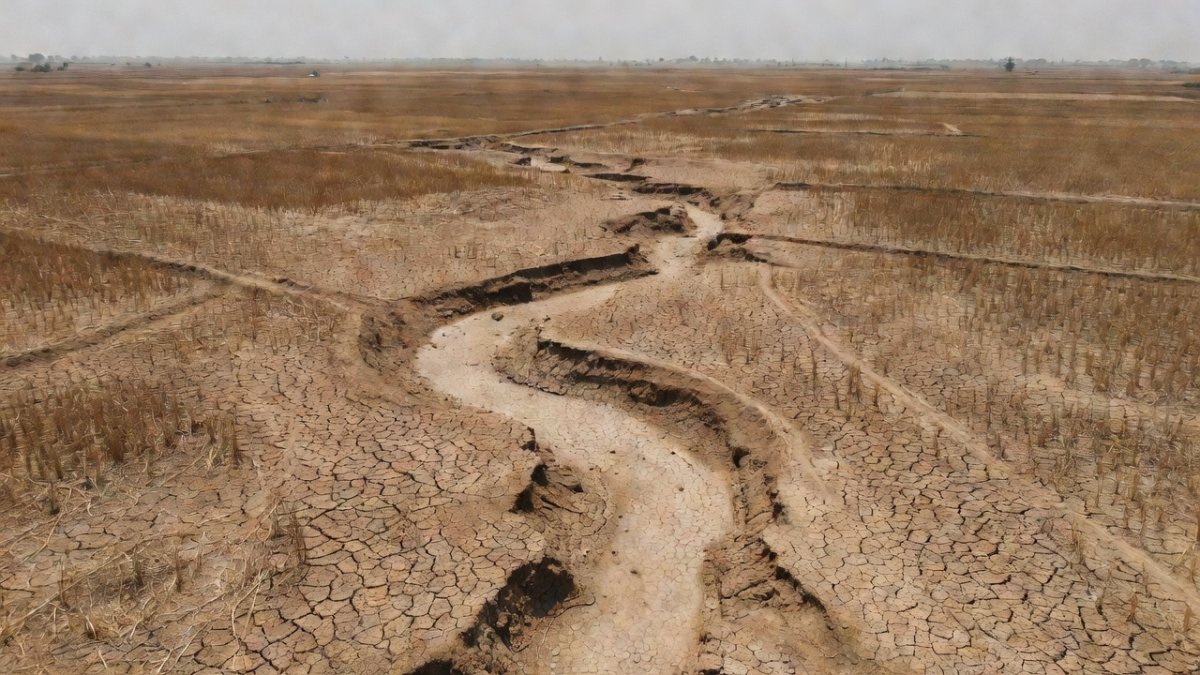
The rainfall shortfall has already begun to affect the kharif sowing season. The Indian Council of Agricultural Research (ICAR) and state agriculture departments report delayed transplantation of paddy and pulses across Punjab, Haryana, Uttar Pradesh, and Madhya Pradesh. Soil moisture levels remain critically low in these states, which together account for a substantial share of India's food grain production.
NITI Aayog has flagged risks to food inflation and rural incomes if the deficit persists. Farmers are increasingly reliant on groundwater pumping to sustain nursery beds, driving up power demand in agricultural states. Temperatures running 4 to 8 degrees Celsius above normal across several regions have compounded the stress on both crops and livestock. The Ministry of Agriculture has advised contingency cropping plans, recommending shorter-duration varieties and alternate crops for districts with severe rainfall shortfalls.
The Regional Paradox: Deficit Nationwide, Floods in Spots
While most of India contends with a rainfall deficit, the same weakened monsoon system has produced intense, localised extremes in certain regions. Assam has witnessed major flooding that washed away a bridge, while Mumbai and Uttarakhand have experienced severe waterlogging — events captured in India Today's broadcast coverage. This illustrates how a disrupted monsoon trough can still generate extreme precipitation when atmospheric conditions align locally, even as broader rainfall patterns remain deficient.
Policy Response and Long-Term Preparedness
The Ministry of Earth Sciences and IMD are expanding real-time monitoring of the MJO and other intra-seasonal phenomena to improve forecast accuracy at the monthly scale. ICAR has released district-level contingency plans, and NITI Aayog is reviewing water storage and micro-irrigation targets under the Pradhan Mantri Krishi Sinchayee Yojana to buffer against future deficits.
For citizens, the implications are direct. Drought-prone districts face higher costs for drinking water, fodder, and electricity. Food inflation, already under pressure from global commodity trends, could accelerate if the kharif harvest falls short. The Centre's disaster response infrastructure — including the National Disaster Management Authority and state-level drought relief cells — remains on alert as the monsoon season enters its critical July-September window.
The Bottom Line
India's monsoon has delivered its weakest opening in over a decade, with a 39.8% June deficit, a fifth-driest ranking since 1901, and a July outlook that offers only marginal hope of recovery. The convergence of the MJO, missing Bay of Bengal low-pressure systems, Pacific typhoon activity, and El Niño has created a rare multi-factor suppression of rainfall that underscores the vulnerability of India's rain-fed agriculture and water infrastructure. Whether the monsoon gathers momentum in the weeks ahead — or slides deeper into deficient territory — will determine the trajectory of food production, inflation, and rural distress for the remainder of 2026.
— By Dr. Raj Patel, Staff Writer
This article was produced with AI-assisted research and editorial support. Reporting is based on sources cited in the article.
What's Your Reaction?
 Like
0
Like
0
 Dislike
0
Dislike
0
 Love
0
Love
0
 Funny
0
Funny
0
 Wow
0
Wow
0
 Sad
0
Sad
0
 Angry
0
Angry
0

India/South Asia Correspondent at Global1.News. Analytical voice with a background in science and health journalism. Based in New Delhi, covering Indian politics, education, healthcare, technology, and policy. Breaks down complex data into clear, actionable reporting.















Comments (0)