
Israeli Ministers Reject US-Iran Deal as Security Failure
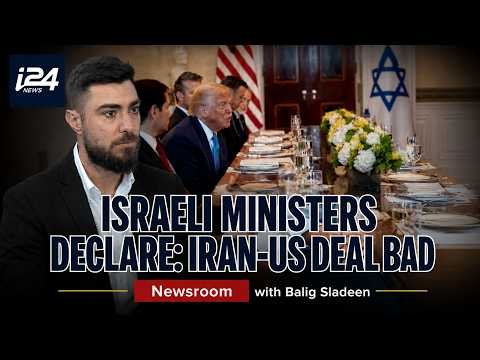
In a recent i24NEWS English report, analyst Catherine Perez-Shakdam joined host Balig Sladeen to break down the immediate backlash from Israeli ministers following the US-Iran peace agreement announced by President Donald Trump. The segment highlighted the sharp divide between Washington's diplomatic breakthrough and Jerusalem's security establishment, with top Israeli official
In a recent i24NEWS English report, analyst Catherine Perez-Shakdam joined host Balig Sladeen to break down the immediate backlash from Israeli ministers following the US-Iran peace agreement announced by President Donald Trump. The segment highlighted the sharp divide between Washington's diplomatic breakthrough and Jerusalem's security establishment, with top Israeli officials declaring the deal a failure that does not guarantee Israel's safety.
Israeli Ministers Declare Iran-US Deal Bad, Fails to Ensure Security
Jerusalem, Israel — Israeli National Security Minister Itamar Ben-Gvir and Finance Minister Bezalel Smotrich led a wave of condemnation against the US-Iran peace deal reached this week, rejecting the agreement as fundamentally incompatible with Israel's security requirements along its northern border and against Iran's nuclear ambitions. The deal, announced by President Trump, includes an immediate ceasefire across multiple fronts, a scheduled reopening of the Strait of Hormuz, and a framework for further talks on Iran's nuclear and ballistic missile programs.
Terms of the US-Iran Agreement and International Response
The agreement reached between the United States and Iran this week includes an immediate and permanent ceasefire, the reopening of the Strait of Hormuz, and a framework for future negotiations on nuclear and ballistic programs. Pakistan, Qatar, Egypt, Saudi Arabia, and Turkey served as mediators during the talks.
International reaction was swift and overwhelmingly positive. United Nations Secretary-General Antonio Guterres congratulated both sides, calling the deal a "critical step towards the peaceful settlement of the conflict." UK Prime Minister Keir Starmer described it as "a hugely important step forward in ending the war, ensuring regional stability, and reopening the Strait of Hormuz." French President Emmanuel Macron welcomed the agreement but stressed the need to address Iran's nuclear program and "policy of regional destabilization." German Chancellor Friedrich Merz called it a "diplomatic breakthrough" that could support global economic recovery.
European Commission President Ursula von der Leyen called for "swift and full implementation by all parties," while EU foreign policy chief Kaja Kallas confirmed the EU stands ready to contribute to a sustainable resolution. These endorsements from world capitals stand in stark contrast to the rejection coming from Jerusalem.
The agreement marks the culmination of months of intensive diplomacy following the outbreak of hostilities that shut the Strait of Hormuz earlier this year, disrupting global oil markets and sending energy prices soaring. The mediators each played distinct roles in bridging gaps between Washington and Tehran during negotiations held in Doha.
European leaders emphasized that the deal must be a starting point rather than an endpoint. Macron specifically noted that Iran's nuclear program and its policy of regional destabilization must be addressed in subsequent talks, a position that aligns closely with Israeli concerns. Starmer affirmed that the UK stands ready to support technical talks that will begin in the coming weeks.
Ben-Gvir and Smotrich Lead Rejection from Coalition
National Security Minister Itamar Ben-Gvir issued a forceful statement declaring that "Trump's agreement does not bind us." He insisted that "Israel is not subject to the United States, and we are an independent and sovereign nation. We are not partners to this agreement that does not ensure our security, and it does not bind us in any way."
Ben-Gvir laid out a list of non-negotiable demands: "We must not compromise on anything less than the dismantling of Hezbollah, we must not withdraw from any territory that our fighters have captured and cleared of terror infrastructure, we must not return to a situation where thousands of terrorists sit on the fences of northern settlements, and certainly we must not remain silent for a moment in the face of fire directed at the State of Israel."
Finance Minister Bezalel Smotrich was equally blunt, posting that "the agreement with Iran is bad for Israel and for the entire free world. Period." He indicated that Israel would need to continue its own campaign against Iran to prevent the Islamic Republic from achieving nuclear weapons, rejecting any framework that leaves Tehran's capabilities intact while sanctions relief potentially channels billions of dollars to the regime.
The ministerial statements reflect a broader coalition position that the deal's terms are incompatible with Israel's post-October 7 security doctrine, which prioritizes preemptive action and sustained military presence in cleared areas. Ben-Gvir's reference to thousands of terrorists sitting on the fences of northern settlements directly evokes the pre-war situation along the Lebanon border.
Smotrich's warning that Israel would need to continue military operations against Iran independently signals a potential point of friction with Washington. The Finance Ministry has already allocated additional funds for sustained IDF deployments in northern Israel and the Golan Heights.
Opposition Leaders Label Deal a Strategic Failure
Opposition leader Yair Golan of The Democrats described the agreement as a "strategic failure" that "funnels billions to the Ayatollahs' regime, leaves the nuclear infrastructure intact, preserves the ballistic threat as is, and throws a lifeline to the murderous regime in Tehran." He called replacing Prime Minister Benjamin Netanyahu "not just a political necessity — it is an existential security imperative."
Benny Gantz of the National Unity Party warned that the emerging agreement "appears to be a strategic failure that will require Israel to engage in diplomatic, military, and legal struggles in the coming years, which only a broad Zionist government can lead." Former IDF chief of staff Gadi Eisenkot lamented that the process has "ripened into the bleak outcome of a failed government," adding that "an abyss yawns between the empty promises of 'total victory' and this morning."
MK Miki Zohar of Likud took a different line, defending the Trump-Netanyahu relationship. "The bond between Trump and Netanyahu will only grow stronger," he said, asserting that "Trump loves Netanyahu and Israel."
The opposition's unified criticism reflects rare cross-party alignment against the government's handling of the agreement. Golan's characterization of the deal as funneling billions to Tehran echoes concerns from security officials that sanctions relief could provide Iran with financial resources to rebuild proxy networks across the region.
Eisenkot, who served as IDF chief of staff during the 2014 Gaza conflict, brought military credibility to the opposition's critique. His assessment that the government operated without strategy or diplomatic or leadership courage over three years and lost the public's trust struck at the core of the Netanyahu government's claims.
Defense Minister Katz Vows Indefinite IDF Presence
Defense Minister Israel Katz confirmed that the IDF will remain in security zones in Lebanon, Syria, and Gaza indefinitely. He described the seizure of territory and establishment of these security zones as "among the greatest achievements of the IDF," and emphasized that no withdrawal will occur from areas cleared of terror infrastructure in southern Lebanon.
Katz stated that the policy dictates "the IDF will remain in the security zones in Lebanon, Syria, and Gaza — indefinitely — in order to protect the border and Israeli communities." This position directly challenges the ceasefire framework's inclusion of Lebanon, which Israeli officials have rejected as incompatible with ongoing operational requirements.
The defense minister's statements align with the concerns of northern Israeli communities, many of which remain evacuated since the escalation that began in October 2023. Residents of settlements near the Lebanon border await clarity on whether the government will maintain security zones or face international pressure to withdraw.

Regional Implications for Hezbollah and the Northern Border
The inclusion of Lebanon in the ceasefire framework is a central point of contention. Israeli officials insist that Hezbollah must be dismantled — a condition not met by the current agreement. The preservation of Iran's ballistic missile capabilities under the deal raises immediate concerns for the IDF's ability to deter attacks on northern Israeli communities.
Shin Bet assessments shared with the Knesset Foreign Affairs and Defense Committee indicate that Hezbollah retains significant operational capacity in southern Lebanon despite IDF clearing operations. The absence of a dismantling requirement in the US-Iran agreement leaves this threat unaddressed, according to multiple ministers.
Regional dynamics involving Iranian proxies in Syria continue to influence IDF planning, with security zones viewed as essential buffers for communities near the border. The reopening of the Strait of Hormuz may ease global oil pressures but does not alter the security equation for Israel, where daily life in the Galilee and Golan Heights remains shaped by the threat of cross-border fire.
What This Means for Israel Going Forward
The split between coalition ministers and opposition leaders has intensified debate inside the Knesset over the proper response. Israeli diplomats at the Foreign Ministry in Jerusalem are preparing for potential legal and diplomatic friction with European partners who have endorsed rapid implementation, which could affect coordination on sanctions enforcement and intelligence sharing.
The agreement's failure to address Iran's nuclear program and ballistic missile capabilities leaves core threats to Israeli cities such as Tel Aviv and Haifa unaddressed. Israeli officials in the Prime Minister's Office have signaled that any future negotiations must include verifiable limits on these systems, and that Israel will pursue its own security arrangements regardless of the multilateral framework.
The coming weeks will test whether Israel can secure additional bilateral understandings with the United States that address the gaps left by the agreement mediated by Pakistan, Qatar, Egypt, Saudi Arabia, and Turkey. For now, the message from Jerusalem is unified in its skepticism: the deal, as currently structured, does not ensure Israel's security.
Internationally, the deal has been welcomed as a diplomatic breakthrough that ends active hostilities between the United States and Iran. But for Israel, the agreement raises fundamental questions about its long-term security architecture. The Knesset is expected to hold emergency sessions to debate Israel's official response, with both coalition and opposition members demanding clarity on how the government plans to address the gaps.
What remains clear is that Israel's security establishment views the agreement as insufficient. Whether through continued military operations, bilateral understandings with Washington, or independent action against Iranian targets, Israeli leaders across the political spectrum have signaled that they will not be bound by terms they consider inadequate. The coming weeks will reveal whether Israel's stance leads to renewed tensions with its closest ally or secures additional guarantees that ministers have demanded.
By Hannah Berg, Staff Writer
This article was produced with AI-assisted research and editorial support. Reporting is based on sources cited in the article.
What's Your Reaction?
 Like
0
Like
0
 Dislike
0
Dislike
0
 Love
0
Love
0
 Funny
0
Funny
0
 Wow
0
Wow
0
 Sad
0
Sad
0
 Angry
0
Angry
0
Israel Correspondent at Global1.News. Based in Tel Aviv, covering Israeli politics, security, technology, and society. Provides balanced, deeply-sourced reporting on one of the most closely-watched regions in the world.













Comments (0)