
Iran's Missile Program Non-Negotiable Amid Ceasefire Efforts
Iran's Missile Defense: A Pillar of Strategic Autonomy in Turbulent Times Iranian President Masoud Pezeshkian has underscored the centrality of the country's ballistic missile capabilities to its national survival, drawing a stark parallel to the devastation seen in Gaza. In remarks delivered during a visit to Pakistan, he emphasized that without these defensive assets, Iran wo
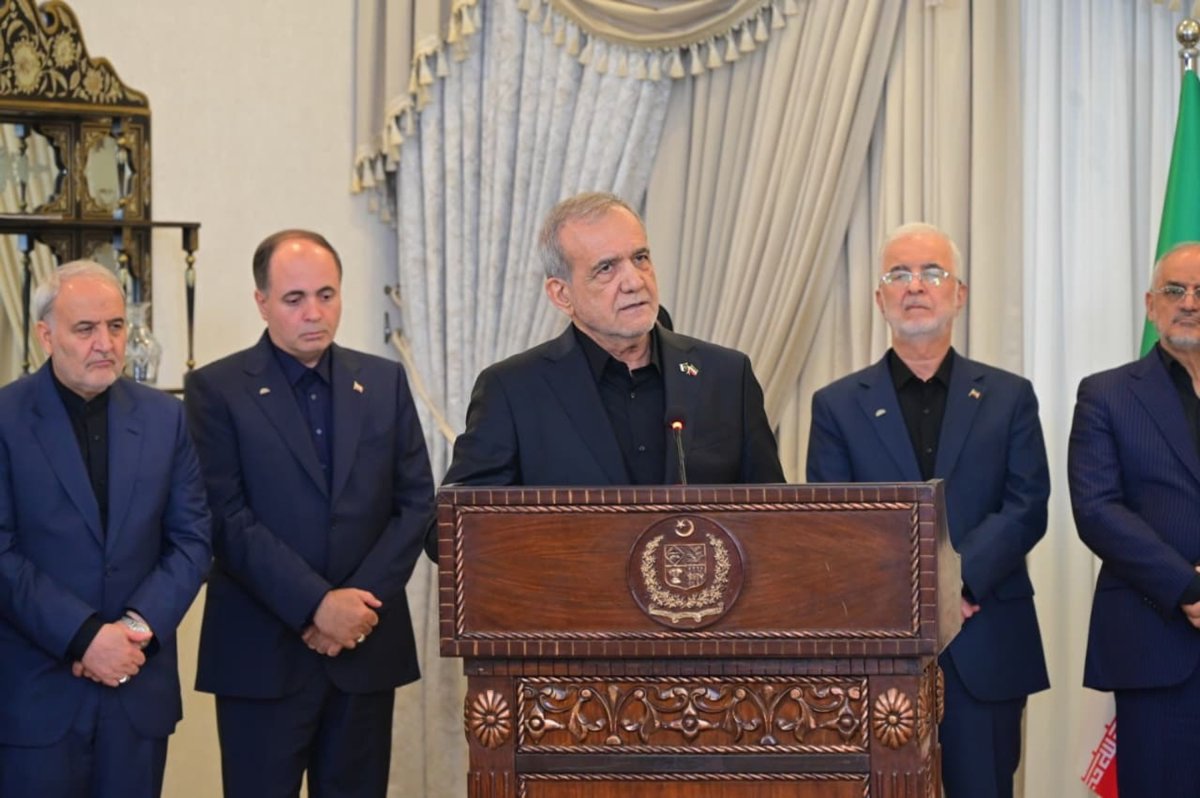
Iranian President Masoud Pezeshkian has underscored the centrality of the country's ballistic missile capabilities to its national survival, drawing a stark parallel to the devastation seen in Gaza. In remarks delivered during a visit to Pakistan, he emphasized that without these defensive assets, Iran would face the same fate as Gaza at the hands of Israel and the United States, with no mercy shown to civilians of any age. This position frames the missile program as an indispensable deterrent rather than a bargaining chip, reflecting a broader strategic calculus in a region marked by asymmetric power dynamics and repeated military confrontations.
The Uncompromising Position on Defensive Capabilities
President Pezeshkian articulated a clear red line during his Pakistan trip, stating that Iran will never negotiate with anyone under any circumstances about its defensive capabilities. This declaration comes in the wake of a war initiated by joint U.S.-Israeli strikes on Iran, during which Tehran responded by firing hundreds of missiles and thousands of drones. The president's words highlight a consistent Iranian policy that treats missile development as integral to sovereignty, especially given the country's experience with external threats that have historically targeted civilian populations without restraint.
By invoking the Gaza scenario, Pezeshkian draws on observable regional patterns where lack of comparable defensive systems has left certain actors vulnerable to overwhelming force. This rhetorical strategy serves to rally domestic support while signaling to international audiences that any pressure to dismantle the program would be met with firm resistance. The stance aligns with Iran's long-standing view that its security environment demands robust self-reliance in the face of superior conventional forces from adversaries.
Historical Roots of the Ballistic Missile Arsenal
Iran's missile program traces its origins to the 1980s war with Iraq, when the need for long-range strike options became acute amid sustained conflict. Over subsequent decades, this capability evolved into the largest ballistic missile arsenal in the Middle East, encompassing systems such as the Shahab-3 with a 1,300 km range as a medium-range ballistic missile, the solid-fuel Sejjil intermediate-range ballistic missile, as well as the Emad, Khorramshahr, and Kheibar Shekan variants. These assets represent a layered defensive architecture developed through necessity rather than offensive ambition, according to Iranian perspectives.
The progression from early wartime adaptations to sophisticated modern platforms underscores how external pressures have shaped Iran's military doctrine. Without these tools, the country would lack credible means to impose costs on potential aggressors, a reality that Pezeshkian ties directly to the protection of its population. This historical trajectory illustrates the interplay between conflict experience and technological adaptation in Middle Eastern security strategies.
The Pakistan-Mediated Agreement and Its Boundaries
A 14-point memorandum of understanding signed on June 17, 2026, between Iran and relevant parties marks a tentative step toward de-escalation, facilitated by Pakistan's mediation along with Turkey, Saudi Arabia, Egypt, and Qatar. The framework includes provisions to end military strikes, reopen the Strait of Hormuz, and extend a 60-day ceasefire, supported by a $300 billion reconstruction fund. Pakistani Prime Minister Shehbaz Sharif confirmed that the MOU contains no reference to ballistic missiles, preserving Iran's core defensive posture amid these diplomatic efforts.
The agreement deliberately sidesteps several contentious issues, including Iran's nuclear program, its ballistic missile capabilities, the future regime governing the Strait of Hormuz, and the role of non-state actors. This selective scope reflects the pragmatic recognition that certain red lines cannot be crossed without derailing the entire process. By excluding missiles from the agenda, the MOU allows for incremental confidence-building while acknowledging the program's entrenched status in Iranian strategy.
Addressing Perceived Double Standards in Regional Armaments
Prime Minister Sharif highlighted the inconsistency of allowing some countries to possess ballistic missiles while denying Iran the same right, framing this as an unacceptable application of double standards. Such observations resonate with broader Middle Eastern debates over equitable security arrangements, where geographic proximity and threat perceptions vary widely among states. Israel's position, located approximately 1,500 km from Iran, treats the program as an existential concern, yet Iranian officials counter that their capabilities serve purely defensive ends in response to prior aggressions.
This tension reveals the challenges of achieving balanced arms control in a region where multiple actors maintain advanced missile systems. The Pakistani emphasis on fairness underscores how mediation efforts must navigate these asymmetries to sustain any lasting truce. Without addressing such perceptions, future agreements risk remaining superficial and prone to breakdown under renewed pressures.
Global Reactions and the Question of Fairness
Comments from U.S. President Trump at the G7 summit acknowledged the inherent unfairness in denying missile capabilities to nations when others already possess them, adding a layer of international acknowledgment to the debate. This perspective intersects with the Iranian argument that defensive needs cannot be selectively curtailed based on political alignments. The war sparked by U.S.-Israeli strikes demonstrated Iran's willingness to deploy its arsenal extensively, reinforcing the program's role as a response mechanism rather than an unprovoked escalation tool.
Regional facilitators including Turkey, Saudi Arabia, Egypt, and Qatar played supporting roles in the MOU process, illustrating how collective diplomacy can create space for dialogue even on sensitive topics. Yet the exclusion of missile discussions from the 14-point framework indicates that core security assets remain off-limits, preserving Iran's strategic autonomy while allowing economic and humanitarian measures to proceed through the reconstruction fund.
Strategic Implications for Lasting Regional Stability
The interplay between Iran's missile doctrine and the recent ceasefire extension points to a delicate balance in Middle East affairs, where deterrence and diplomacy must coexist. Pezeshkian's refusal to entertain negotiations on defensive systems signals that any comprehensive settlement would require mutual recognition of security concerns across all parties. The reopening of the Strait of Hormuz under the MOU offers economic relief, yet underlying military postures continue to shape interactions among Iran, Israel, and external powers.
By maintaining its arsenal developed since the 1980s Iran-Iraq conflict, Iran positions itself against scenarios reminiscent of Gaza's experience. This approach prioritizes resilience in an environment where conventional disparities could otherwise dictate outcomes. The involvement of multiple mediators demonstrates potential pathways for managed competition, though the program's non-negotiable status ensures it will remain a central factor in future strategic calculations.
By Malik Hassan, Staff WriterThis article was produced with AI-assisted research and editorial support. Reporting is based on sources cited in the article.
What's Your Reaction?
 Like
0
Like
0
 Dislike
0
Dislike
0
 Love
0
Love
0
 Funny
0
Funny
0
 Wow
0
Wow
0
 Sad
0
Sad
0
 Angry
0
Angry
0

India/South Asia Correspondent at Global1.News. Analytical voice with a background in science and health journalism. Based in New Delhi, covering Indian politics, education, healthcare, technology, and policy. Breaks down complex data into clear, actionable reporting.











Comments (0)