
Indonesia-Singapore Leaders' Retreat Reaffirms Open Access to Malacca Strait
Indonesia-Singapore Leaders' Retreat Reaffirms Open Access to Malacca Strait The July 2026 Leaders' Retreat and Core Commitments Indonesian President Prabowo Subianto and Singapore's Prime Minister Lawrence Wong convened the second Singapore-Indonesia Leaders' Retreat in Jakarta on July 6, 2026. Their joint statement emphasized the shared responsibility of the two nations to ma
The July 2026 Leaders' Retreat and Core Commitments
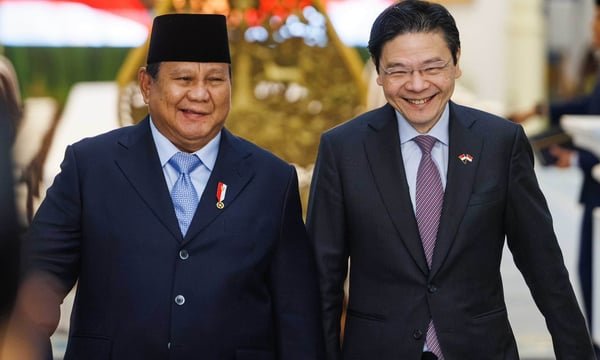
Indonesian President Prabowo Subianto and Singapore's Prime Minister Lawrence Wong convened the second Singapore-Indonesia Leaders' Retreat in Jakarta on July 6, 2026. Their joint statement emphasized the shared responsibility of the two nations to maintain the Strait of Malacca as an open passage for all vessels. Both leaders explicitly linked this position to the United Nations Convention on the Law of the Sea, describing navigational rights and freedoms as consistent with both treaty obligations and customary international law.
President Prabowo noted that Indonesia and Singapore directly border one another in the strait and therefore possess a common interest in preserving it as a route free for all parties. He further stated that coordination would continue with Malaysia and Thailand to ensure the waterway remains open, safe, and accessible in line with UNCLOS provisions. Prime Minister Wong endorsed these remarks, observing that recent disruptions in the Middle East had highlighted the necessity of keeping the Strait of Malacca secure and unobstructed.
Rejection of Toll Proposals and Regional Reassurance
Earlier statements by Indonesian Foreign Minister Purbaya Yudhi Sadewa in April had raised the possibility of a cooperative levy on vessels transiting the strait, modeled on proposals associated with the Strait of Hormuz. The minister suggested that revenue could be divided among Indonesia, Malaysia, and Singapore, with Indonesia's longer coastline potentially entitling it to a larger share. Such remarks generated immediate regional concern, including from Singapore's Foreign Minister Vivian Balakrishnan.
The July 2026 joint press conference effectively closed off this avenue. President Prabowo's reaffirmation of free access, coupled with Prime Minister Wong's description of strategic alignment between the two capitals, signaled that monetization efforts would not advance. This outcome removes a potential source of friction among the littoral states and restores predictability to one of the world's busiest sea lanes.
South Korea's Maritime Energy Security Vulnerabilities
South Korea depends on the Strait of Malacca for approximately 80 percent of its crude oil and liquefied natural gas imports, according to analyses produced by the Korea Energy Economics Institute over the past decade. These studies have repeatedly identified the waterway as the single most critical conduit linking Middle Eastern suppliers to Korean refineries and power plants. Any interruption or added cost would immediately translate into higher import bills and potential shortfalls in industrial feedstock.
The institute's scenario modeling has also examined container shipping volumes, noting that the strait handles a substantial share of Korea's intermediate goods trade. Policymakers in Seoul therefore treat Malacca not merely as a transit route but as an integral component of national energy security architecture. The July 2026 reaffirmation of open access directly mitigates one layer of uncertainty that KEEI assessments have long flagged as requiring continuous diplomatic attention.
Should a toll regime nevertheless materialize despite the retreat outcome, Korean businesses and consumers would confront elevated energy expenditures that propagate through multiple sectors. Refineries processing imported crude would face sustained increases in feedstock costs, directly affecting petrochemical production and the manufacture of plastics, fertilizers, and synthetic materials essential to export industries. Power generation facilities reliant on LNG would encounter parallel pressures, raising electricity tariffs for industrial users and households alike. Downstream effects would extend to consumer products such as automobiles, electronics, and household appliances, where higher input costs erode competitiveness in global markets and contribute to domestic price inflation. The absence of precise quantification in current assessments underscores the value of continued diplomatic vigilance to avert such scenarios.
Dependence of Korean Shipbuilders and Shipping Lines
Korean shipbuilders such as HD Hyundai Heavy Industries, Samsung Heavy Industries, and Hanwha Ocean construct a significant portion of the global fleet that transits the Strait of Malacca on a daily basis. Their order books include very large crude carriers, LNG carriers, and container vessels whose commercial viability rests on predictable passage times and the absence of arbitrary levies. Any toll regime would alter operating cost structures and potentially shift newbuilding demand toward yards in jurisdictions perceived as less exposed to Southeast Asian regulatory risk.
Shipping lines including HMM and Sinokor similarly rely on unobstructed access. Their service schedules between the Persian Gulf, Indian Ocean, and Northeast Asian ports are calibrated to the strait's narrow navigational windows. Disruptions or added fees would force rerouting around Australia or through the Lombok Strait, lengthening voyages and eroding the competitive margins these carriers maintain against regional rivals. The retreat's outcome therefore preserves the operational assumptions underpinning both shipbuilding contracts and liner service planning.
Seoul's Diplomatic Response to the April Toll Proposal
Following the April remarks by Indonesia's foreign minister, South Korean diplomats engaged quietly with counterparts in Jakarta and Singapore while working through ASEAN+3 channels. Seoul also invoked the Korea-ASEAN Solidarity Initiative to underscore the importance of maintaining established transit regimes. These efforts avoided public confrontation yet conveyed clear concern that any levy would affect Korean energy costs and supply-chain resilience.
Although specific démarches remain confidential, the pattern aligns with Korea's established preference for multilateral coordination over bilateral pressure. By reinforcing UNCLOS principles within ASEAN+3 discussions, Korean officials contributed to the broader consensus that ultimately shaped the July 2026 joint statement. This episode illustrates how middle powers can influence littoral-state decision-making through sustained, low-profile engagement rather than overt public diplomacy.
Energy Interconnection Agreements and Cross-Border Trade
Beyond the maritime pledge, the retreat produced 26 concrete agreements, comprising 18 government-to-government instruments and eight business-to-business arrangements. Among the most significant was a memorandum of understanding between Indonesia's new sovereign wealth fund Danantara and three Singaporean entities: Keppel Electric, Sembcorp Industries, and Singapore Energy Interconnections.
The MoU focuses on expanding cross-border electricity trade, including the offtake of imported low-carbon power and resolution of commercial and technical issues surrounding interconnector development. Indonesian Energy Minister Bahlil Lahadalia indicated that price negotiations were underway and expressed optimism about an early breakthrough. These arrangements illustrate how the two countries are translating their geographic proximity into practical energy cooperation, potentially creating new supply options that complement traditional seaborne imports.
Such bilateral electricity frameworks resonate with South Korea's longstanding interest in regional energy interconnection initiatives. Discussions surrounding the Northeast Asian Power Grid Interconnection concept have periodically explored linkages among Korea, China, Russia, and Japan, while proposals for an inter-Korean energy grid have remained stalled amid broader political constraints. The Indonesia-Singapore model offers a pragmatic reference point for addressing technical, commercial, and regulatory hurdles that have historically impeded progress on these Korean-led ambitions, highlighting the potential for incremental advances even where comprehensive multilateral grids face persistent obstacles.
Northeast Asian Coordination on Maritime Security
China, Japan, and South Korea share a common interest in unobstructed passage through the Strait of Malacca, yet their approaches to Indo-Pacific maritime security display both cooperative and competitive elements. Trilateral dialogues have occasionally addressed sea-lane protection, but differing strategic priorities—particularly Beijing's assertiveness in the South China Sea—complicate unified positions. Seoul has sought to balance its alliance commitments with Washington against the need for stable relations with all three Northeast Asian capitals on energy transit issues.
The Indonesia-Singapore outcome provides a modest precedent for rules-based management that all three capitals can endorse without conceding ground on territorial disputes. Korean analysts view this alignment as reinforcing the multilateral norms that underwrite Northeast Asian prosperity, even as competition persists over port infrastructure and naval presence in the wider region.
Comparative Analysis of Regional Chokepoints
The Malacca Strait developments interact with vulnerabilities at the Taiwan Strait, South China Sea, and Korea Strait in ways that complicate Korean risk diversification. While the Taiwan Strait remains the most direct route for certain intra-Asian container services, tensions there have prompted contingency planning that increases reliance on Malacca for Middle Eastern energy cargoes. Similarly, South China Sea disputes raise the prospect of intermittent restrictions that could funnel additional traffic through the already congested Malacca corridor.
The Korea Strait, by contrast, lies entirely within allied waters and offers greater predictability. Yet its limited capacity for very large vessels means it cannot substitute for Malacca on energy routes. The July 2026 reaffirmation therefore reduces the cumulative risk across this network of chokepoints, allowing Seoul to allocate naval and diplomatic resources more efficiently rather than concentrating solely on any single passage.
Further distinctions emerge when comparing governance and operational characteristics. The Korea Strait, situated between Busan and Tsushima Island, operates under a bilateral framework shaped by the Republic of Korea and Japan, with traffic volumes considerably lower than those recorded in Malacca and subject to coordinated naval oversight that reflects alliance structures. Strategic significance centers on regional defense postures rather than global energy transit. Busan Port functions as a premier transshipment hub, facilitating connections across Northeast Asia and supporting Korea's role in container logistics, yet this infrastructure cannot replicate the scale or centrality of Malacca for crude and LNG movements originating from distant suppliers.
ROK Naval Modernization and Regional Vulnerabilities
South Korea's naval modernization program, including the construction of Aegis-equipped destroyers and expanded submarine capabilities, has been shaped in part by lessons from episodic disruptions in the Strait of Hormuz. These platforms enhance the Republic of Korea Navy's ability to conduct distant operations and contribute to coalition maritime security efforts. However, the geographic distance to the Strait of Malacca limits the practical reach of Korean surface combatants in a crisis.
Capacity-building therefore emphasizes interoperability with partners in Southeast Asia and participation in information-sharing arrangements rather than unilateral presence. The retreat's confirmation of open access suggests that diplomatic instruments remain the primary tool for managing Malacca-related risks, while naval investments address the broader spectrum of contingencies illustrated by Hormuz-style events.
Operational experience gained through the Cheonghae anti-piracy unit's sustained deployments in the Gulf of Aden has informed these priorities. Korean naval personnel have developed expertise in escort operations, intelligence coordination, and multinational task force integration that could translate to collaborative arrangements supporting Malacca security. Korea's contributions to ReCAAP, the Singapore-based information-sharing center, further illustrate this approach by facilitating real-time data exchange on piracy and armed robbery incidents across Asian sea lanes, thereby strengthening collective situational awareness without requiring direct Korean naval deployments in Southeast Asian waters.
Long-Term Outlook for Regional Stability
The July 2026 Leaders' Retreat combined a clear political signal on navigational freedoms with tangible economic deliverables. By anchoring commitments in UNCLOS and extending cooperation into electricity trade, Indonesia and Singapore have established a template that balances sovereignty concerns with the practical requirements of global commerce. South Korea, as a major user state, benefits from the resulting stability, which helps safeguard both energy security and the broader maritime architecture upon which Northeast Asian prosperity depends.
By Prof. David Park, Staff WriterThis article was produced with AI-assisted research and editorial support. Reporting is based on sources cited in the article.
What's Your Reaction?
 Like
0
Like
0
 Dislike
0
Dislike
0
 Love
0
Love
0
 Funny
0
Funny
0
 Wow
0
Wow
0
 Sad
0
Sad
0
 Angry
0
Angry
0

East Asia/Technology Correspondent at Global1.News. Seoul-based voice covering Korean politics, technology, business, and culture. Analyzes how technology and geopolitics intersect across East Asia.













Comments (0)