
Global Eid prayers draw millions in early morning gatherings
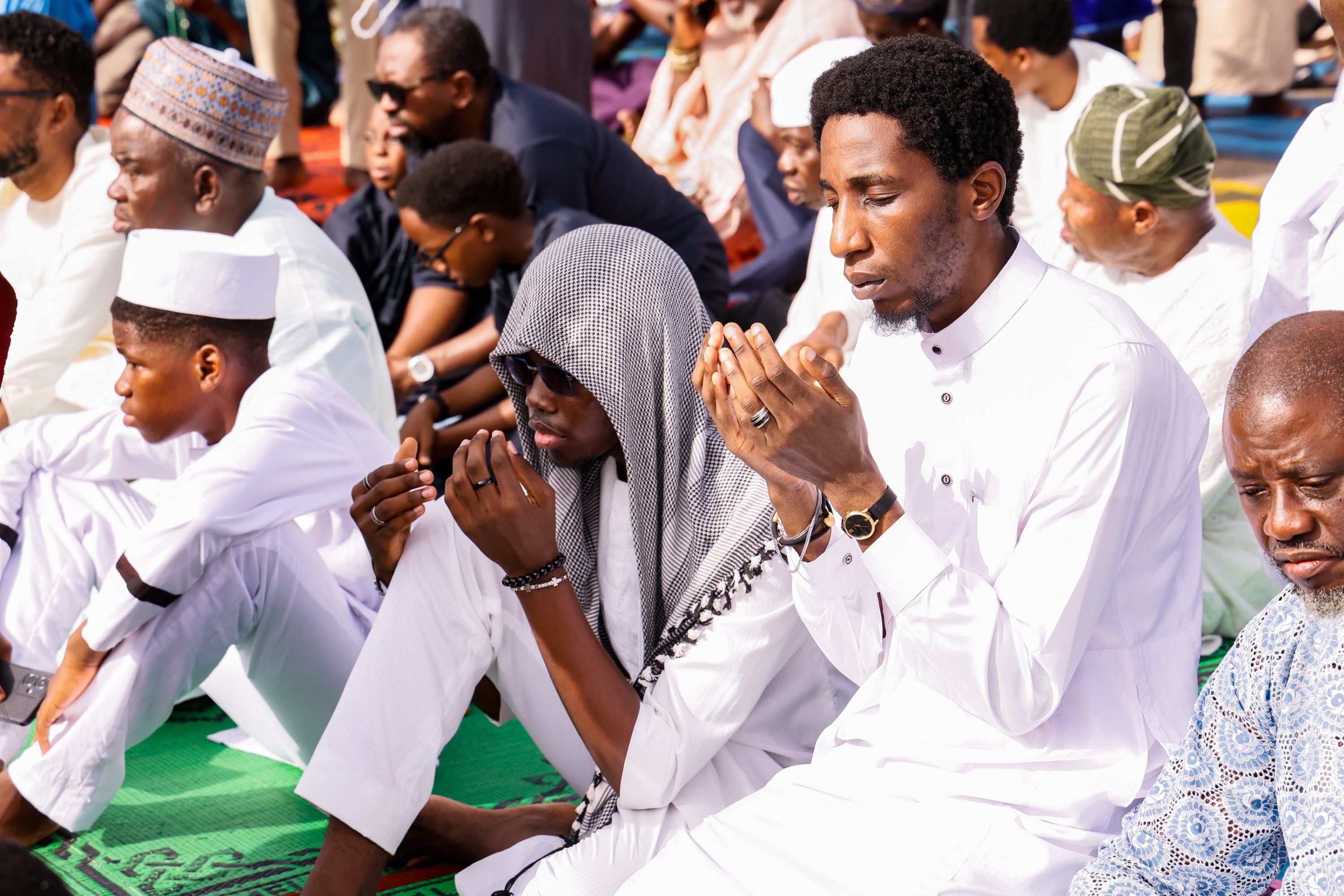
Global Eid prayers draw millions in early morning gatherings
Muslims across continents rose before dawn on Wednesday for Eid al-Adha prayers, filling squares, stadiums and mosque courtyards in numbers that underscored both the holiday’s enduring pull and the fractures of the present moment. From the granite plains of Mina outside Mecca to the traffic-choked avenues of Beirut’s southern suburbs, worshippers performed the Eid prayer in near unison, their white garments catching the first light. The ritual opened four days of sacrifice, family visits and charity that sit at the heart of the Islamic calendar.
Mecca and the logistics of one million pilgrims
Saudi authorities reported that roughly 1.8 million pilgrims had arrived for this year’s Hajj, a figure tightly managed after the pandemic-era caps. At the Grand Mosque, rows stretched beyond the mataf into the surrounding hills. Security forces guided the elderly and families with children toward designated prayer zones while medical teams stood ready for heat-related cases. Temperatures at 05:30 local time already hovered near 32 °C. The sermon delivered by Sheikh Abdul Rahman al-Sudais emphasised tawhid and the willingness of Prophet Ibrahim to submit to divine command, themes that resonated across loudspeakers carried into the valley.
Outside the ritual core, the logistical machinery was equally visible. Special trains ran every four minutes between Mecca and Mina; 6,000 shuttle buses ferried those unable to walk the eight-kilometre route. Water misting stations lined the pathways, a direct response to last year’s heat-related fatalities. Saudi officials described the operation as the largest annual peacetime mobilisation in the kingdom’s history.
Beirut’s divided skyline and shared dawn
In Lebanon’s capital the call to prayer echoed differently across neighbourhoods. In Dahiyeh, the southern suburbs, thousands gathered at the al-Mahdi mosque complex under the watchful gaze of Hezbollah security. Further west, in the mixed Ras Beirut district, worshippers spilled from the Muhammad al-Amin mosque into Martyrs’ Square. The Lebanese army deployed extra patrols but reported no incidents, a small mercy in a country still reeling from last year’s port explosion and ongoing currency collapse.
Sheikh Mohammad Abu Zaki, a Sunni cleric from the Bekaa, told Global1 News that the Eid prayer this year carried an added weight. “We stand on the same carpets as our Shia brothers and Druze neighbours,” he said. “The sacrifice we remember is not only of livestock but of the idea that Lebanon itself can still be offered for the common good.” Meat distribution committees formed on the spot, with volunteers loading refrigerated trucks bound for Palestinian refugee camps in the south and Syrian settlements in the north.
Jerusalem, Gaza and the politics of access
At the al-Aqsa Mosque compound, Israeli police allowed limited numbers of worshippers inside after weeks of tension. Jordan’s Islamic Affairs Ministry noted that only 8,000 permits were issued for West Bank residents, down from pre-2023 averages. In Gaza, where the war has left most mosques damaged or destroyed, prayers were held in tent encampments near Khan Younis. Local imams recited the Eid takbir over battery-powered speakers while aid workers distributed canned meat rather than fresh slaughter.
Palestinian analyst Dr. Leila Khatib observed that the holiday’s central motif of ransom and substitution now carries immediate resonance. “Every family here has lost someone or something they were prepared to give,” she said. “The Quranic story of the ram replaces the son; today people ask what will replace the homes and futures taken in this war.”
Regional contrasts: Cairo, Istanbul, Jakarta
In Cairo’s Abbassiya district, the military cleared Tahrir Square for an estimated 120,000 worshippers, an arrangement that doubled as a public show of stability ahead of presidential elections. Egyptian television carried live footage of President Abdel Fattah el-Sisi greeting families after the prayer. In Istanbul, President Recep Tayyip Erdoğan attended the Fatih Mosque service before joining a traditional sacrifice at a municipal facility, underscoring the ruling AK Party’s continued emphasis on Islamic identity. Indonesia’s capital Jakarta saw the largest single gathering outside the Middle East, with more than 300,000 people filling the national monument grounds; organisers distributed 40,000 sacrificial animals funded by zakat collections that reached record levels this year.
Theological weight and contemporary sacrifice
Eid al-Adha commemorates the Quranic account in Surah as-Saffat of Ibrahim’s readiness to sacrifice his son. The substitution of a ram is read by scholars as divine rejection of human offering. Yet in conflict zones the symbolism inverts: families must decide which animals to slaughter when food itself is scarce. Dr. Rami Khouri of the American University of Beirut noted that the holiday’s economic dimension has grown more pronounced. “In stable Gulf states the price of a sheep has risen 18 percent; in Lebanon it has tripled in local currency terms. The ritual now tests both piety and purchasing power.”
Charity organisations reported a surge in online donations earmarked for “Eid qurbani” projects in Sudan, Yemen and Somalia. The Saudi-based International Islamic Relief Organisation alone coordinated the slaughter and vacuum-packing of 120,000 head of livestock for shipment to 38 countries, a logistical chain that begins weeks before the holiday.
Looking ahead: unity and fracture
The four days of Eid al-Adha coincide this year with continued diplomatic efforts to revive a Gaza ceasefire and renewed Saudi-Iranian talks mediated by Oman. Observers in Beirut see the holiday’s emphasis on communal meals and open doors as a temporary counterweight to sectarian narratives. Whether the spirit survives the return to work and politics remains an open question.
For millions who stood shoulder to shoulder at dawn on Wednesday, the immediate task is simpler: to complete the sacrifice, share the meat in three portions—one for the household, one for relatives, one for the needy—and to carry the memory of Ibrahim’s submission into another year of uncertainty.
This is Malik Hassan for Global1 News, reporting from Beirut. 🇱🇧
This article was produced with AI-assisted research and editorial support. Reporting is based on sources cited in the article.
What's Your Reaction?
 Like
0
Like
0
 Dislike
0
Dislike
0
 Love
0
Love
0
 Funny
0
Funny
0
 Wow
0
Wow
0
 Sad
0
Sad
0
 Angry
0
Angry
0

Middle East Correspondent at Global1.News. Based in Beirut, covering politics, conflict, energy, and society across the Middle East. Brings context and depth to a region often reduced to headlines.











Comments (0)