
Eagles OTA depth chart offers clues at several key positions
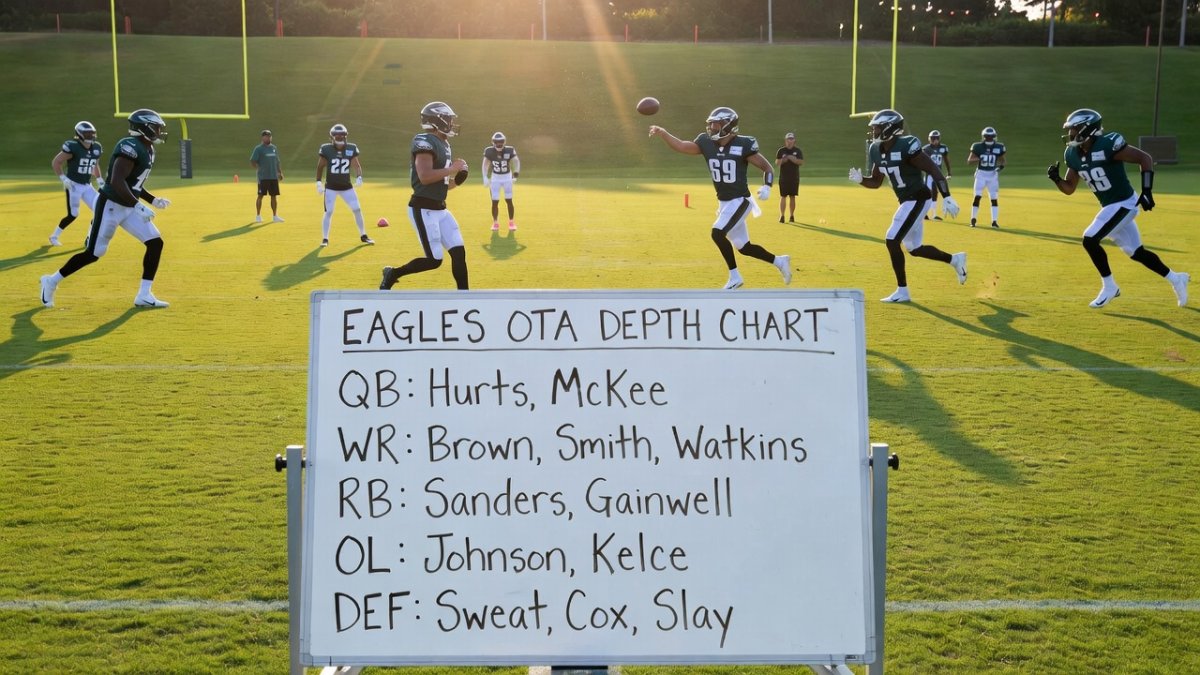
Eagles OTA Depth Chart Offers Clues at Several Key Positions
Early Glimpses into Philadelphia’s 2026 Vision
From my base in Johannesburg, where the passion for sport runs as deep as the Highveld thunderstorms, the Philadelphia Eagles’ organized team activities have caught my eye. Even in these opening sessions, the unofficial depth chart speaks volumes about roster construction, simmering positional battles, and the front office’s blueprint for 2026. With the NFL’s salary-cap realities tightening and free agency still months away, every rep in May carries weight.
The Eagles finished 2025 with a 10-7 record, missing the playoffs by a single game after a late-season collapse on defense. That disappointment has accelerated the organization’s timeline. Head coach Nick Sirianni and general manager Howie Roseman are using OTA periods to test experimental alignments and evaluate young talent that could define the next window of contention.
Quarterback Room: Stability or Succession Planning?
Jalen Hurts remains the clear-cut starter, but the depth chart lists second-year signal-caller Tanner McKee and rookie seventh-rounder Dorian Smith in a battle for the backup role. McKee’s 2025 preseason numbers—68.4% completion rate and 4.2 yards per attempt—suggest the staff still wants to see growth under live pressure.
One offensive assistant, speaking on condition of anonymity, noted, “We’re installing more RPO variations this spring. Hurts thrives in those, but McKee’s pocket presence is improving daily.” The presence of Smith, a dual-threat prospect from a small-school program, hints at long-term succession thinking. If Hurts’ contract extension talks stall beyond 2026, Philadelphia could pivot quickly.
Statistically, the Eagles ranked 18th in passing yards per game last season. Any improvement at backup could stabilize the offense during inevitable injury stretches, a lesson learned after Hurts missed three games in 2024.
Running Back Depth: A Committee Approach Emerges
Saquon Barkley’s 2025 workload of 312 carries took a toll, prompting the staff to list three backs in the top tier: Barkley, sixth-year veteran Kenneth Gainwell, and 2025 third-round pick Will Shipley. The unofficial depth chart rotates Shipley into passing-down packages, a nod to his 4.38-second 40-yard dash and improved route-running at OTAs.
Analysts project the Eagles will reduce Barkley’s snap count by roughly 15% in 2026 to preserve his explosiveness. Gainwell’s special-teams value remains a tiebreaker, but Shipley’s vision in zone schemes has impressed running-game coordinator Kevin Patullo. “We’re building a three-headed monster that keeps defenses honest,” Patullo said after Tuesday’s session.
Context from the prior campaign matters: Philadelphia rushed for 2,487 yards, eighth in the league. Sustaining that output without over-relying on one back is essential for playoff aspirations.
Wide Receiver and Tight End Battles Heat Up
A.J. Brown and DeVonta Smith anchor the outside, yet the slot competition between rookie Jalen Royals and returnee Quez Watkins has drawn attention. Royals’ 6-foot-1 frame and 4.42 speed allow him to win contested catches, something the Eagles lacked in 2025 when they converted just 41% of third downs.
Tight end remains fluid. Dallas Goedert is listed first, but second-year player Grant Calcaterra and free-agent addition Johnny Mundt are splitting first-team reps. The staff is experimenting with 12-personnel packages that feature two tight ends to counter nickel defenses prevalent across the NFC East.
Advanced metrics from Pro Football Focus show the Eagles’ tight ends combined for only 38 receptions last season—below the league average of 52. Improvement here could unlock intermediate routes that stretch linebackers thin.
Defensive Line and Linebacker Realignment
The defensive front continues to evolve under new coordinator Vic Fangio. Jalen Carter and Milton Williams headline the interior, while first-round rookie edge rusher from 2025, Nolan Smith, has climbed the depth chart ahead of veteran Josh Sweat in sub-packages. The chart lists four defensive ends rotating on early downs, emphasizing situational pass-rush specialists.
At linebacker, Nakobe Dean sits atop the depth chart, but second-year player Devin White’s return has created a three-way battle with rookie tackle-to-linebacker convert Ty Robinson. Fangio’s system demands versatile ‘Will’ linebackers who can drop into coverage; White’s 2025 coverage grade of 61.2 leaves room for competition.
Philadelphia allowed 24.8 points per game in 2025, 22nd league-wide. Fangio’s emphasis on simulated pressures during OTAs aims to drop that figure below 20 by opening night 2026.
Secondary and Special Teams Nuances
Cornerback Darius Slay is still penciled in as CB1, yet second-year player Kelee Ringo’s increased reps with the first-team defense signal a potential shift. Safety metrics highlight a glaring need: the Eagles ranked 29th in opponent passer rating when targeting the intermediate middle last season. Rookie safety from 2025, Sydney Brown, is listed as the starting free safety, pairing with Reed Blankenship.
Special teams coordinator Michael Clay has elevated undrafted rookie kicker Jake Camarda onto the depth chart, citing improved kickoff hang time averaging 4.3 seconds in drills. Field-position battles often decide NFC East games, and the Eagles are leaving nothing to chance.
Long-Term Organizational Implications
The 2026 offseason will feature significant cap decisions, including extensions for Brown and Carter. The current OTA depth chart suggests Roseman is prioritizing youth at skill positions while maintaining veteran anchors on the lines. This hybrid approach mirrors successful models in Kansas City and Baltimore.
From a global perspective, the NFL’s growing footprint in South Africa—evident in the 2025 Johannesburg flag-football clinics—means stories like the Eagles’ roster evolution resonate with emerging fans. Athletic traits such as speed, explosiveness, and endurance translate across codes, whether it’s rugby sevens or American football.
Coaching staff continuity remains a quiet strength. Sirianni’s staff has now worked together for five seasons, allowing nuanced installation of Fangio’s defensive concepts without starting from zero. That institutional knowledge could prove decisive when September arrives.
As OTAs progress into mandatory minicamp next month, expect further tweaks. The depth chart is a living document, but the early clues are clear: Philadelphia is building for sustained contention, not merely a one-year rebound. The pieces are aligning, and the 2026 campaign promises to be a fascinating watch.
This is Dante Williams for Global1 News, reporting from Johannesburg. 🇿🇦
This article was produced with AI-assisted research and editorial support. Reporting is based on sources cited in the article.
What's Your Reaction?
 Like
0
Like
0
 Dislike
0
Dislike
0
 Love
0
Love
0
 Funny
0
Funny
0
 Wow
0
Wow
0
 Sad
0
Sad
0
 Angry
0
Angry
0

Breaking News and Investigations Correspondent at Global1.News. Based in London, covering global breaking news, security, and investigative stories. Known for digging deeper and connecting the dots across continents.









Comments (0)