
DILG chief Remulla appeals to Dela Rosa to surrender
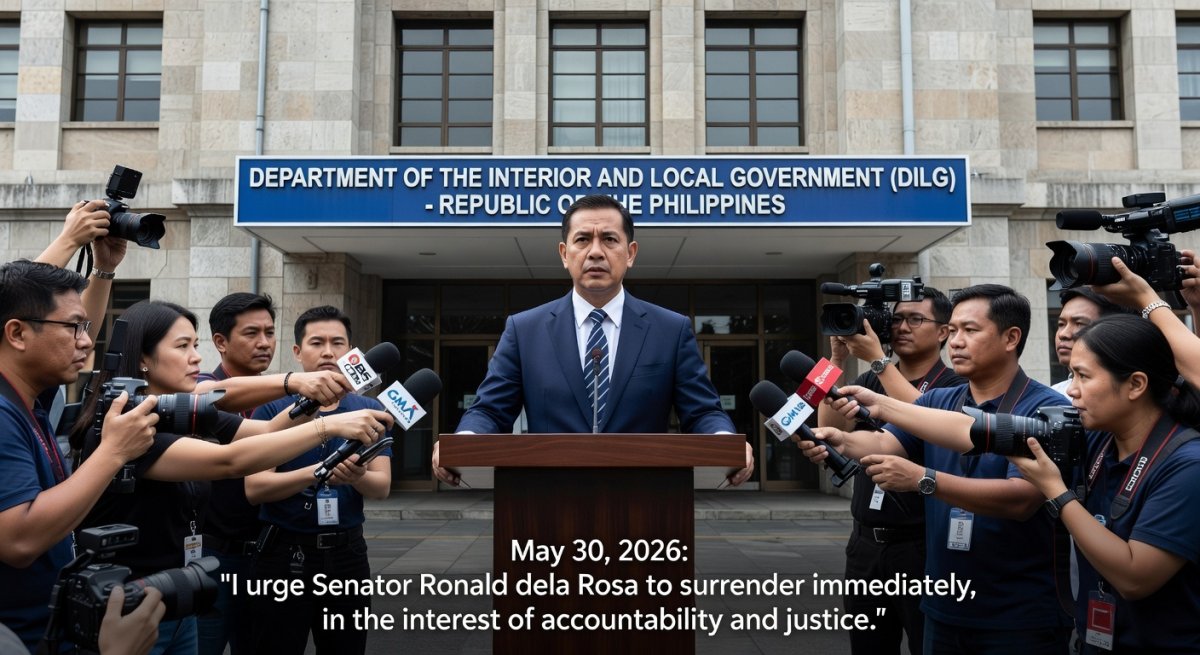
The decision by the Department of the Interior and Local Government to publicly urge Senator Ronald dela Rosa to surrender marks a pivotal moment in the ongoing effort to uphold accountability at the highest levels of Philippine governance. As of May 30, 2026, DILG Secretary Jesus Remulla has appealed directly to the fugitive senator to submit to law enforcers, signaling that authorities are prepared to escalate measures—including the possible introduction of a bounty—if voluntary compliance does not occur. This development underscores the tension between institutional authority and individual responsibility, particularly when a sitting senator becomes the subject of law enforcement action. The stakes extend beyond one individual, touching on questions of equal application of the law and the mechanisms available to compel compliance from those who once held significant power.
The appeal arrives at a time when public confidence in state institutions remains fragile, making the handling of high-profile cases a test of institutional credibility. Remulla’s statements indicate that the DILG is weighing practical steps to expedite dela Rosa’s capture, reflecting a shift from persuasion toward more assertive enforcement tools.
The Nature of the Appeal and the Bounty Consideration
Secretary Remulla’s call for dela Rosa to surrender represents an attempt to resolve the situation through direct communication rather than prolonged pursuit. By framing the request publicly, the DILG seeks to place the onus on the senator to end the uncertainty surrounding his status. At the same time, the department’s openness to offering a bounty introduces a dual-track approach that combines moral suasion with material incentives for information leading to an arrest. Bounties have long served as a supplementary tool in Philippine law enforcement when traditional methods encounter resistance or evasion. In this instance, the possibility signals that authorities view dela Rosa’s continued freedom as a challenge requiring additional resources. The strategy carries both operational and symbolic weight: it demonstrates that no individual, regardless of past or present position, is beyond the reach of standard enforcement procedures. Yet it also raises questions about the resource allocation required to pursue a single case and the precedent it sets for future high-profile fugitives. The appeal itself avoids inflammatory language, focusing instead on the expectation that dela Rosa will comply with lawful orders. This measured tone aligns with the DILG’s mandate to maintain peace and order while respecting due process. Should the bounty option advance, it would likely involve coordination with the Philippine National Police and other agencies to establish clear criteria for claims and protect informants, illustrating the administrative layers involved in such decisions.Background on Institutional Roles and Historical Context
The DILG oversees local government units and the police force, giving it a central role in matters of internal security and public safety. When a senator is declared at large, the department’s involvement highlights the intersection of legislative immunity concerns and criminal accountability. Dela Rosa’s background as a former national police chief adds another dimension, as it places a former leader of the very institution now tasked with his capture in an unusual position. Philippine history offers several examples of elected officials facing legal proceedings, yet cases involving sitting senators remain relatively rare. Each instance tests the constitutional balance between the separation of powers and the principle that laws apply equally. The current approach—combining an appeal with the potential for a bounty—reflects an effort to navigate these sensitivities without immediate resort to more coercive operations that could escalate tensions. Public discourse around such cases often centers on perceptions of fairness. Observers note that when enforcement actions involve prominent figures, the process itself becomes a referendum on whether institutions can operate independently of political influence. The DILG’s measured statements suggest an awareness of this scrutiny and a desire to project consistency in the application of procedures.Implications for the Rule of Law and Public Trust
The handling of dela Rosa’s case carries consequences for how citizens perceive the justice system’s impartiality. An appeal followed by a bounty offer communicates that authorities prioritize resolution through established channels while remaining willing to adapt when necessary. This flexibility can strengthen deterrence by showing that evasion carries increasing costs, yet it also invites debate over whether bounties risk turning serious legal matters into spectacles driven by financial reward. For democracy to function effectively, institutions must demonstrate that accountability mechanisms operate without regard to status. Remulla’s statements reinforce the expectation that public officials remain subject to the same standards as ordinary citizens. At the same time, the emphasis on voluntary surrender preserves an avenue for dela Rosa to engage with the legal process on terms that avoid further confrontation. Analysts point out that prolonged fugitive status for any elected official can erode public confidence if it appears that enforcement lacks resolve. By combining persuasion with the potential for a bounty, the DILG aims to close that gap while maintaining procedural legitimacy. The outcome will likely influence future discussions on how to manage similar situations involving national figures.What Happens Next and Forward Outlook
Attention now turns to whether dela Rosa will respond to the appeal or whether authorities will proceed with the bounty mechanism. Coordination between the DILG, the police, and prosecutorial offices will determine the timeline and operational details should the latter path be chosen. Legal observers expect that any bounty program would include safeguards to ensure claims rest on verifiable information and that due process remains intact throughout. The coming weeks will reveal whether the combination of public appeal and potential financial incentive produces results. Should dela Rosa surrender, the focus would shift to the judicial proceedings that follow. If he remains at large, the DILG’s next moves will test the effectiveness of the tools at its disposal. In either scenario, the case will continue to serve as a reference point for how Philippine institutions manage accountability at the highest levels. Ultimately, the resolution will contribute to ongoing conversations about strengthening enforcement mechanisms while upholding constitutional protections. The emphasis on surrender as the preferred outcome leaves room for a dignified conclusion, even as authorities prepare contingency measures to ensure that legal obligations are met.By Bella Reyes, Staff Writer
This article was produced with AI-assisted research and editorial support. Reporting is based on sources cited in the article.
What's Your Reaction?
 Like
0
Like
0
 Dislike
0
Dislike
0
 Love
0
Love
0
 Funny
0
Funny
0
 Wow
0
Wow
0
 Sad
0
Sad
0
 Angry
0
Angry
0

Isabella "Bella" Reyes
Philippines/Southeast Asia Correspondent at Global1.News. Manila-based journalist covering Philippine politics, environment, maritime security, and social issues. Passionate about marine conservation and the communities protecting the Philippines' natural heritage.















Comments (0)