
Colombia Runoff 2026: De la Espriella Faces Cepeda
In a recent DW News report from Bogotá, Colombia stands at a pivotal crossroads as the nation's presidential election heads to a high-stakes June 21 runoff between two sharply opposed candidates. The May 31 first round delivered a narrow split: far-right populist Abelardo de la Espriella won 43.7 percent of the vote, while leftist senator and ruling party ally Iván Cepeda took
In a recent DW News report from Bogotá, Colombia stands at a pivotal crossroads as the nation's presidential election heads to a high-stakes June 21 runoff between two sharply opposed candidates. The May 31 first round delivered a narrow split: far-right populist Abelardo de la Espriella won 43.7 percent of the vote, while leftist senator and ruling party ally Iván Cepeda took 40.9 percent, setting up a contest that will shape Colombia's security policy, its 2016 peace deal with the FARC, and its relationship with the United States for years to come.
Colombia Presidential Runoff 2026: Far-Right Populist vs Petro's Leftist Ally — What's at Stake
Bogotá, Colombia – June 2026 — More than 41 million registered voters turned out on May 31 for a first-round election that upended political expectations. Abelardo de la Espriella, a 47-year-old lawyer and businessman who holds dual US-Colombian citizenship, surged past conservative senator Paloma Valencia — who had been widely viewed as the stronger contender — to claim the top spot in the race for the Casa de Nariño.
De la Espriella, a self-described outsider endorsed by former US President Donald Trump on June 2, campaigned on a hardline security platform, promising to build 10 mega-prisons and proposing that Colombia withdraw from the United Nations, the Organization of American States, and the Inter-American Court of Human Rights. Trump called Cepeda a "Radical Left Marxist" in his endorsement post.
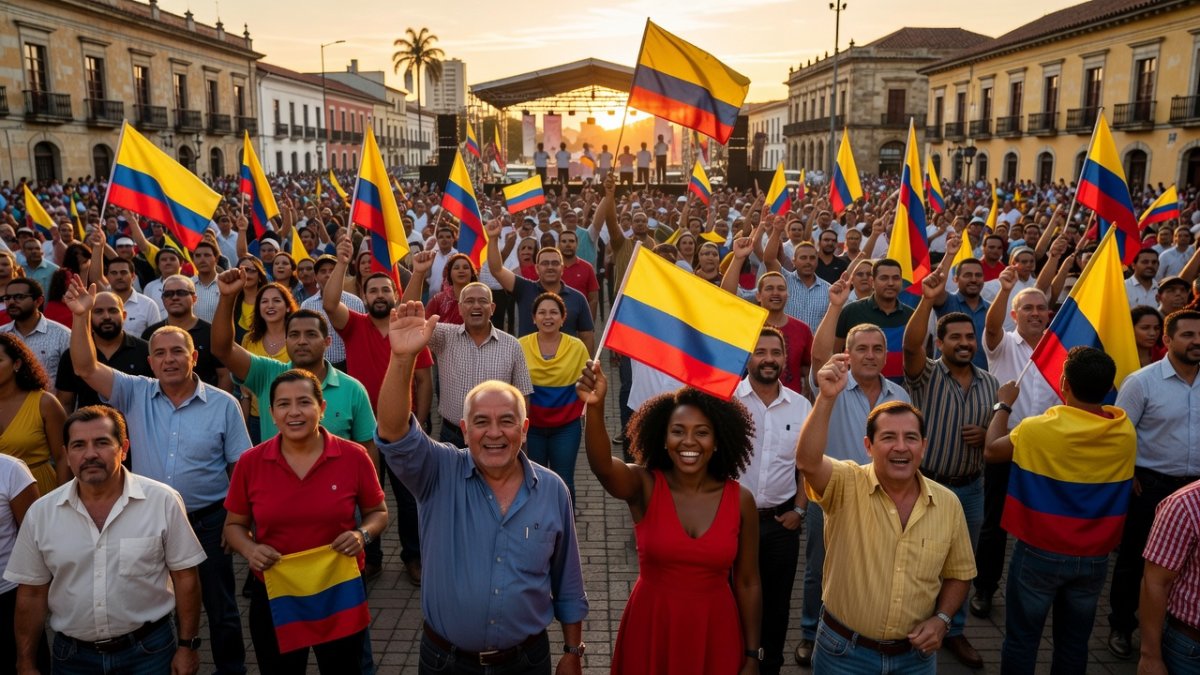
Security at the Center of the Campaign
Violence remains the dominant concern for Colombian voters. More than a quarter of the country's municipalities face some risk of election-related bloodshed, according to security assessments published this week. De la Espriella advocates a militarized crackdown on organized crime and armed groups, while Cepeda promotes a continuation of President Gustavo Petro's approach — emphasizing dialogue, institutional reform, and social investment to address the root causes of violence.
In the Guaviare department, small-scale coffee and coca farmers report that armed factions already control large areas. "Whoever wins, we still have to negotiate with whoever holds the guns," said María Elena Rodríguez, a coffee grower in San José del Guaviare, in an interview cited by local media. Her family's three-hectare plot sits in a region where extortion and forced displacement have become routine.
These pressures mirror those faced by rural communities in Mexico's Chiapas and Guerrero states, where campesinos and indigenous families navigate similar dynamics of organized crime control amid shifting national security policies under President Claudia Sheinbaum. The parallel struggles of farmers in both countries highlight a common Latin American challenge: balancing militarized responses with community-level prevention.
The 2016 Peace Deal Hangs in the Balance
The June 21 runoff will determine whether Colombia maintains or reverses the landmark 2016 peace accord signed with the Revolutionary Armed Forces of Colombia (FARC) in Havana. The agreement established rural development programs, transitional justice mechanisms, and political participation guarantees for former combatants — institutions that remain operational in departments including Cauca, Meta, and Nariño.
De la Espriella has called the accord a failure and accused Cepeda and Petro of attempting to "steal democracy" by defending it. He has suggested that a de la Espriella administration would dismantle key provisions of the pact, including the Special Jurisdiction for Peace (JEP), which has prosecuted former FARC commanders and military officers for wartime atrocities.
Cepeda argues that scrapping the accord would plunge Colombia back into the cycles of armed conflict that killed more than 220,000 people and displaced millions between 1964 and 2016. Indigenous and Afro-Colombian communities in the Pacific region have already formed local monitoring committees to protect the territorial rights enshrined in the agreement, fearing those protections could vanish under a far-right government.
US-Colombia Relations at a Crossroads
The runoff carries major implications for Washington's most important bilateral relationship in South America. De la Espriella, who has publicly praised Trump and described himself as a "friend of the United States," has pledged to restore the close security alliance that characterized US-Colombia cooperation during the Plan Colombia era.
Trump's endorsement on June 2 gave de la Espriella a significant boost among Colombian diaspora voters in Florida, where he captured roughly 90 percent of the expatriate vote in the first round, according to reports from Miami-Dade County. However, questions have emerged in Bogotá and Washington about whether his dual citizenship could present constitutional conflicts if he assumes the presidency.
Cepeda has taken a sharply different position, insisting that Colombia must not act as a "vassal state" to the United States. He has signaled he would renegotiate aspects of the bilateral security framework to give Colombia greater autonomy over counternarcotics operations and military cooperation, while maintaining the core alliance.
Economic Stakes for Colombian Families
Beyond security, the election outcome will shape the economic prospects of millions of Colombian households. Under Petro, social programs expanded significantly — including cash transfers for low-income families, free university tuition for students from poor backgrounds, and pension reforms that extended coverage to informal workers.
De la Espriella has pledged to cut government spending, reduce taxes for businesses, and attract foreign investment through deregulation. Urban workers in Medellín's textile workshops and Bogotá's construction sites say they are watching closely, aware that the result could mean sharp changes in the 2027 national budget.
In Mexico, policymakers in the Secretaría de Hacienda are monitoring the Colombian contest with particular attention. A shift toward hardline security policies in Bogotá could affect joint counternarcotics operations along the Pacific maritime corridor — a key transit route linking the two countries that both nations have prioritized for interdiction efforts under the US-Colombia-Mexico trilateral framework.
Rural Communities and Armed Groups
Farmers in Guaviare and other rural departments express exhaustion with the campaign rhetoric. "Every election, the candidates come and promise safety," Rodríguez said. "But after they leave, we are the ones who live with the armed groups."
De la Espriella's running mate has pledged to deploy military engineers to build roads and schools in conflict zones as part of a "security through development" strategy. Cepeda's platform proposes expanding the voluntary crop-substitution programs introduced under the 2016 peace deal, which pay farmers to replace coca with legal alternatives such as coffee, cacao, and palm hearts.
These competing visions reflect a broader debate across Latin America about how to reduce the influence of organized crime without sacrificing human rights or rural livelihoods — a debate playing out simultaneously in Mexico's Sierra Madre and Peru's Alto Huallaga Valley.
What to Watch For
The final two weeks of campaigning will test whether either candidate can expand their coalition beyond the 43.7-40.9 percent split of the first round. Paloma Valencia, who finished third with roughly 10 percent, has not formally endorsed either contender, and her supporters could prove decisive.
International observers from the Organization of American States and the European Union are already deploying teams across Colombia's 32 departments, with particular focus on the 200-plus municipalities identified as high-risk for violence. Mexico's Instituto Nacional Electoral, which has extensive experience monitoring high-risk elections, has offered technical support to Colombia's Registraduría Nacional.
Whoever wins on June 21 will inherit a country that remains deeply divided — not only about security and peace, but about its place in the hemisphere. For the families in Guaviare, Medellín, and Bogotá who will live with the consequences, the choice could not be more consequential.
By Rosa Martinez, Staff Writer
This article was produced with AI-assisted research and editorial support. Reporting is based on sources cited in the article.
What's Your Reaction?
 Like
0
Like
0
 Dislike
0
Dislike
0
 Love
0
Love
0
 Funny
0
Funny
0
 Wow
0
Wow
0
 Sad
0
Sad
0
 Angry
0
Angry
0
Latin America/Andes Correspondent at Global1.News. Based in Bogota, covering politics, environment, energy, and social movements across the Andean region. Passionate about environmental journalism and communities protecting their land.













Comments (0)