
Coal Mine Disaster in Shanxi: 82 Dead in China's Deadliest Mining Accident in 15 Years
The Liushenyu Explosion and Its Operational Context The explosion at the Liushenyu coal mine in Shanxi province on 22 May 2026 resulted in 82 fatalities and more than 120 injuries, marking the deadliest such incident in China since the 2009 disaster. Operated by the private Tongzhou Group, the mine's blast exposed discrepancies between registered operations and actual activitie
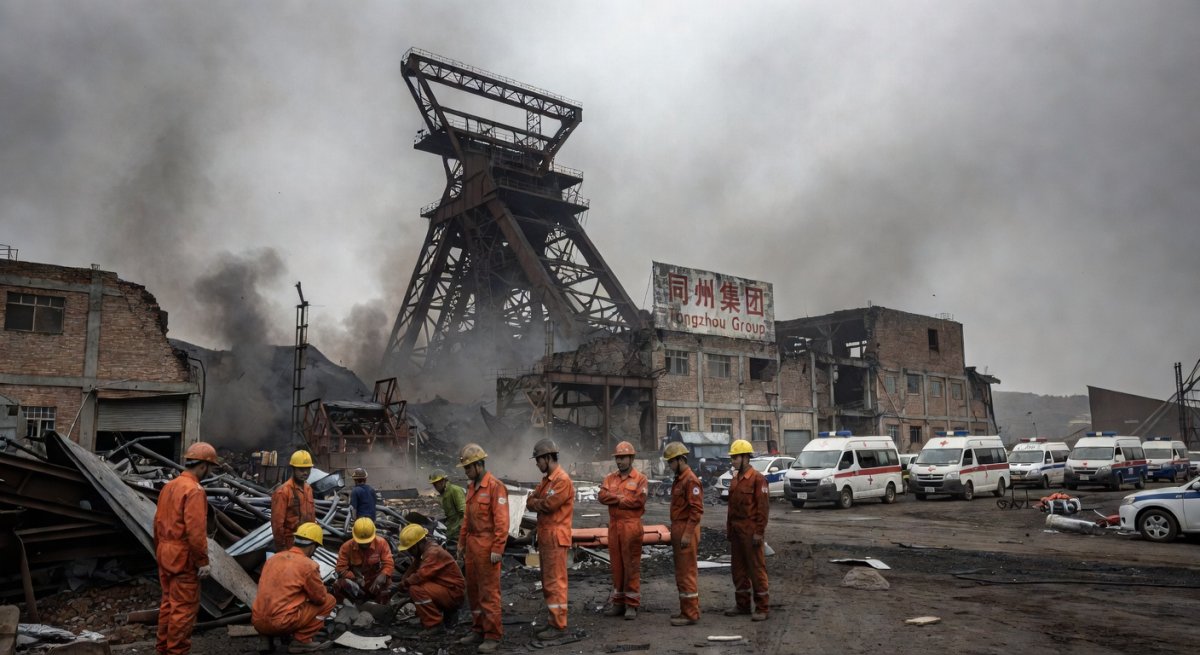
The Liushenyu Explosion and Its Operational Context
The explosion at the Liushenyu coal mine in Shanxi province on 22 May 2026 resulted in 82 fatalities and more than 120 injuries, marking the deadliest such incident in China since the 2009 disaster. Operated by the private Tongzhou Group, the mine's blast exposed discrepancies between registered operations and actual activities, including unapproved coal seams and secret tunnels that hindered rescue efforts. A survivor described to CCTV how the force swept to the entrance and knocked workers down, underscoring immediate failures in underground safety protocols. This event illustrates ongoing tensions in China's coal sector, where rapid extraction demands clash with enforcement mechanisms under the National Mine Safety Administration.
Regulatory Lapses and Corporate Violations
Initial investigations revealed that Tongzhou Group had committed serious illegal violations, with a notice board indicating only half the underground workers were officially registered and many lacking mandatory tracking devices. The mine had appeared on a 2024 list of facilities with severe hazards issued by the Chinese National Mine Safety Administration, and the company faced two penalties for safety breaches in 2025. Authorities subsequently placed Tongzhou Group's leadership under control measures and suspended operations at its other sites. These steps reflect the central government's emphasis on accountability through bodies like the Ministry of Emergency Management, yet they also highlight persistent gaps in oversight that undermine the safety culture reforms pursued since the 1980s economic opening, when coal output surged without commensurate institutional safeguards.
Shanxi's Role in National Energy Supply and Historical Patterns
Shanxi province contributes nearly 30 percent of China's coal production, positioning it as a critical node in the country's energy framework even as fatality rates across the sector have declined more than 90 percent since 1990. Earlier incidents, such as the 2010 blast that killed 78 and the 2016 explosion claiming 32 lives, demonstrate recurring issues tied to private operators prioritizing output over compliance. A worker's account to Lengshan Record noted that tracking devices were avoided due to illegal seam mining, revealing how local economic pressures can erode national standards. Analytically, this pattern challenges governance efforts to balance provincial growth targets with centralized safety directives, affecting broader policy coherence in resource-dependent regions.
Prof. Hong Chen of Jiangnan University observed that the accident should not have occurred, pointing to the need for deeper integration of monitoring technologies and blueprint accuracy in mine management. Such comments underscore how isolated violations can erode public trust in regulatory bodies and complicate the implementation of policies aimed at modernizing extractive industries.
Energy Transition Pressures Amid Coal Dependence
China's ongoing pivot toward green energy sources occurs against the backdrop of sustained coal reliance, with incidents like Liushenyu raising questions about the pace of this shift. While national strategies promote renewables to meet climate commitments, Shanxi's output remains essential for industrial stability and energy security. The disaster amplifies scrutiny on how safety enforcement aligns with transition timelines, particularly as private firms navigate incentives that favor short-term production. In geopolitical terms, persistent coal-related risks influence international perceptions of China's environmental governance, potentially complicating diplomatic engagements on global energy cooperation and technology transfers.
Broader Implications for Policy and Institutional Reforms
The response to the Liushenyu event, including operational halts and leadership controls, signals an intent to reinforce central oversight amid decentralized mining activities. This approach intersects with wider governance priorities, where safety improvements must support economic objectives without disrupting supply chains critical to Belt and Road infrastructure demands. Effective reforms could strengthen China's position in US-China climate dialogues by demonstrating credible risk reduction, yet repeated violations suggest that cultural and incentive shifts in private operations require sustained attention from ministries and provincial authorities alike. The incident thus serves as a reminder that energy policy success hinges on aligning enforcement with the realities of resource extraction.
By Prof. Marcus Chen, Staff WriterThis article was produced with AI-assisted research and editorial support. Reporting is based on sources cited in the article.
What's Your Reaction?
 Like
0
Like
0
 Dislike
0
Dislike
0
 Love
0
Love
0
 Funny
0
Funny
0
 Wow
0
Wow
0
 Sad
0
Sad
0
 Angry
0
Angry
0

World Politics Analyst at Global1.News. Based in Beijing, covering US-China relations, global trade, and geopolitical strategy. Brings deep analytical perspective to the power dynamics shaping international affairs.














Comments (0)