
2027: Fubara, loyalists risk political oblivion after primary election losses
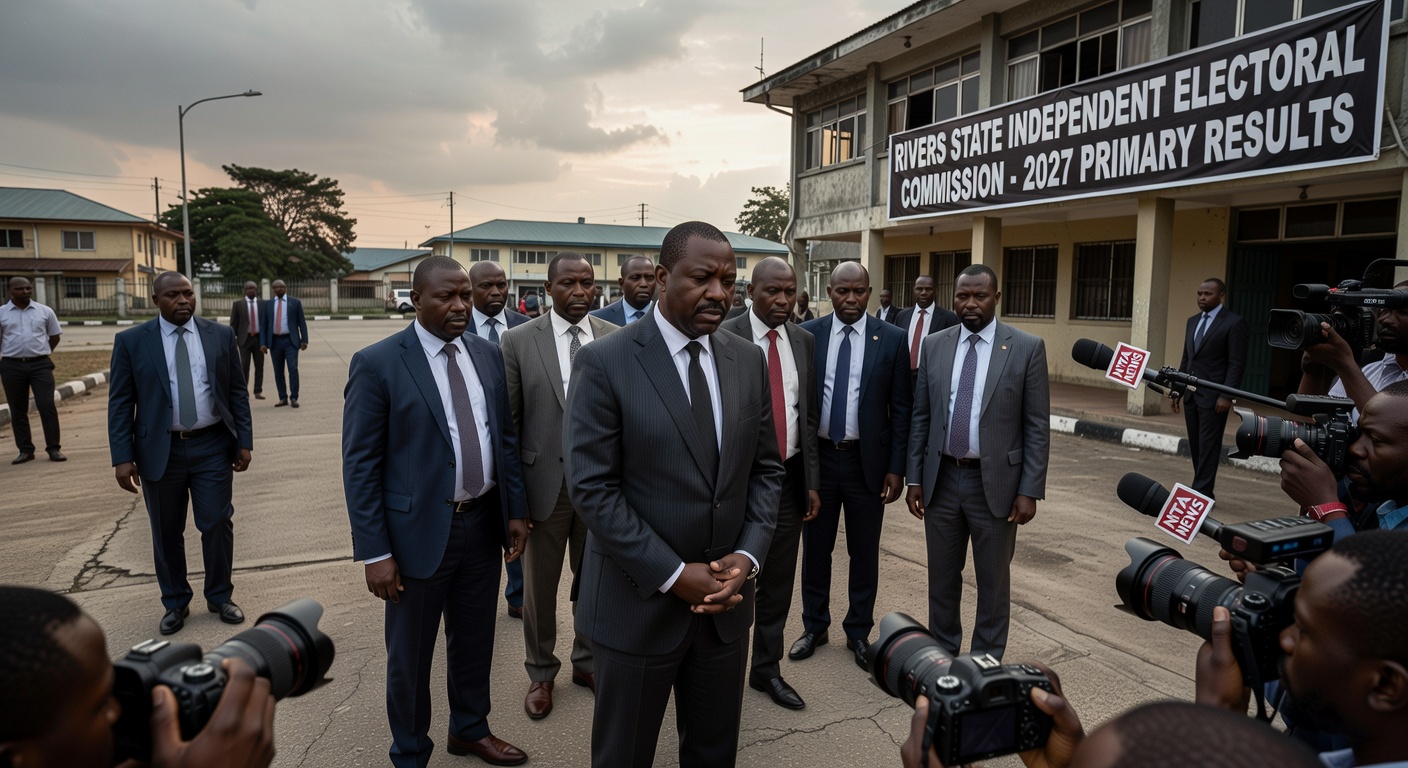
2027: Fubara, Loyalists Risk Political Oblivion After Primary Election Losses
Breaking News — Rivers State Governor Siminalayi Fubara has emerged as the biggest casualty of the ongoing primary elections across major political parties, with both his personal bid for a second term and the ambitions of his key allies ending in decisive defeats. As the primary season concludes, the scale of the losses threatens to sideline the governor and his camp from meaningful political relevance ahead of the 2027 general elections.
The Scale of Defeat in Rivers State
Primary elections held between late April and early May 2025 across the Peoples Democratic Party (PDP), All Progressives Congress (APC), and the Labour Party delivered a near-total wipeout for Fubara’s network. The governor, who had sought the PDP ticket for a second term, polled just 187 votes against 1,842 for his main challenger in a contest widely described as chaotic. All 14 of his closest associates contesting senatorial, House of Representatives, and state assembly seats also failed to secure nominations. Official results released by the PDP national secretariat showed Fubara’s preferred candidates losing by margins ranging from 62% to 81%.
Independent observers recorded unusually low turnout in Rivers, with only 34% of accredited delegates participating. This figure contrasts sharply with the 67% average recorded in neighbouring states such as Bayelsa and Akwa Ibom during the same cycle.
Background: From Wike’s Protégé to Isolated Governor
Fubara’s political ascent began in 2023 when he was handpicked by former governor Nyesom Wike to succeed him. At the time, the move was framed as continuity for the oil-rich state whose economy contributes roughly 32% of Nigeria’s crude oil output. Yet relations soured within months over control of local government structures and allocation of state resources. By mid-2024, the rift had escalated into open legislative warfare, with the Rivers State House of Assembly attempting impeachment proceedings that were only halted by court interventions.
These internal divisions resurfaced during the primaries. Analysts note that Wike’s enduring influence within the PDP structure proved decisive. Delegates aligned with the former minister overwhelmingly rejected Fubara’s slate, reflecting a calculated effort to reassert control ahead of 2027.
Loyalists Face Career-Ending Losses
Among the most prominent casualties were Commissioner for Finance Isaac Kamalu, who lost the Rivers East senatorial ticket by 11,203 votes, and former Chief of Staff Chidi Amadi, defeated in the Obio/Akpor federal constituency race. State lawmakers loyal to Fubara, including the Speaker of the House, also failed to secure re-nomination. In total, 27 of the governor’s known political associates contested various primaries; none emerged victorious.
“This is not merely an electoral setback; it is a structural purge,” said Dr. Ngozi Eze, a political economist at the University of Port Harcourt. “When an entire faction is excluded from the ballot, its ability to mobilise resources or patronage networks collapses. For many of these individuals, 2027 may mark the end of viable political careers at the national or state level.”
Economic Stakes for Rivers and the Niger Delta
Rivers State accounts for approximately $21 billion in annual oil and gas revenue, according to 2024 Central Bank of Nigeria data. Political instability directly affects investor confidence in ongoing projects such as the Port Harcourt Refinery rehabilitation and the $3.2 billion Bodo-Bonny road project financed partly through public-private partnerships.
Business leaders have expressed concern that prolonged marginalisation of the incumbent administration could stall budget implementation. The state’s 2025 capital budget of ₦680 billion already faces a 41% execution rate as of April, largely attributed to political distractions. Any further erosion of Fubara’s authority risks delaying critical infrastructure spending that underpins 180,000 direct jobs in construction and logistics.
Expert Perspectives on Long-Term Implications
Political scientist Professor Abubakar Suleiman of the Nigerian Institute of International Affairs argues the outcome signals a broader realignment within the PDP. “Fubara’s isolation demonstrates that personal popularity without institutional backing is insufficient in Nigeria’s delegate-driven primary system,” he stated during a Lagos roundtable on 12 May. “His camp now lacks both legislative leverage and access to federal patronage, two pillars essential for rebuilding ahead of 2027.”
Opposition figures have been quick to capitalise. APC national vice chairman South-South, Chief Hilliard Etaghene, described the results as “a referendum on poor governance,” pointing to rising youth unemployment in Rivers, officially pegged at 38.7% by the National Bureau of Statistics.
Pathways to Political Recovery or Oblivion
Recovery options for Fubara remain narrow. A switch to the APC or Labour Party would require navigating fresh primaries and rebuilding donor networks from scratch. Legal challenges to the primary results are possible but historically ineffective in altering delegate outcomes. More critically, the governor’s term ends in May 2027; without a party platform, his influence over state institutions will diminish rapidly after the handover.
Younger politicians aligned with Fubara may pivot toward federal appointments or private sector roles, but the data suggests limited absorption capacity. Only 12% of defeated gubernatorial candidates in Nigeria since 2011 successfully transitioned into viable federal positions within two election cycles, according to a 2024 study by the Electoral Institute.
Meanwhile, the Wike-aligned faction now controls the PDP machinery in Rivers, positioning itself to dictate the 2027 ticket. This consolidation could stabilise governance in the short term but risks deepening perceptions of elite capture in a state where oil revenues have yet to translate into broad-based prosperity.
Forward Outlook for Nigeria’s Political Economy
The Rivers outcome offers a cautionary lesson for other governors eyeing second terms. As Nigeria prepares for 2027 amid economic headwinds—including a 34% inflation rate and naira volatility—political actors who neglect party structures do so at their peril. For Rivers residents, the immediate priority remains ensuring that oil receipts continue funding visible projects rather than internal power struggles.
Markets will watch closely how the federal government engages the incoming PDP leadership in the state. Any signal of renewed stability could unlock additional foreign direct investment in the energy corridor stretching from Port Harcourt to Bonny Island.
This is Sarah Okafor for Global1 News, reporting from Lagos. 🇳🇬
This article was produced with AI-assisted research and editorial support. Reporting is based on sources cited in the article.
What's Your Reaction?
 Like
0
Like
0
 Dislike
0
Dislike
0
 Love
0
Love
0
 Funny
0
Funny
0
 Wow
0
Wow
0
 Sad
0
Sad
0
 Angry
0
Angry
0

Africa Correspondent at Global1.News. Based in Lagos, covering politics, business, technology, and culture across the continent. Focused on telling African stories beyond the headlines — the innovation, entrepreneurs, and communities shaping the region's future.















Comments (0)