
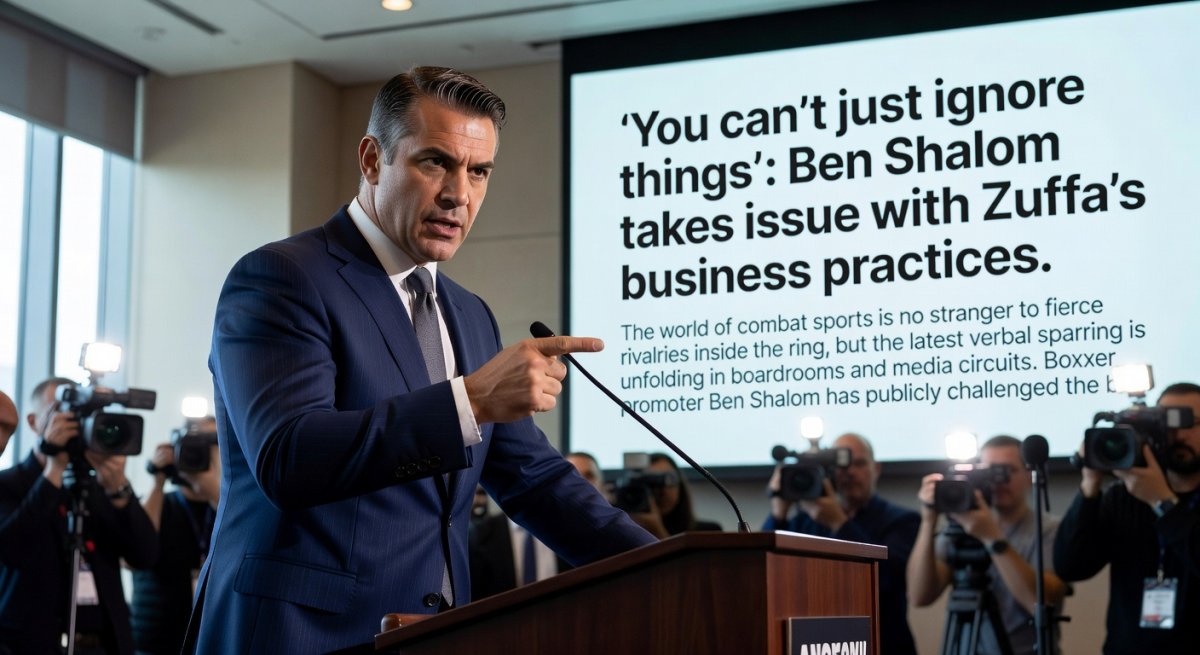
‘You can’t just ignore things’: Ben Shalom takes issue with Zuffa’s business practices
‘You can’t just ignore things’: Ben Shalom takes issue with Zuffa’s business practices
The world of combat sports is no stranger to fierce rivalries inside the ring, but the latest verbal sparring is unfolding in boardrooms and media circuits. Boxxer promoter Ben Shalom has publicly challenged the business tactics of Zuffa, the powerhouse behind the UFC, declaring that “you can’t just ignore things” when it comes to industry standards and fighter welfare. Speaking after the Frazer Clarke versus Jeamie TKV card at Vaillant Live in Derby on November 29, 2025, Shalom laid bare his frustrations with what he sees as monopolistic maneuvers that threaten the broader ecosystem of professional fighting.
The Spark Behind Shalom’s Outburst
Shalom’s comments come at a pivotal moment for combat sports. Boxxer, the UK-based promotion he founded, has carved out a reputation for nurturing British and European talent through high-profile events on Sky Sports and DAZN. In contrast, Zuffa’s UFC has dominated mixed martial arts with an estimated $1.2 billion in annual revenue and a global reach that extends into 200 countries. Shalom did not mince words about perceived imbalances, highlighting how Zuffa’s control over broadcasting rights and fighter contracts creates ripple effects that boxing promoters cannot simply overlook.
“We’re all in this together, whether it’s gloved fists or open-hand strikes,” Shalom told a cluster of reporters post-fight. “But when one entity leverages its market position to dictate terms across disciplines, it’s not competition—it’s consolidation. You can’t just ignore things like that.” His remarks reference ongoing antitrust scrutiny that has followed Zuffa since its 2016 acquisition of Strikeforce and the subsequent merger talks with other promotions.
Zuffa’s Track Record Under the Microscope
To understand Shalom’s stance, it helps to examine Zuffa’s operational model. Founded by Frank and Lorenzo Fertitta and later sold to Endeavor for $4 billion in 2023, Zuffa has streamlined MMA into a vertically integrated machine. Data from the Nevada State Athletic Commission shows average UFC fighter purses hovering around $150,000 per bout for ranked athletes, though entry-level contracts often start below $20,000. Critics argue this structure funnels disproportionate profits to the parent company while limiting fighters’ ability to negotiate across promotions.
Shalom contrasted this with Boxxer’s approach, where emerging talents like Clarke receive transparent pay structures and multi-fight deals that include profit-sharing elements. “Boxing has its own issues, no doubt,” he admitted, “but we’re transparent. Fighters know the gate, the TV numbers, and their cut. That accountability matters.” Industry analysts note that UFC events generate average live gate revenues exceeding $10 million, yet fighter compensation as a percentage of revenue remains lower than in boxing’s top-tier matches, where stars can claim 30-40% splits.
Expert Perspectives on Cross-Discipline Tensions
Legal experts in sports antitrust law see Shalom’s intervention as part of a wider conversation. Professor Lena Okoro, who specializes in entertainment law at the University of Cape Town, explained that Zuffa’s practices have already drawn regulatory attention in the United States. “The 2023 class-action lawsuit alleging wage suppression is still winding through courts,” she noted. “Promoters like Shalom are essentially flagging how those tactics could bleed into boxing if crossover events or shared media rights become normalized.”
From a South African vantage point, where boxing legends like Gerrie Coetzee once put the nation on the global map, the stakes feel personal. Local promoters have long battled limited broadcasting infrastructure and sponsorship gaps. If Zuffa-style consolidation spreads, smaller markets risk being priced out entirely. “South African fighters already fight uphill for international exposure,” said former WBA super-middleweight contender and current trainer Thulani Mthembu. “Any tightening of the global market only makes that hill steeper.”
Implications for Fighters and the Sport’s Future
The ripple effects extend beyond balance sheets. Shalom pointed to fighter health and long-term security as non-negotiable. Zuffa has invested heavily in its own performance institute and medical protocols, yet independent studies from the Journal of Combat Sports Medicine suggest that fighters under exclusive long-term contracts experience higher rates of delayed-career planning. Boxxer, by comparison, encourages athletes to maintain multiple income streams, including sponsorships outside the promotion.
Data from the Association of Boxing Commissions reveals that 2024 saw a 12% increase in fighters crossing into MMA for better paydays. Shalom views this migration as a warning sign. “When the best athletes feel they have no choice but to leave boxing for financial survival, the sport loses depth,” he argued. His comments arrive just as Boxxer prepares a major 2026 schedule featuring potential unification bouts that could generate combined gates above £15 million.
Global Context and South African Lens
Reporting from Johannesburg, the contrast between Zuffa’s American-centric dominance and the grassroots reality of African combat sports is stark. While UFC events routinely sell out arenas in Johannesburg’s Sandton district, local boxing shows still rely on community sponsorships and modest television slots. Shalom’s critique resonates here because it underscores the need for diversified promotion models that protect regional identities rather than flattening them under one corporate umbrella.
Market analysts project that the global combat sports industry will surpass $25 billion by 2028, driven largely by UFC’s international expansion. Yet Shalom insists growth must be inclusive. “We’re not asking for handouts,” he said. “We’re asking that the rules of engagement remain fair so that every promoter, every fighter, every fan benefits.” His stance aligns with calls from the World Boxing Council for greater transparency in cross-promotional negotiations.
Looking Ahead: What This Means for 2026 and Beyond
As Boxxer finalizes its January slate and UFC prepares its annual International Fight Week in Las Vegas, the tension between the two worlds is unlikely to dissipate. Shalom has signaled openness to dialogue but remains firm that silence is not an option. “Ignoring these dynamics only lets problems compound,” he concluded in Derby. For athletes dreaming of world titles and promoters building sustainable businesses, the message is clear: accountability cannot be optional.
The coming months will test whether Shalom’s words translate into tangible shifts—perhaps through new regulatory frameworks or collaborative events that bridge boxing and MMA without sacrificing fighter leverage. One thing is certain: in the high-stakes arena of combat sports business, the gloves are off.
This is Dante Williams for Global1 News, reporting from Johannesburg. 🇿🇦
This article was produced with AI-assisted research and editorial support. Reporting is based on sources cited in the article.
What's Your Reaction?
 Like
0
Like
0
 Dislike
0
Dislike
0
 Love
0
Love
0
 Funny
0
Funny
0
 Wow
0
Wow
0
 Sad
0
Sad
0
 Angry
0
Angry
0

Breaking News and Investigations Correspondent at Global1.News. Based in London, covering global breaking news, security, and investigative stories. Known for digging deeper and connecting the dots across continents.














Comments (0)