
The Emergence of North Korea's Nuclear-Capable Naval Forces: Commissioning of the Choe Hyon and Northeast Asian Maritime Shifts
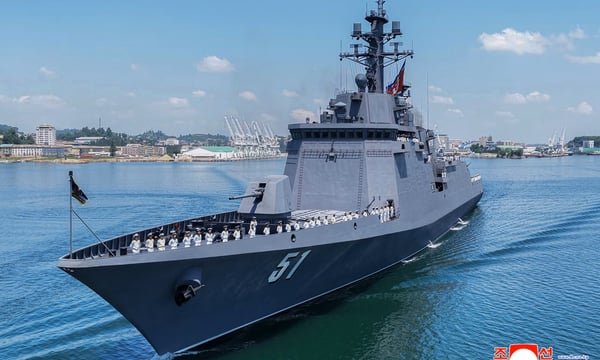
Historical Context of North Korean Naval Priorities North Korean naval development has long reflected the Korean People's Army Navy's secondary status within the broader military structure, a pattern traceable to the post-Korean War era. The commissioning of the 5,000-ton Choe Hyon destroyer on June 23, 2026, marks a deliberate departure from this trajectory. Kim Jong Un explicitly framed the event as the Korean People's Army Navy entering a new era after more than seventy years of stagnation.
Historical Context of North Korean Naval Priorities
North Korean naval development has long reflected the Korean People's Army Navy's secondary status within the broader military structure, a pattern traceable to the post-Korean War era. The commissioning of the 5,000-ton Choe Hyon destroyer on June 23, 2026, marks a deliberate departure from this trajectory. Kim Jong Un explicitly framed the event as the Korean People's Army Navy entering a new era after more than seventy years of stagnation. This emphasis aligns with signals first issued in 2023, when greater institutional attention began to shift toward maritime capabilities. The vessel's naming after Choe Hyon, the independence activist and former Defense Minister who lived from 1907 to 1982, underscores an effort to link contemporary naval expansion to historical narratives of Korean resistance and sovereignty.
Technical Capabilities of the Choe Hyon Destroyer
The Choe Hyon incorporates 88 vertical launch system cells, configured as 64 aft and 24 forward, supplemented by eight inclined launchers. These arrangements permit carriage of up to 104 missiles, including nuclear-capable cruise and ballistic variants. Such armament density on a 5,000-ton platform represents a significant concentration of strike potential. The destroyer was first unveiled in April 2025, allowing observers to track its progression from initial display to formal commissioning. Reports from The Diplomat, drawing on analysis by Logan Rolleigh and Ryan Brobst of the Foundation for Defense of Democracies and dated July 24, 2026, confirm these specifications through open-source imagery and official Korean Central News Agency releases.
The Choe Hyon destroyer’s vertical launch configuration invites direct comparison with South Korean surface combatants tracked by the ROK Ministry of National Defense, whose assessments emphasize how Seoul’s larger-tonnage platforms integrate networked air-defense and strike systems developed through decades of indigenous shipbuilding programs. Historical context from earlier North Korean naval efforts, documented in KCNA releases, shows a progression from coastal patrol craft to ocean-going hulls, underscoring Pyongyang’s sustained attempt to project power beyond the immediate littoral. Technical depth emerges when considering the density of launch cells relative to displacement, a metric The Diplomat has analyzed in regional fleet-modernization studies; such concentration on a 5,000-ton hull implies trade-offs in endurance and sensor integration that differ markedly from Japanese Aegis-equipped destroyers, which prioritize multi-mission flexibility over single-salvo saturation. Strategic implications include the potential for preemptive nuclear cruise-missile strikes against fixed targets, altering deterrence calculations that ROK defense planners have long modeled around conventional superiority.
Five-Year Naval Expansion Roadmap
Kim Jong Un outlined a five-year construction schedule that envisions two Choe Hyon-class destroyers annually alongside a single 10,000-ton cruiser. This program aims to establish a 12-warship nuclear fleet. Implementation remains in its initial phase, with the first vessel already commissioned and subsequent hulls still under construction. The plan's measured pace reflects resource constraints typical of North Korean defense industries, yet it signals sustained institutional commitment. Korean Central News Agency coverage has presented these targets as achievable milestones, though external assessments note that actual delivery rates will depend on shipyard throughput and supply chain reliability.
North Korea’s five-year naval roadmap, as outlined in KCNA reporting, must be evaluated against the Republic of Korea’s far larger shipbuilding capacity, which the ROK Ministry of National Defense credits with delivering multiple Aegis destroyers and submarines on accelerated timelines supported by advanced commercial yards. Resource constraints highlighted by FDD analysts limit Pyongyang’s ability to sustain serial production at scale, yet the commitment to two Choe Hyon-class units annually plus a larger cruiser signals institutional prioritization of nuclear-capable surface forces despite chronic material shortages. In practice, a 12-warship nuclear fleet would require corresponding advances in crew training, maintenance infrastructure, and command-and-control networks—areas where historical North Korean naval development, per diplomatic assessments in The Diplomat, has lagged behind platform acquisition. This measured pace therefore reflects both technical limitations and a deliberate strategy to create a survivable second-strike component that complicates ROK and U.S. contingency planning in the East Sea.
Implications for Inter-Korean Maritime Dynamics
The introduction of nuclear-capable surface combatants alters the calculus of inter-Korean naval interactions along the Northern Limit Line and in the Yellow Sea. South Korean naval planners have historically maintained qualitative superiority in surface and subsurface platforms. North Korea's new destroyer class introduces a platform capable of saturating regional air defenses with missile salvos, potentially complicating Republic of Korea Navy freedom of maneuver. Historical precedents, such as the 2010 sinking of the ROKS Cheonan, illustrate how even limited North Korean naval actions can escalate tensions. The current trajectory suggests Pyongyang seeks to offset South Korean advantages through asymmetric nuclear delivery options at sea, thereby raising the prospective costs of any future maritime confrontation.
Effects on the US-ROK Alliance Posture
United States and Republic of Korea combined naval exercises have long emphasized sea control and deterrence against North Korean provocations. The Choe Hyon and its planned successors challenge this framework by providing Pyongyang with mobile, nuclear-armed platforms that can operate beyond the immediate littoral zone. Alliance responses may include enhanced anti-submarine and anti-surface warfare training, as well as accelerated integration of missile defense systems aboard ROK Navy destroyers. The US-ROK Mutual Defense Treaty continues to anchor extended deterrence commitments, yet the emergence of North Korean sea-based nuclear assets requires recalibration of operational concepts to address dispersed threats. Joint statements from the Combined Forces Command have historically stressed interoperability; the 2026 commissioning adds urgency to those longstanding priorities.
Regional Security Architecture and External Assistance
North Korea's pursuit of nuclear submarines, reportedly drawing on Russian technical assistance, extends the surface fleet's implications into the undersea domain. This development intersects with broader Northeast Asian security concerns involving Japan, China, and the United States. The Korean Peninsula's geographic position amplifies the reach of any new North Korean naval capabilities, particularly when integrated with existing ballistic missile programs. Policy analysts note that such assets could influence freedom of navigation operations in the East Sea and complicate trilateral coordination among Washington, Seoul, and Tokyo. While the five-year plan remains aspirational in scale, its articulation alone prompts neighboring states to reassess maritime surveillance and rapid response mechanisms.
Russian technical assistance for North Korean nuclear-submarine development, referenced in FDD assessments of bilateral military cooperation, introduces undersea dimensions that intersect with China’s strategic calculus of maintaining influence over Pyongyang while avoiding direct entanglement in regional arms racing. Japan’s response, documented through joint statements with the United States and tracked by The Diplomat, centers on bolstering its own submarine and destroyer fleets alongside expanded trilateral exercises, yet coordination challenges persist because differing threat perceptions among Seoul, Tokyo, and Washington complicate unified rules of engagement. The ROK Ministry of National Defense has repeatedly underscored how North Korea’s surface-to-undersea expansion alters the broader Northeast Asian security architecture, forcing adjustments in missile-defense architectures and intelligence-sharing protocols. Historical patterns of North Korean external partnerships suggest that such cooperation may remain episodic, constrained by sanctions and divergent long-term interests among the involved parties.
Strategic Significance and Future Trajectories
The Choe Hyon commissioning constitutes a concrete step in North Korea's effort to diversify nuclear delivery vectors beyond land-based systems. By embedding these capabilities within surface combatants, Pyongyang gains potential second-strike options that are harder to preempt than fixed installations. The historical resonance of the vessel's namesake reinforces domestic legitimacy narratives, while the technical specifications documented in July 2026 reporting provide measurable indicators of progress. Continued monitoring by institutions such as the Foundation for Defense of Democracies and The Diplomat will be essential for tracking whether announced construction rates materialize. In the interim, the Korean People's Army Navy's expanded role reshapes deterrence calculations across the peninsula and the wider region, demanding sustained analytical attention from scholars of Korean security affairs.
By Prof. David Park, Staff WriterThis article was produced with AI-assisted research and editorial support. Reporting is based on sources cited in the article.
What's Your Reaction?
 Like
0
Like
0
 Dislike
0
Dislike
0
 Love
0
Love
0
 Funny
0
Funny
0
 Wow
0
Wow
0
 Sad
0
Sad
0
 Angry
0
Angry
0

East Asia/Technology Correspondent at Global1.News. Seoul-based voice covering Korean politics, technology, business, and culture. Analyzes how technology and geopolitics intersect across East Asia.















Comments (0)