
Cyclospora 2026: 1,645 Cases Reveal Food Safety Gaps
CDC confirms 1,645 US cyclosporiasis cases since May 2026 across 34 states, with 5,100+ investigations pending. Michigan reports 992 cases with lettuce suspected. Analysis of food safety gaps, FSSAI implications, and climate-driven parasite spread.
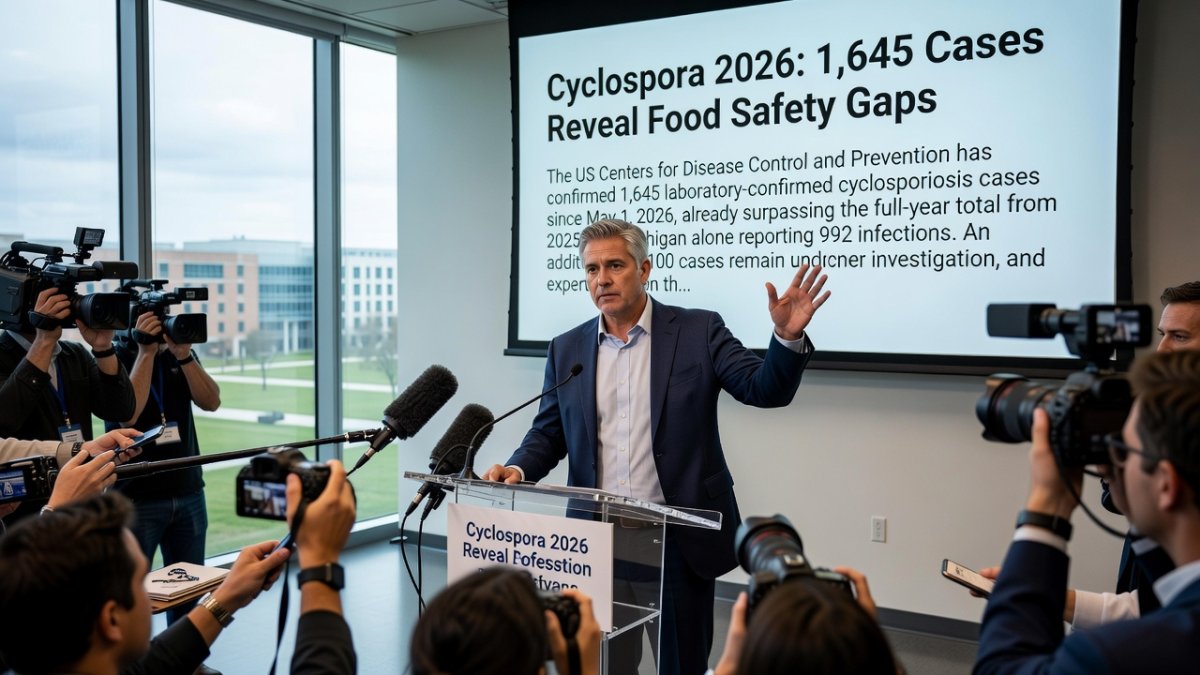
The US Centers for Disease Control and Prevention has confirmed 1,645 laboratory-confirmed cyclosporiasis cases since May 1, 2026, already surpassing the full-year total from 2025, with Michigan alone reporting 992 infections. An additional 5,100 cases remain under investigation, and experts warn the true toll is substantially higher due to underdiagnosis. This record outbreak exposes critical weaknesses in food safety systems on both sides of the globe.
Cyclospora 2026: 1,645 Cases Reveal Food Safety Gaps
New Delhi – July 16, 2026 — The US Centers for Disease Control and Prevention has confirmed 1,645 laboratory-confirmed domestic cyclosporiasis cases since May 1, 2026. An additional 5,100 cases remain under investigation. CDC deputy director Gwen Biggerstaff stated the true number is almost certainly higher due to underdiagnosis. This figure already exceeds the 249 cases reported by the same date in 2025. Cases span 34 states, affecting individuals aged 2 to 95 years with a median age of 44; 56 percent are female. Hospitalizations total 141, or 9 percent of confirmed cases, with zero deaths reported.
Michigan Leads Geographic Clusters Under Investigation
Michigan has recorded 992 confirmed cases, marking the largest outbreak in state history and approximately 40 hospitalizations. Lucas County, Ohio, reports 306 cases, while northwest Ohio exceeds 500. Linked clusters in Michigan, Ohio, West Virginia, and Kentucky suggest a shared food source. Michigan officials have identified lettuce as a potential source, with federal and state teams examining possible links to Taco Bell locations in the state. Dr. Natasha Bagdasarian, Michigan Chief Medical Executive, confirmed a linked outbreak is occurring.
Federal and state investigators from the CDC, FDA, and Michigan, Ohio, and Kentucky health departments are jointly conducting open-ended interviews, menu analysis, and whole-genome sequencing to link cases. Lettuce has emerged as a leading hypothesis after 68 percent of Michigan patients reported consuming leafy greens at restaurants or grocery stores in the two weeks before onset, yet no Cyclospora-positive product sample has been recovered, leaving the vehicle unconfirmed. Traceback is complicated by the commodity's rapid, multi-tiered distribution through national processors that commingle product from several farms within days. This mirrors the 2018 romaine E. coli outbreak, in which 210 illnesses across 36 states required six weeks of record reconstruction before a single California growing region was implicated. Matching cases across state lines is further hindered because patients ate at different Taco Bell or retail locations weeks apart; only high-resolution genomic clustering has so far connected the four-state cluster, underscoring the limits of traditional epidemiology when the exposure window is both long and geographically diffuse.
Parasite Characteristics and Diagnostic Challenges
Cyclospora cayetanensis is a microscopic single-cell protozoan parasite transmitted through food or water contaminated with feces. It is not spread person-to-person. The incubation period ranges from 2 to 14 days, typically about one week. Symptoms include watery diarrhea, loss of appetite, weight loss, bloating, nausea, and fatigue. Without treatment, illness can follow a remitting-relapsing course lasting days to a month or longer. Standard ova and parasite exams may miss the organism; PCR testing is recommended. Treatment requires 7 to 10 days of trimethoprim-sulfamethoxazole.
Patients frequently characterize the diarrhea as explosive, with sudden onset of 10–20 voluminous watery stools per day that rapidly cause dehydration, electrolyte imbalance, and profound fatigue, often forcing individuals to miss work for weeks and disrupting family caregiving responsibilities. In Michigan clusters, multiple patients experienced a classic remitting-relapsing course lasting 22–28 days before diagnosis, with apparent improvement after 5–7 days followed by abrupt recurrence that repeatedly led clinicians to attribute symptoms to viral gastroenteritis or irritable bowel syndrome. Hospitalization occurred in roughly 4 percent of confirmed cases for intravenous rehydration, though rates climbed above 12 percent among adults over 60. Standard ova-and-parasite microscopy misses Cyclospora because the 8–10 µm oocysts do not stain reliably with routine trichrome; modified acid-fast or safranin staining, plus UV autofluorescence, is required, while real-time PCR achieves over 95 percent sensitivity on stool. Compounding these laboratory hurdles, food-history interviews must probe meals consumed 6–8 weeks earlier, introducing substantial recall decay and increasing the chance that the true exposure vehicle is never identified.
Historical Trends and Climate Factors Driving Rise
Past US outbreaks include over 1,000 cases linked to Guatemalan raspberries in 1997 and more than 2,400 cases tied to Mexican basil in 2019. A CDC study documented a 443 percent increase in infections from the 2016-2018 period to 2021. Previous incidents have involved bagged salads, herbs, raspberries, and lettuce. Laboratory studies show Cyclospora oocysts become fully sporulated and infectious after 7–15 days at sustained temperatures above 22 °C; Indian meteorological records indicate that the Indo-Gangetic plain now experiences 18 additional days per year above this threshold compared with 1990 baselines. Extended warm seasons have correspondingly lengthened the window during which contaminated irrigation water can seed crops, a pattern epidemiologists link to the 443 percent rise in U.S. cases. FDA acting deputy commissioner Donald Prater noted that Cyclospora remains a challenging agent for investigators.
Resource Cuts Expose Surveillance Limitations
The Trump administration reduced funding to state and local health departments by $11.4 billion before the outbreak. CDC's FoodNet surveillance program was significantly narrowed. FoodNet's contraction eliminated active surveillance for Cyclospora in four states and halved isolate submission targets. CDC has warned for years that comprehensive efforts are needed to improve food safety, acknowledging that states are often under-resourced. State laboratories now operate with 15–30 percent vacancy rates in epidemiology posts, forcing reliance on passive reporting that captures only an estimated 2–3 percent of infections. University of Minnesota researcher Melanie Firestone highlighted substantial underreporting of such infections. These constraints mirror India's IDSP, where district-level budgets have stagnated at roughly ₹12 lakh per year despite a 40 percent rise in reported diarrheal outbreaks since 2018. Per-capita public-health spending remains starkly divergent: the United States allocates approximately $286 annually versus India's $32.
Challenges for India's Regulatory Systems
India's FSSAI faces comparable challenges monitoring fresh produce contamination. Cyclospora outbreaks have occurred in India, particularly during monsoon months. Published studies document Cyclospora cayetanensis in 4–7 percent of stool samples from Delhi and Vellore during July–September. FSSAI's current standards for fresh produce remain largely aligned with Codex Alimentarius yet lack enforceable microbial criteria for protozoa. Cold-chain coverage for fruits and vegetables stands at only 12 percent of total production. NCDC and ICMR maintain surveillance for foodborne parasitic illnesses amid resource constraints similar to those reported by US states. State public-health laboratories in Karnataka and Tamil Nadu have begun piloting multiplex PCR panels, but reagent budgets cover fewer than 500 tests per month. WHO estimates place India's annual foodborne-disease burden at 100 million cases and 120,000 deaths; parasitic agents including Cyclospora account for an under-ascertained 8–12 percent of these.
What This Means for Policy and Preparedness
The scale of 1,645 confirmed cases and ongoing investigations underscore gaps in early detection and coordinated response. For India, strengthened FSSAI produce testing protocols and expanded NCDC laboratory capacity could reduce underreporting. India's FSSAI could adopt FDA-style mandatory lot-coding and rapid traceback for high-risk produce such as berries and leafy greens, coupled with quarterly third-party audits of packing houses. Pilot programs already operating in Maharashtra show that adding PCR-based Cyclospora screening at major mandis raises detection rates from less than 5 percent to 22 percent within six months. Scaling this nationally would require an estimated ₹180 crore annual outlay. Integrating ICMR's climate-informed surveillance nodes with the NCDC's existing IDSP platform would close the 4–6 week reporting lag that currently separates monsoon produce contamination from clinical recognition. Cross-border data-sharing agreements modeled on the FDA-FSSAI 2023 memorandum could further reduce export-related risks while strengthening domestic preparedness. Sustained investment in diagnostics remains essential to limit future outbreaks.
The Bottom Line
A single parasite — Cyclospora cayetanensis — has sickened thousands across 34 U.S. states, hospitalised over 140 people, and exposed the fragility of food safety surveillance on two continents. For India, the outbreak is both a warning and an opportunity: the same climate pressures, cold-chain gaps, and resource constraints that amplified the U.S. outbreak are present across Indian agricultural supply chains. The cost of inaction — measured in preventable illness, missed workdays, and eroded public trust — far exceeds the ₹180 crore annual investment needed to bring laboratory capacity, traceability, and cross-border data sharing up to the standard the moment demands.
— By Dr. Raj Patel, Staff Writer
This article was produced with AI-assisted research and editorial support. Reporting is based on sources cited in the article.
What's Your Reaction?
 Like
0
Like
0
 Dislike
0
Dislike
0
 Love
0
Love
0
 Funny
0
Funny
0
 Wow
0
Wow
0
 Sad
0
Sad
0
 Angry
0
Angry
0

India/South Asia Correspondent at Global1.News. Analytical voice with a background in science and health journalism. Based in New Delhi, covering Indian politics, education, healthcare, technology, and policy. Breaks down complex data into clear, actionable reporting.















Comments (0)