
West Bank Ethnic Cleansing: Amnesty Exposes State Policy
In a recent Middle East Eye report, veteran journalist Peter Oborne takes viewers on a stark journey through the occupied West Bank, documenting what he describes as a state-orchestrated campaign of ethnic cleansing. The video, titled "The West Bank is being ethnically cleansed," arrives alongside a devastating new report from Amnesty International that confirms what Palestinia
In a recent Middle East Eye report, veteran journalist Peter Oborne takes viewers on a stark journey through the occupied West Bank, documenting what he describes as a state-orchestrated campaign of ethnic cleansing. The video, titled "The West Bank is being ethnically cleansed," arrives alongside a devastating new report from Amnesty International that confirms what Palestinians have long known: the forcible displacement of communities from their ancestral lands is not the work of rogue settlers but a deliberate government policy pursued with mounting intensity under Israel's current far-right coalition.
The Settlers Are in Control: West Bank Ethnic Cleansing Is State Policy
Ramallah, Occupied West Bank – June 24, 2026 — The 50-kilometre journey from Ramallah north to Nablus once took an hour. Today, Israeli checkpoints and floating barriers installed across the West Bank transform this route into a gruelling half-day ordeal. Along Highway 60, which runs along the ancient route from Hebron to Jenin, Israeli flags mark every hundred metres, and armed settlers patrol the hillsides above Palestinian villages. The landscape itself tells the story of a slow but systematic erasure.

A State-Led Campaign, Not Rogue Settlers
Amnesty International's June 2026 report, "Erasing anything Palestinian: Israel's ethnic cleansing of West Bank Bedouin and herding communities," presents overwhelming evidence that the ethnic cleansing of Area C — which constitutes over 60 percent of the occupied West Bank — is not the work of extremist individuals but a coordinated state strategy pursued through legislation, budget allocations, and military cooperation. The report examines 27 Bedouin and herding communities forcibly displaced between 2023 and 2025, based on interviews with 45 Palestinians, 19 lawyers and activists, and analysis of over 420 videos and images.
Amnesty's Secretary General Agnes Callamard stated: "What we are witnessing is deliberate, state-led annexation, in complete violation of international law unfolding before the eyes of the entire world." She emphasised that settler violence is "a core component of a state-sanctioned campaign of ethnic cleansing, central to maintaining Israel's system of apartheid." The report explicitly rebuts the Israeli government's narrative that these abuses stem from a few "bad apples" among settler extremists.
The data is staggering. According to the United Nations Office for the Coordination of Humanitarian Affairs, at least 117 predominantly Bedouin and herding Palestinian communities faced full or partial displacement between January 2023 and April 2026. By the end of April 2026, at least 5,910 people had been forcibly displaced from their ancestral lands. Israeli authorities demolished 3,407 Palestinian homes and structures in Area C during this period, displacing 2,996 people. These are not isolated incidents but the predictable outcome of policies designed to minimise Palestinian presence in territory Israel seeks to annex.
'Erasing Anything Palestinian': The Amnesty Report in Detail
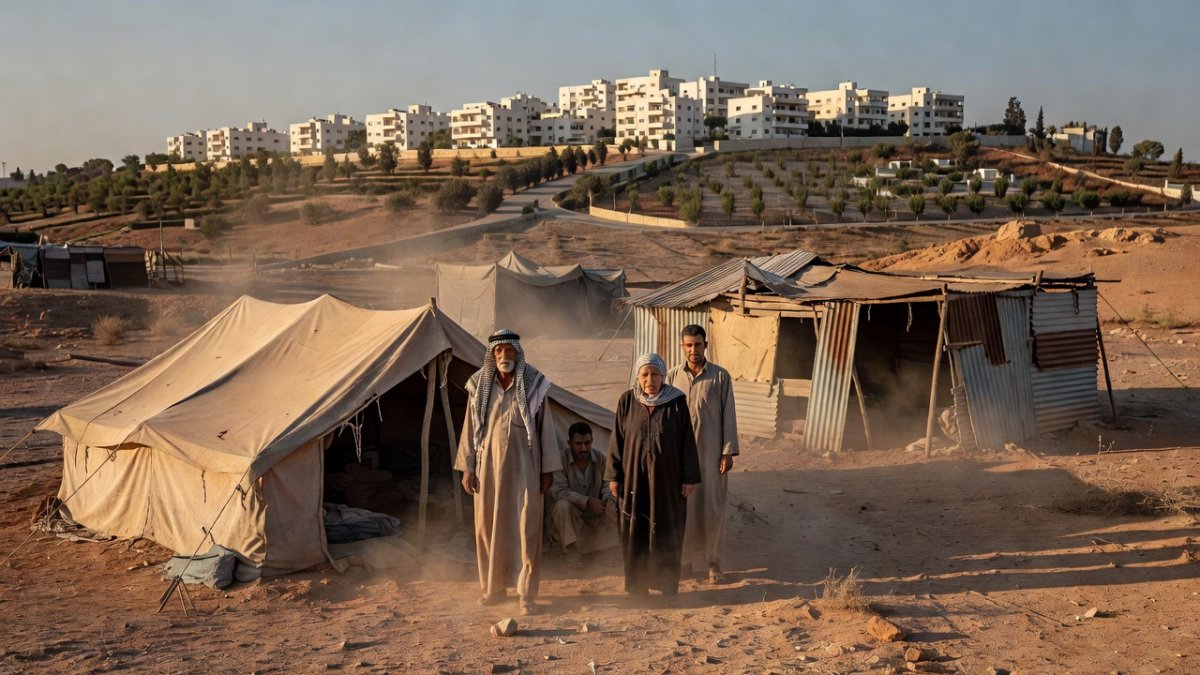
The Amnesty International report details three emblematic cases that expose the systematic nature of displacement. Khirbet Zanuta, a village in the South Hebron Hills home to around 250 Palestinian Bedouins who had lived there for generations, represents the most devastating example. In 2021, settlers established an illegal outpost called Meitarim Farm just one kilometre away, initiating a sustained campaign of harassment, threats and violent attacks. The entire community was displaced following a series of violent settler raids that escalated after October 7, 2023. Despite two rulings from the Israeli Supreme Court in July 2024 and February 2025 ordering authorities to facilitate residents' return and protect them from settler violence, residents have been unable to return due to ongoing attacks and the destruction of key infrastructure. Satellite imagery confirms that Zanuta no longer exists; it has been extensively destroyed and totally depopulated.
Ein Samia in the central Jordan Valley faced similar erasure in 2023, with all structures demolished. In the northern Jordan Valley, communities of Ein al-Hilweh, Makhoul, and Al-Farisiya endured repeated attacks, water cutoffs, and livestock seizures until most families fled by early 2025. At least 38 communities in the northern Jordan Valley, home to around 7,000 Palestinians, remain threatened with displacement. Nearly 90 percent of this area is designated as state land, military firing zones, nature reserves, or archaeological sites — all tools Israel uses to restrict Palestinian access.
These cases form part of a broader pattern of escalating violence. OCHA recorded nearly 2,000 settler attacks in 2025 alone, averaging five incidents per day. The violence included arson targeting agricultural fields, shootings at homes, and systematic destruction of centuries-old olive groves. Israeli authorities issued 240,000 firearms licenses between 2023 and 2026, a 15-fold increase from the annual average of 8,000 before the policy change, transforming civilian outposts into armed enclaves where settlers operate with military impunity.
Smotrich and Ben-Gvir: The Architects of Annexation
Finance Minister Bezalel Smotrich has consolidated unprecedented control over the West Bank through the Settlement Administration, a civilian body he established in 2023 that operates within the Ministry of Defence while answering to his political office. This arrangement fundamentally breached international law, which requires any occupying power to govern occupied territory through a military mechanism duty-bound to act in the interests of the occupied population. Instead, the Settlement Administration serves only Israeli settlers.
Under Smotrich's direction, the Ministry of Settlement and National Missions' annual budget grew by 122 percent, reaching NIS 764 million (USD 254.5 million) by 2026. He allocated an additional seven billion shekels (USD 2.4 billion) to a five-year plan for settlement roads, many built on Palestinian-owned land — representing 30 percent of Israel's national intercity roads budget for just three percent of the population. Peace Now executive director Lior Amihai called this "daylight robbery of public funds." Between 2023 and 2025, plans for 50,785 settlement housing units were advanced, with 27,941 approved in 2025 alone, the highest annual figure ever recorded. The total number of new settlements reached 102 by April 2026, by far the largest authorised by any single Israeli government in history.
National Security Minister Itamar Ben-Gvir complemented Smotrich's land-grab strategy by flooding settlements with weapons. In January 2026, he approved personal gun licences in 18 illegal settlements, and the loosened criteria after October 2023 led to over 240,000 settlers receiving firearms. Former Mossad chief Tamir Pardo, after visiting the West Bank, remarked: "My mother was a Holocaust survivor, and what I saw reminded me of the events that happened against Jews in the last century. What I saw today made me feel ashamed to be Jewish."
Life Under the Settler Boot: Voices from the Ground
Peter Oborne's Middle East Eye footage captures the daily reality in villages across the West Bank. In Burqa, an ancient village where Ottoman-era buildings stand alongside modern homes, the Handala statue — a cartoon character symbolising Palestinian steadfastness — was destroyed by Israeli soldiers, but its feet remain fixed in the ground. Residents describe how the nearby Homesh settlement, established on stolen land in 1978 and now rebuilt, has expanded ambitions to claim surrounding hills. Settlers descend from Homesh several times a week to steal cars, sheep, and agricultural equipment, often setting olive groves ablaze.
In Turmus Ayya, a Palestinian town near the Shilo settlement, families recount nightly raids where armed settlers burn cars and wreck agricultural machinery. A young mother on Oborne's bus described Shilo as "the one that's killing everybody ... the head of the snake." In Beita, sixteen young residents had been shot dead by September 2024, with many others injured. Every Friday, the youth of Beita march to protect their land, throwing stones at armed settlers backed by Israeli soldiers.
Makhoul resident Najiyyah Bisharat told interviewers: "We face constant harassment by the settlers, but we will not give in. The land is our identity, and if we are forced out of it, we'll die. Just like fish if taken out of water." Her community lost access to the only spring after armed settlers occupied it in 2024. Across the Jordan Valley, herding families now crowd into rented rooms in Jericho after losing livestock and tents. The psychological toll is immense, yet many continue planting olive trees and documenting attacks, refusing to surrender the narrative of their own displacement.
International Complicity and the Call for Action
Amnesty International has called on states to impose targeted sanctions against senior Israeli officials directly implicated in the ethnic cleansing campaign, including Prime Minister Benjamin Netanyahu, Finance Minister Bezalel Smotrich, National Security Minister Itamar Ben-Gvir, Minister for Settlement and National Missions Orit Strock, and Defense Minister Israel Katz. The organisation also urges states to halt all trade, investment, and security cooperation that sustains the settlement enterprise, and to support the International Criminal Court's investigation into the situation in Palestine.
Despite clear legal obligations under the Fourth Geneva Convention and the International Court of Justice's 2024 Advisory Opinion declaring Israel's occupation unlawful, major powers have continued business as usual. The United States maintains its military assistance package. The United Kingdom has taken limited steps, sanctioning some individual settlers, but continues arms sales. Germany, one of Israel's strongest European allies, has resisted any meaningful measures. European Union trade agreements continue treating settlement goods as Israeli products in practice. As Callamard warned: "To world leaders who repeatedly say they oppose annexation but do nothing to stop it: know that your inaction is directly fuelling crimes against humanity."
The ICC investigation remains active but arrest warrants have not materialised. Without concrete measures such as asset freezes, travel bans, and suspension of trade privileges, the machinery of ethnic cleansing operates with near-total impunity, shielded by powerful allies who prioritise strategic interests over Palestinian rights and the fundamental principles of international law.
Resistance and Steadfastness in the Face of Erasure
Despite the overwhelming forces arrayed against them, Palestinians continue to resist through sheer presence. In Burqa, a wall of martyrs near the village entrance commemorates those killed defending their land, dating back to the Arab revolt against British rule in 1936. More than 70 names are inscribed, with the most recent being 16-year-old Nidal Shaqnoubi — and there remains a gap for the next name. Mamoun, a retired social worker and teacher who fought in the first Intifada, told MEE: "Burqa has a long tradition of resistance. In our DNA we have loyalty to this country."
Communities maintain schools under tarpaulins where Israeli bulldozers have destroyed buildings. They graze sheep along routes that have been restricted, file endless legal petitions even when courts offer little protection, and document every attack on mobile phones for the historical record. The Statue of Handala in Burqa, whose feet the soldiers could not remove, has become a symbol of this obstinate refusal to be erased — "fixed, obstinate, unyielding, immovable, stubbornly planted in Palestinian soil," as Oborne described it.
What is at stake extends far beyond maps and statistics. It is the survival of entire ways of life rooted in centuries of connection to this land. The ethnic cleansing unfolding in the West Bank tests whether international law retains any meaning when powerful states look away. Palestinian steadfastness, documented by journalists like Peter Oborne and organisations like Amnesty International, insists that erasure will not succeed as long as people remain to tell their stories, plant next season's crops, and keep their feet planted in the soil. The world still has time to act before the hills of the West Bank are emptied completely. But that time is running out fast.
By Fatima Al-Rashid, Staff Writer
This article was produced with AI-assisted research and editorial support. Reporting is based on sources cited in the article.
What's Your Reaction?
 Like
0
Like
0
 Dislike
0
Dislike
0
 Love
0
Love
0
 Funny
0
Funny
0
 Wow
0
Wow
0
 Sad
0
Sad
0
 Angry
0
Angry
0

Gulf/MENA Correspondent at Global1.News. Based in Doha, covering Gulf politics, energy markets, diplomacy, and development across the Middle East and North Africa. Tracks the economic transformation of the Gulf states.










Comments (0)