
The Atemoya Trap: How Taiwan's Prized Fruit Became Beijing's Latest Economic Lever in the Cross-Strait Chessboard
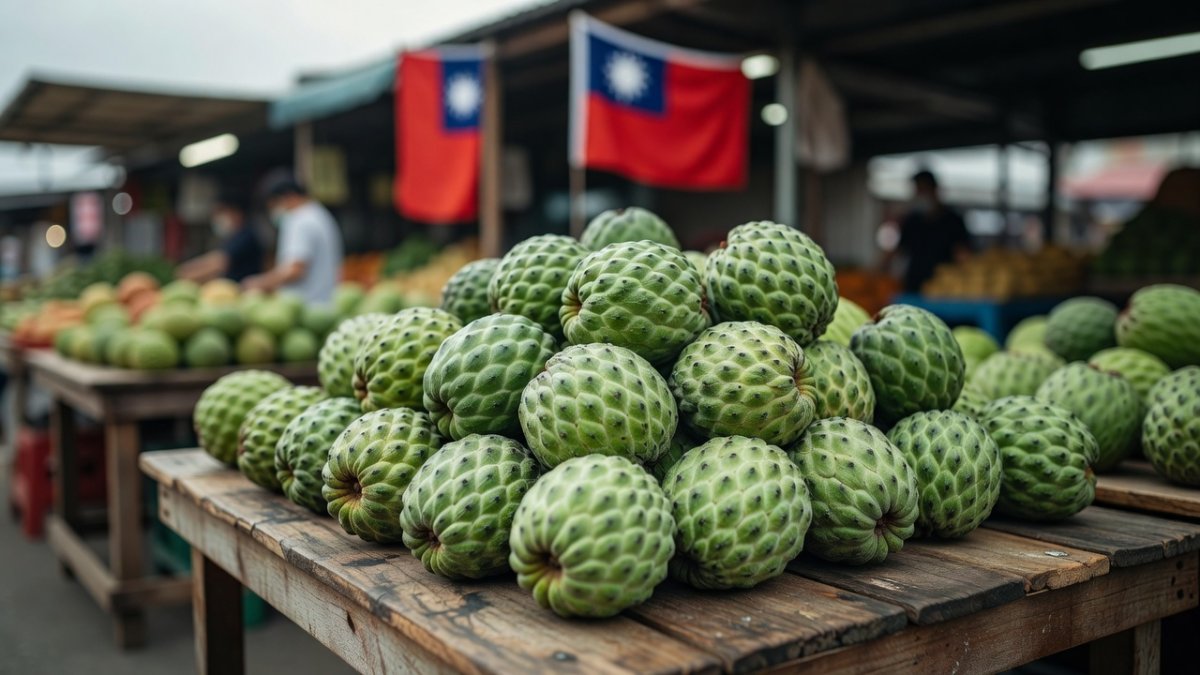
The Atemoya Trap: How Taiwan's Prized Fruit Became Beijing's Latest Economic Lever in the Cross-Strait Chessboard A Strategic Fruit: The Atemoya as a Cross-Strait Flashpoint The atemoya, a hybrid custard apple with creamy white flesh and a rough green exterior, has emerged as a specialty crop from Taiwan's Taitung county. Its position as a key export item to China places it at
A Strategic Fruit: The Atemoya as a Cross-Strait Flashpoint
The atemoya, a hybrid custard apple with creamy white flesh and a rough green exterior, has emerged as a specialty crop from Taiwan's Taitung county. Its position as a key export item to China places it at the center of cross-strait economic dynamics. Beijing has long viewed Taiwan as its territory and has not ruled out the use of force, while simultaneously employing a range of non-military measures to exert pressure. Fruit exports represent one such avenue, allowing Beijing to influence Taiwan's agricultural sector without direct confrontation. The atemoya's high value and limited production base make it particularly vulnerable to shifts in Chinese import policies, turning a niche agricultural product into a potential instrument of leverage.
China's role as a major importer of Taiwanese atemoyas gives it significant market power. When Chinese companies signal increased purchases, Taiwanese farmers respond by expanding cultivation, creating dependence on a single buyer. This pattern aligns with broader Chinese strategic interests in maintaining economic ties that can be adjusted to serve political objectives. Taiwan's agriculture ministry has highlighted how such reliance exposes farmers to abrupt market changes. The fruit thus functions not merely as a commodity but as a barometer of cross-strait relations, where economic gestures carry implicit political weight. Observers note that Beijing's approach combines military drills simulating blockades with these targeted economic moves, creating a multi-layered pressure campaign that tests Taiwan's resilience across sectors.
The 'Raise, Trap, Kill' Accusation: Taiwan's Ministry Raises the Alarm
Taiwan's agriculture ministry issued a press release describing China's recent pledge to increase atemoya imports as a classic example of a "raise, trap, kill" process. According to the ministry, Beijing first makes large purchases to demonstrate goodwill and encourage farmers to expand production. Once reliance is established, unilateral export restrictions are imposed without warning, leaving the industry exposed. The statement emphasized that such tactics cause huge instability for the sector and place great risks on individual farmers. This framing positions the atemoya issue within a deliberate strategy rather than routine trade fluctuations.
The ministry further noted China's expansion of its own atemoya cultivation, which directly threatens Taiwan's competitive position. By building domestic capacity while controlling access to its market, Beijing can reduce the long-term value of Taiwanese exports. The agriculture ministry's response focuses on guiding the industry toward sustainable development and stable farmer incomes through measures such as diversified processing into frozen products, puree, and wines. This approach seeks to mitigate risks associated with over-reliance on Chinese demand. The ministry's public warning underscores Taiwan's concern that economic courtship from Beijing often precedes restrictive actions, requiring proactive diversification to protect agricultural livelihoods.
Historical Precedent: From Pineapples to Atemoyas
The current debate over atemoyas echoes earlier disputes involving Taiwanese fruit exports. In 2021, China banned imports of Taiwanese pineapples, which caused major disruption to farmers' livelihoods and prompted a domestic consumption campaign in Taiwan. Many viewed the ban as economic coercion tied to political tensions. The same pattern appears to be unfolding with atemoyas, according to Taiwan's agriculture ministry. Imports of the fruit were suspended in 2021 on grounds of pest concerns, partially resumed in 2023, and then subjected to taxes in 2024. These successive adjustments have created ongoing uncertainty for producers.
The ministry's statement links these moves to a broader strategy of creating dependence followed by sudden restrictions. The 2021 pineapple episode demonstrated how quickly market access can be withdrawn, forcing Taiwan to seek alternative outlets and stimulate local demand. Atemoya farmers now face similar risks as China signals both increased purchases and expanded domestic production. This historical sequence illustrates how agricultural trade has become a recurring site of friction, with Beijing using import policies to apply pressure while Taiwan responds through diversification efforts and public awareness campaigns. The repetition of these tactics reinforces perceptions that fruit exports serve as tools in the larger cross-strait contest.
The Xiamen Forum: Cricket Diplomacy and Economic Courtship
Earlier this month, Chinese companies pledged to buy more Taiwanese atemoyas at a forum held in Xiamen, a coastal city on the Taiwan Strait. The event formed part of a wider initiative to expand purchases of Taiwanese exports including fish and tea. Business leaders and opposition politicians from Taiwan attended despite an official ban on participation by Taiwan's central government. The forum presented an image of economic cooperation, yet Taiwan's Mainland Affairs Council subsequently warned that officials who took part could face investigation. This response highlights the political sensitivities surrounding direct engagement with Chinese economic overtures.
The pledges at Xiamen illustrate Beijing's dual approach of offering market access while maintaining political conditions. By inviting opposition figures, the forum bypassed official channels and created divisions within Taiwan. The agriculture ministry's subsequent cautionary statement framed these purchase commitments as the initial stage of the "raise, trap, kill" sequence. The contrast between the forum's economic promises and the ministry's warnings reveals the underlying strategic calculations on both sides. Beijing seeks to demonstrate goodwill to certain Taiwanese constituencies while preserving the ability to adjust trade flows, whereas Taipei views such events as potential precursors to future restrictions that could destabilize key industries.
Taiwan's Response: Diversification, Domestic Politics, and the KMT Divide
Taiwan's agriculture ministry has stated that authorities will prioritize sustainable agricultural development and stable incomes for farmers by directing the atemoya industry toward diversified processing. This includes production of frozen fruit products, puree, and wines to reduce dependence on fresh exports to China. The approach aims to build resilience against sudden policy shifts from Beijing. At the same time, the issue has exposed domestic political divisions, with opposition lawmakers from the Kuomintang criticizing the ministry's warnings as an attempt to politicize the industry in ways that could ultimately harm farmers.
Taipei Mayor Chiang Wan-an accused the Mainland Affairs Council of using the atemoya issue to "bully and oppress" Taiwanese farmers. He described the fruit as the "TSMC of the fruit world," arguing that no other country can produce one as delicious and special. These statements reflect competing views on how Taiwan should manage economic relations with China. While the government emphasizes risk mitigation through diversification, opposition voices argue that politicizing trade threatens livelihoods. The resulting debate reveals the challenge of maintaining unified policy when economic incentives from Beijing intersect with internal political competition, potentially weakening Taiwan's ability to respond coherently to external pressure.
Strategic Implications for Cross-Strait Relations
The atemoya dispute underscores Beijing's use of non-military tools to influence Taiwan amid ongoing military drills near the island. By alternating between expanded import pledges and restrictive measures, China can create economic uncertainty that tests Taiwan's political cohesion. The involvement of opposition politicians at the Xiamen forum further complicates Taipei's efforts to present a unified front. Taiwan's responses, including calls for diversified processing and investigations into forum participation, represent attempts to counter this leverage while managing domestic divisions.
Over time, these episodes may encourage Taiwan to accelerate efforts to reduce reliance on the Chinese market across agricultural sectors. The pattern observed with pineapples and now atemoyas suggests that Beijing will continue to calibrate economic access in line with broader strategic objectives. For Taiwan, the challenge lies in balancing the immediate interests of farmers with the need to avoid entrapment in cycles of dependence and restriction. The atemoya case thus illustrates how seemingly minor trade issues can reveal deeper calculations about leverage, resilience, and the future trajectory of cross-strait relations.
By Prof. Marcus Chen, Staff WriterThis article was produced with AI-assisted research and editorial support. Reporting is based on sources cited in the article.
What's Your Reaction?
 Like
0
Like
0
 Dislike
0
Dislike
0
 Love
0
Love
0
 Funny
0
Funny
0
 Wow
0
Wow
0
 Sad
0
Sad
0
 Angry
0
Angry
0

World Politics Analyst at Global1.News. Based in Beijing, covering US-China relations, global trade, and geopolitical strategy. Brings deep analytical perspective to the power dynamics shaping international affairs.















Comments (0)