
Israeli Demolitions in the West Bank: A Pattern of Displacement Under International Scrutiny
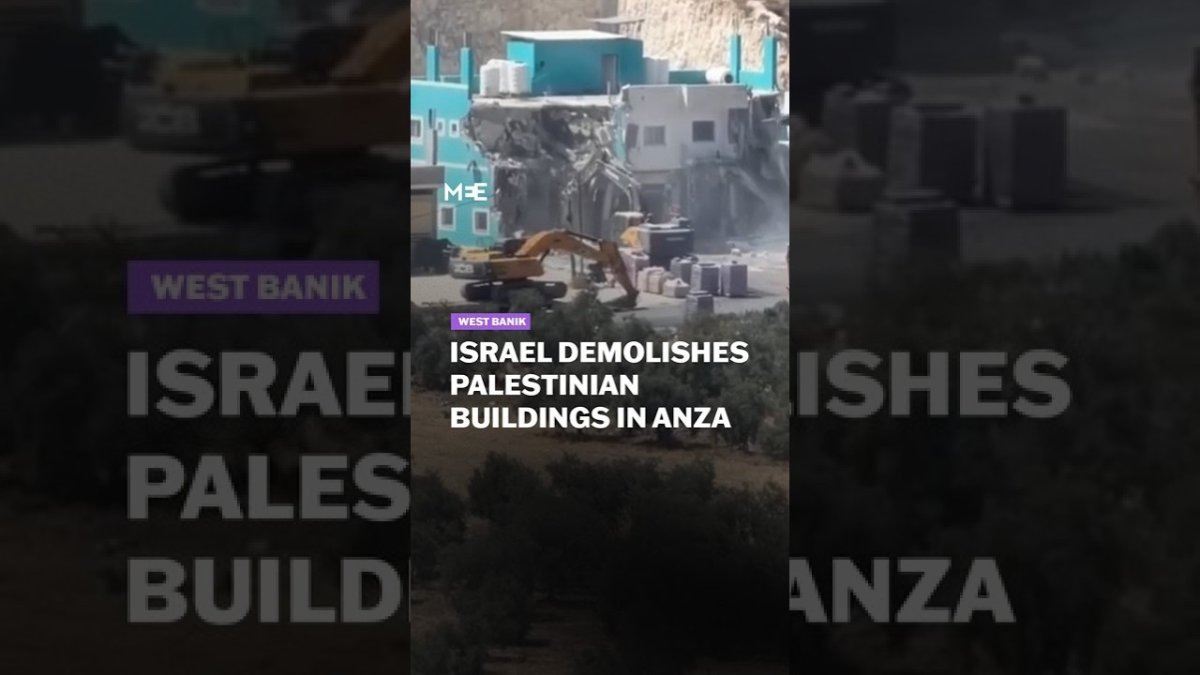
In a recent Middle East Eye report published in July 2026, Israeli forces are shown carrying out demolitions of Palestinian-owned buildings across the occupied West Bank, targeting homes, agricultural structures, and community facilities in areas under full Israeli military control.
In a recent Middle East Eye report published in July 2026, Israeli forces are shown carrying out demolitions of Palestinian-owned buildings across the occupied West Bank, targeting homes, agricultural structures, and community facilities in areas under full Israeli military control.
Israeli Demolitions in the West Bank: A Pattern of Displacement Under International Scrutiny
Ramallah, Occupied West Bank — July 2026 — Israeli forces have continued systematic demolitions of Palestinian-owned structures across the occupied West Bank throughout 2026, displacing hundreds of families and drawing renewed condemnation from human rights organizations and international bodies. The demolitions, concentrated in Area C — which comprises approximately 60 percent of the West Bank and remains under full Israeli military and administrative control — target homes, agricultural buildings, water infrastructure, and community facilities.
The Pattern of Demolitions in Area C
Israeli forces regularly demolish Palestinian-owned structures in the occupied West Bank, particularly in Area C, which remains under full Israeli military and administrative control. These operations have continued into late July 2026, with multiple sites cleared in a single week. Structures are often targeted because they were built without Israeli-issued permits, which Palestinian residents and advocacy groups describe as nearly impossible to secure under current military regulations.
The practice follows established Israeli military orders that govern construction in the occupied territory. Palestinian communities report that permit applications face prolonged delays or outright rejection, leaving families with limited options for legal building. Data compiled by the UN Office for the Coordination of Humanitarian Affairs shows consistent enforcement of these orders over recent months.
The Israeli Civil Administration maintains strict control over building permits in Area C of the occupied West Bank, requiring Palestinians to navigate an opaque and lengthy approval process that often spans years without resolution. In practice, approval rates for Palestinian applications remain below 5 percent, forcing many families to construct homes without permits and live under constant threat of demolition. According to OCHA data, over 1,200 Palestinian structures were demolished in Area C during 2026 alone, displacing hundreds and underscoring the systemic barriers embedded in the permit regime.
These restrictions draw on a complex layering of legal frameworks, including Ottoman land laws that classify much of the territory as state land, British Mandate regulations on zoning, Jordanian planning statutes from the pre-1967 era, and overriding Israeli military orders issued since the occupation began. This patchwork effectively denies Palestinians the ability to develop their communities legally while enabling rapid expansion elsewhere. The result is a de facto policy of displacement through administrative means rather than outright military action.
Displacement Figures and Affected Populations
More than 1,000 Palestinians were displaced in the West Bank in recent months due to demolitions of their homes. The majority of those affected belong to Bedouin and herder communities who have maintained presence on the land for generations. These groups face repeated displacement cycles that disrupt traditional livelihoods tied to livestock and seasonal grazing.
Demolitions have concentrated in the South Hebron Hills, the Jordan Valley, and areas around East Jerusalem. In these locations, entire clusters of residential and agricultural buildings have been removed, leaving open land that falls under ongoing Israeli administrative oversight. Families must then seek alternative shelter, often in already crowded neighboring communities.
In the South Hebron Hills, communities such as Masafer Yatta, Khirbet Jenbah, and Khirbet al-Fakhit have faced repeated waves of demolitions that have uprooted dozens of families in 2026, according to UN documentation tracking the destruction of residential caves, tents, and water infrastructure. Bedouin communities in the Jordan Valley have similarly endured the loss of dozens of structures, with OCHA reporting at least 450 individuals displaced across these areas during the year. The UN has highlighted how these targeted operations exacerbate vulnerability in already marginalized populations reliant on herding and agriculture.
Overall displacement figures for 2026 reached more than 1,800 Palestinians across Area C, with the UN documenting a sharp increase in incidents involving schools and clinics. These numbers reflect not isolated events but a sustained pattern that fragments communities and severs access to essential services, leaving many without viable alternatives for resettlement within the West Bank.
Human Impact on Daily Life and Livelihoods
Demolitions displace families, destroy livelihoods, and contribute to a broader pattern of displacement and land confiscation in the occupied territories. Residents lose access to homes, water infrastructure, and farming plots in a single operation, forcing immediate relocation and long-term economic strain. Local economies in rural West Bank areas rely heavily on agriculture and herding, both of which suffer direct setbacks from the loss of built structures.
Children in affected households experience interruptions in schooling when families move to temporary locations without established services. Health access also declines because demolished sites frequently include clinics or storage facilities for medical supplies. These outcomes accumulate across multiple incidents documented through mid-2026.
Demolitions in the occupied West Bank directly disrupt children's education by destroying or threatening school buildings, forcing students to travel longer distances or study in temporary shelters amid ongoing instability. Family health suffers as homes and water systems are razed, increasing exposure to harsh weather and limiting access to sanitation, while economic stability erodes through the loss of olive groves and livestock that sustain livelihoods for generations. The psychological trauma of home demolition compounds these hardships, with residents reporting persistent anxiety and a sense of perpetual insecurity.
Efforts to rebuild after demolitions often prove futile, as new structures face the same permit barriers and risk immediate targeting, perpetuating a cycle of loss and reconstruction. Families frequently lose vital agricultural assets like centuries-old olive trees, which represent both economic resources and cultural heritage, further entrenching poverty and dependence on humanitarian aid in affected areas.
International Legal Framework and Condemnations
These demolitions occur under the framework of Israeli military orders in occupied territory, which international law deems illegal under the Fourth Geneva Convention. The convention prohibits the destruction of civilian property unless required by military necessity, a standard human rights monitors argue is not met in routine permit-enforcement cases. The European Union and other international bodies have issued repeated condemnations of the practice.
Legal experts note that the orders operate within a system of military administration established after 1967. Palestinian legal organizations continue to challenge individual demolition orders in Israeli courts, though success rates remain low according to available case records. International observers maintain that the underlying policy framework requires revision to align with humanitarian obligations.
The Fourth Geneva Convention's Article 53 explicitly prohibits the destruction of civilian property in occupied territory except where rendered absolutely necessary by military operations, a standard rarely met in these West Bank demolitions. International Court of Justice advisory opinions have reinforced that such practices violate international humanitarian law, while the International Criminal Court continues investigations into potential war crimes arising from systematic property destruction. EU condemnations have grown louder, with disputes over donor funding highlighting concerns that aid may indirectly support rebuilding efforts undermined by repeated demolitions.
The Hague Group has issued statements calling for accountability mechanisms to address these violations, emphasizing the need for third states to refrain from recognizing or assisting in the unlawful situation created by the demolitions. These international frameworks collectively underscore the tension between ongoing practices and established legal norms governing occupation.
Documentation by Human Rights Organizations
International human rights organizations, including B'Tselem, Amnesty International, and Human Rights Watch, have documented these practices and called for them to stop. Their reports compile photographic evidence, satellite imagery, and field interviews that track the frequency and location of operations. These groups emphasize that the demolitions form part of a consistent administrative approach rather than isolated security measures.
The UN Office for the Coordination of Humanitarian Affairs issues regular updates that record the number of structures demolished and people displaced. Its monitoring covers both residential and non-residential buildings, providing a cumulative picture of impact across the West Bank. Palestinian civil society groups coordinate with these international monitors to verify on-site details.
Broader Political Implications for the Region
The demolitions intersect with wider questions of land control and settlement expansion in the occupied West Bank. Areas cleared of Palestinian structures often border or fall near existing settlement zones, raising concerns among observers about future land allocation. Palestinian political representatives have linked the operations to efforts that limit territorial contiguity for any future Palestinian entity.
Regional dynamics also involve donor-funded projects that have been affected when EU-supported buildings face demolition. These incidents prompt diplomatic exchanges between European representatives and Israeli authorities. The cumulative effect on Palestinian communities reinforces existing patterns of restricted movement and resource access that shape daily life under prolonged occupation.
Israeli demolition policies in Area C facilitate settlement expansion by clearing Palestinian presence from strategic lands, directly undermining prospects for a viable two-state solution through the fragmentation of contiguous Palestinian territory. US policy has at times provided diplomatic cover or withheld criticism, allowing the pattern to continue without significant repercussions. The Palestinian Authority has condemned the actions as collective punishment but faces limited leverage to halt them on the ground.
International responses range from verbal condemnations to calls for renewed negotiations, yet persistent silence from key actors has enabled the policy to advance settlement objectives at the expense of Palestinian rights. This dynamic risks entrenching a one-state reality where demolitions serve as tools for demographic control rather than security measures.
By Fatima Al-Rashid, Staff Writer
This article was produced with AI-assisted research and editorial support. Reporting is based on sources cited in the article.
What's Your Reaction?
 Like
0
Like
0
 Dislike
0
Dislike
0
 Love
0
Love
0
 Funny
0
Funny
0
 Wow
0
Wow
0
 Sad
0
Sad
0
 Angry
0
Angry
0

Gulf/MENA Correspondent at Global1.News. Based in Doha, covering Gulf politics, energy markets, diplomacy, and development across the Middle East and North Africa. Tracks the economic transformation of the Gulf states.











Comments (0)