
China Faces AI Misinformation Crisis as Typhoon Noul Tests Information Integrity
As China contends with Typhoon Noul and a punishing storm season, authorities are battling not only floodwaters but a surge of AI-generated videos and images designed to mislead. Fabricated scenes of mass casualties, crocodiles released into urban rivers, and false power outages have ricocheted across social media, exploiting the chaos of natural disasters to sow confusion.
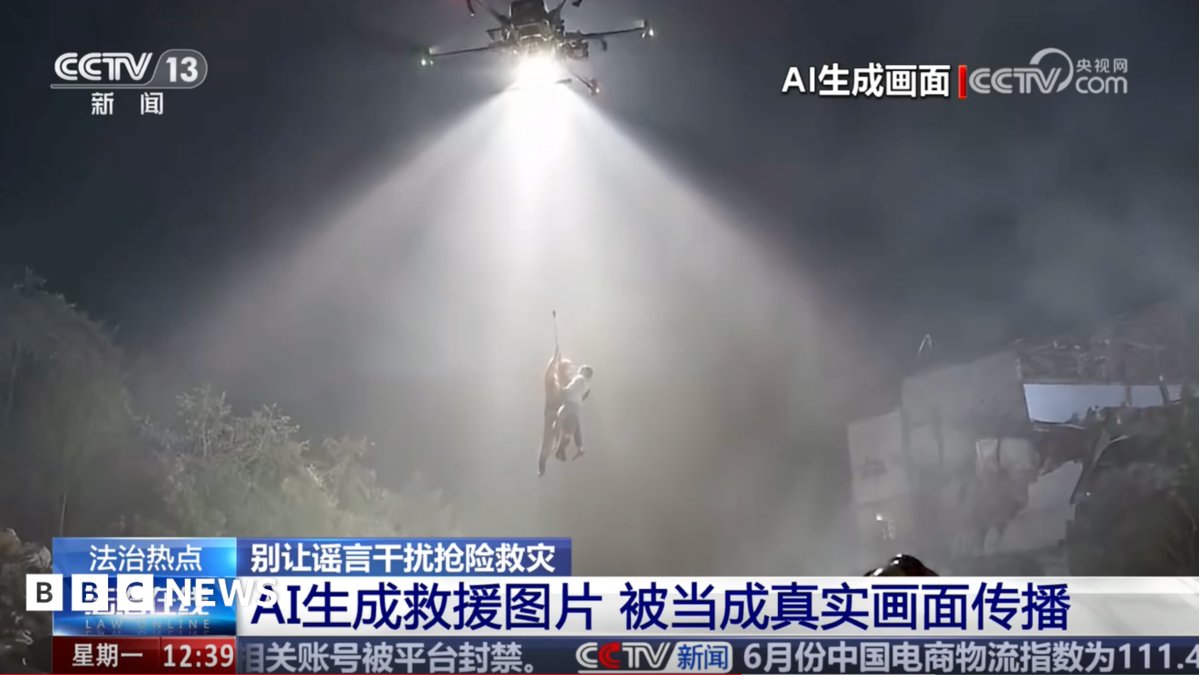
As China contends with Typhoon Noul and a punishing storm season, authorities are battling not only floodwaters but a surge of AI-generated videos and images designed to mislead. Fabricated scenes of mass casualties, crocodiles released into urban rivers, and false power outages have ricocheted across social media, exploiting the chaos of natural disasters to sow confusion. The crisis exposes a deepening tension between Beijing's ambitions as a global AI leader and the domestic instability that unregulated synthetic media can inflict during emergencies.
The Surge of Fake AI Videos During Disasters
As China deals with Typhoon Noul that made landfall over the weekend, officials face misleading AI-generated videos during disasters. Powerful storms and flooding over recent months have seen fake videos inundating social media, including images of dead bodies, false depictions of severe flooding, and fake emergency response details. These fabrications appear precisely when communities seek reliable updates, turning information channels into sources of confusion.
Specific Incidents of Misinformation in Affected Regions
In some areas, videos about false power outages prompted panic buying. Flooding in Hengzhou, Guangxi in early July caused snakes to escape a farm, then fake images showed crocodiles released into a river. Such distortions spread rapidly on social media platforms, amplifying local anxieties into wider unrest without any basis in verified events.
Official Statements from Law Enforcement Authorities
Huang Zhihua, Deputy Chief of online public security for Zhejiang Police, stated that content creators use disaster news to gain followers, deliberately fabricating information. Arrests and punishment, ranging from detention awaiting prosecution to fines, have occurred for bogus reports and video content. Gao Kai, Ningbo Public Security Bureau, advised that when encountering disaster information from an unknown source, people should be sceptical and rely on official announcements.
Academic Analysis of AI Technology Barriers
Professor Chen Bin, writing in the Party Central Party School's newspaper, noted that AI dramatically lowers technical barriers to producing false information, allowing individuals to rapidly generate convincing text, images, audio and video. Professor Gao Fuping from East China University of Political Science and Law explained that motivations range from amusement to traffic generation to deliberate panic or social unrest. These observations highlight how accessible tools reshape the information landscape during crises.
Limitations in Detection and Identification Methods
Professor Xu Xiaoke from Beijing Normal University observed that detection technology still lags behind generation technology, and technology alone cannot identify AI-generated content with a click. This gap leaves authorities and the public reliant on slower verification processes even as fabricated material circulates at high speed across networks.
China's Strategic Embrace of Artificial Intelligence
China is embracing AI. In 2017 it announced AI would be the main driving force of progress. Xinhua reports over 6,000 AI companies in China. This national priority creates both opportunities for innovation and new vulnerabilities when the same technologies enable deceptive content during natural disasters that affect domestic stability and foreign policy perceptions.
China's 2017 designation of artificial intelligence as the main driving force for national development established a deliberate policy architecture that simultaneously accelerates technological self-sufficiency and exposes regulatory gaps. With Xinhua reporting over 6,000 AI companies operating across the country, the ecosystem generates both the tools for disaster response and the instruments for fabricating content such as fake flooding footage or simulated power outages. This scale creates structural tension: the same firms positioned to advance strategic autonomy can produce synthetic media that undermines public order during events like Typhoon Noul's landfall from July 25-27, 2026.
The CAC's nationwide crackdown announced on 23 July 2026 exemplifies China's model of rapid legislative response, deploying enforcement mechanisms to close the interval between technological misuse and state intervention. By targeting AI-generated depictions of dead bodies, escaped wildlife, and emergency failures, regulators seek to preserve the integrity of the 6,000-plus company sector while reinforcing central oversight. The approach reveals an inherent calculus in which promotion of AI leadership must coexist with immediate containment of its destabilizing applications during natural disasters.
Public Trust Issues Stemming from Official Communication
Official sources have downplayed disasters, leading to public mistrust. Earlier July, journalists were asked to soften language about a Liulan Dam breach near Nanning as an opening or gap. Water bursting through killed at least 26. In 2021, local officials were arrested for concealing 139 deaths in Henan province. These past episodes compound the difficulty of countering AI-generated falsehoods in the present.
Previous instances of official language softening, such as the directive to journalists covering the Liulan Dam breach near Nanning that resulted in 26 deaths, have created a persistent credibility deficit that AI-generated content exploits. When citizens recall the 2021 Henan case in which officials were arrested for concealing 139 deaths, calls to rely solely on state announcements during Typhoon Noul encounter structural skepticism. This historical pattern of information control directly amplifies the impact of fabricated videos showing crocodiles or panic buying triggered by false power outages.
The paradox emerges because authorities must simultaneously combat synthetic misinformation while operating within an established framework of narrative management. The CAC crackdown on 23 July 2026 therefore addresses not only the technical proliferation of fake emergency response imagery but also the eroded baseline of public confidence that makes such content credible. Without addressing this accumulated distrust, regulatory efforts risk reinforcing the very vacuum they intend to fill.
Policy Responses and Platform Accountability Measures
On 23 July, China's Cyberspace Administration announced a nationwide crackdown on fake disaster content. Lawyer Peter Pang from Shanghai and Washington noted that platforms should be the first line of accountability because they enable content to go out. Prof Xu believes China needs official government early warning systems and disaster interfaces for news organisations to strengthen reliable information flows.
China's punishment framework, ranging from administrative fines to prison terms of up to seven years, provides a graduated response calibrated to the severity of AI-driven deception during disasters. The 23 July 2026 CAC crackdown operationalizes this spectrum by targeting content that depicts escaped snakes as crocodiles or fabricates flooding scenes in Hengzhou, Guangxi. Peter Pang's observation that platforms constitute the first line of accountability places direct compliance obligations on intermediaries, compelling preemptive moderation before state enforcement escalates.
The challenge lies in the temporal mismatch between rapidly evolving generative techniques and the pace of legal adaptation. While the 2017 national AI priority and the resulting 6,000-plus company ecosystem accelerate innovation, the same dynamism outstrips existing statutes, requiring continuous recalibration of liability standards. This regulatory environment must therefore balance deterrence against the risk of over-criminalizing content that platforms cannot fully anticipate or prevent.
Broader Geopolitical and Future Implications
Prof Xu warns AI-generated misinformation will increase in volume and spread speed, affecting elections, health emergencies, conflicts and disasters. This trajectory aligns with China's strategic interests in maintaining social stability while advancing its AI sector, yet it also underscores second-order effects on public confidence and international perceptions of crisis management. The interplay between technological ambition and information control remains central to how such challenges unfold.
Domestic struggles with AI-generated disaster misinformation directly shape China's international positioning as an AI governance leader. Prof Xu Xiaoke of Beijing Normal University has noted that such content poses risks in elections, health emergencies, and conflicts, underscoring how internal regulatory shortfalls can project outward as evidence of systemic vulnerability. The Belt and Road Initiative's digital infrastructure component becomes correspondingly exposed when foreign partners question the reliability of Chinese AI systems amid visible domestic enforcement actions like the 23 July 2026 CAC crackdown.
The tension between sovereign control of information and the need for international cooperation intensifies as fabricated videos of fake dead bodies or emergency responses circulate beyond national borders. China's model, anchored in the 2017 strategic designation and the ecosystem of over 6,000 AI companies, must therefore demonstrate credible containment mechanisms if it is to export governance norms rather than merely defensive restrictions. Failure to resolve this domestically weakens the persuasive power of any proposed global framework.
By Prof. Marcus Chen, Staff Writer
This article was produced with AI-assisted research and editorial support. Reporting is based on sources cited in the article.
What's Your Reaction?
 Like
0
Like
0
 Dislike
0
Dislike
0
 Love
0
Love
0
 Funny
0
Funny
0
 Wow
0
Wow
0
 Sad
0
Sad
0
 Angry
0
Angry
0

World Politics Analyst at Global1.News. Based in Beijing, covering US-China relations, global trade, and geopolitical strategy. Brings deep analytical perspective to the power dynamics shaping international affairs.













Comments (0)