
Toronto Engulfed by Wildfire Smoke as Toxic Haze Spreads Into US
Toronto topped IQAir's worst air quality list July 15, 2026 as over 128 wildfires raged across northwestern Ontario. Toxic smoke turned skies orange, forced evacuations, cancelled FIFA events, and spread into US cities including New York. A climate-driven crisis deepening across North America.
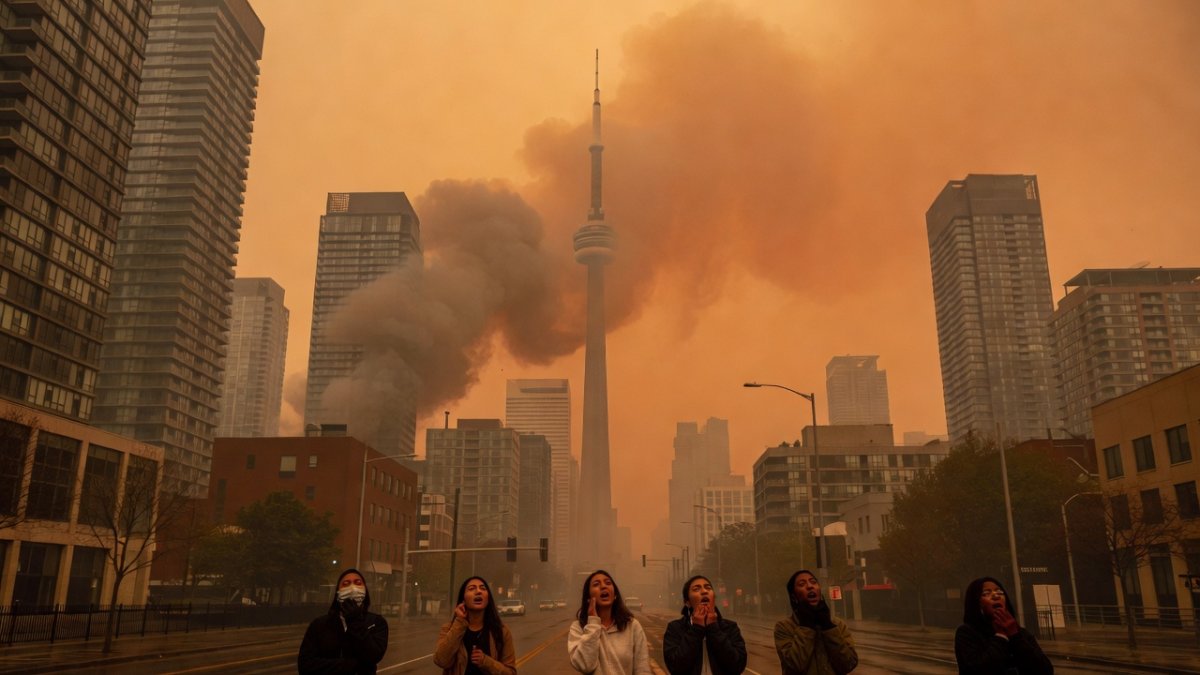
Toronto Engulfed by Wildfire Smoke as Toxic Haze Spreads Into US
When you woke up in Toronto on Wednesday, the sky wasn't blue. It was orange. And not the soft, golden hue of a summer sunset — this was the kind of deep, apocalyptic orange that makes you stop and stare, then reach for your phone to check if the world is still spinning right.
It wasn't. At least, not the way it should be.
Toronto, Canada — Canada's largest city woke to find itself at the top of a list no city ever wants to lead. IQAir, the Swiss firm that tracks the world's air quality in real time, ranked Toronto as having the worst air quality on planet Earth on Wednesday — surpassing Kinshasa in the Democratic Republic of Congo, New Delhi in India, Dubai in the UAE, and Jerusalem in Israel. The smoke, carried south from more than 100 active wildfires raging across northwestern Ontario, had turned the city's skies a thick, hazy orange by mid-morning.
The Scale of the Fires
As of Wednesday, over 128 active wildfires were burning across northwestern Ontario, concentrated in the region around Lake Nipigon, north of Thunder Bay. Extreme heat, bone-dry conditions, and strong winds have turned the boreal forest into a tinderbox, and fire crews are stretched thin trying to contain blazes that seem to multiply faster than they can be extinguished.
Entire communities in the northwest have been placed under mandatory evacuation orders. Highways have been closed. A restricted fire zone is now in effect across much of the region, meaning no campfires, no burning, no sparks of any kind. The provincial government has declared a state of emergency in affected areas, and resources are being mobilised from across the country.
But it's not just Ontario burning. The 2026 Canadian wildfire season has been brutal across the board — over 843 active wildfires reported nationwide in mid-July, primarily in Alberta, British Columbia, and Saskatchewan. A firefighter died in Nova Scotia. A pilot and two crew members were killed in a plane crash during firefighting operations near Fort Simpson in the Northwest Territories. This is a national crisis, and it's far from over.
Toronto Under Orange Skies
The smoke arrived in Toronto early Wednesday morning, carried by northwesterly winds straight from the fire zones. By 8 a.m., the air quality health index (AQHI) had shot up to 10+ — the highest possible rating, meaning "very high risk." The sky was an eerie shade of orange, visibility dropped sharply, and the characteristic smell of burning timber hung over the entire city.
Environment Canada issued an orange-level air quality warning covering much of southern Ontario, warning residents that the smoke could persist through Friday in some areas. The agency advised Canadians to limit time outdoors, keep windows closed, and prioritise staying cool inside — a challenge made worse by the fact that the smoke arrived during a brutal heatwave.
Maximum temperatures of 30 to 36 degrees Celsius were recorded Wednesday, with humidex values making it feel like 38 to 42 degrees. Tuesday was even worse, with humidex values reaching 38 to 45 degrees in parts of southern Ontario. For residents without air conditioning, the choice between suffocating heat and toxic smoke is no choice at all.
Health Warnings and Immediate Impact
The health risks from wildfire smoke are well documented and serious. Environment Canada warned that mild symptoms can include eye, nose and throat irritation, headaches, and a mild cough. More serious symptoms include wheezing, chest pains, and severe cough — requiring immediate medical attention.
"People more likely to be impacted by wildfire smoke, including people aged 65 and older, pregnant people, infants and young children, people with an existing illness or chronic health condition, and people who work outdoors, should avoid strenuous activities outdoors and seek medical attention if experiencing symptoms," the agency said in its warning.
The impact was immediate and visible. The FIFA Fan Festival, which has been hosting World Cup watch parties throughout the tournament, cancelled Wednesday's event due to the smoke. Schools reported reduced outdoor activities. Hospitals braced for an influx of patients with respiratory complaints. Pharmacies saw a run on N95 masks across the Greater Toronto Area.
Smoke Crosses the Border: US Cities Threatened
By Wednesday afternoon, the smoke plume had crossed the Canada-US border, pushing into the northeastern United States. New York City, Buffalo, Rochester, and Syracuse all reported deteriorating air quality as the haze moved south. Air quality alerts were issued across western New York state and into parts of New England.
For New Yorkers, the scene was hauntingly familiar. In June 2023, wildfire smoke from Quebec turned New York City's skies orange and gave it the worst air quality in the world. Now, three years later, the same pattern is repeating — this time with smoke from Ontario. The recurrence underscores a grim reality: the increasing frequency and intensity of Canadian wildfires driven by climate change means these events are no longer one-off anomalies. They are becoming seasonal fixtures.
The US National Weather Service warned that the smoke could linger over the Northeast through the end of the week, with conditions expected to gradually improve as wind patterns shift. But with more than 100 active fires still burning out of control in northwestern Ontario, the smoke source shows no signs of stopping anytime soon.
The Climate Connection
Let's be blunt about this: what we're seeing is not normal. Canada has always had wildfire seasons, but the scale and intensity of recent years is unprecedented. The 2023 season was the worst on record, with more than 18 million hectares burned. The 2024 and 2025 seasons were quieter by comparison, but 2026 is shaping up to be another devastating year.
Scientists point to a dangerous feedback loop. Climate change creates hotter, drier conditions, which make forests more flammable. When those forests burn, they release massive amounts of carbon dioxide and particulate matter into the atmosphere, which accelerates warming, which creates more fire-friendly conditions. The boreal forest, which stretches across northern Canada, has historically acted as a carbon sink. It is now becoming a carbon source.
Driven by persistent drought, record-breaking heat, and lightning storms, the 2026 fire season began early and escalated fast. Ontario has been particularly hard hit because the province's northwest saw below-average snowfall last winter and an exceptionally dry spring, leaving forests parched and primed to burn.
What This Means
Here is the uncomfortable truth: if you live in Toronto, or New York, or any city in the path of these smoke plumes, this is not a one-time event. This is the new normal. The conditions that produced this crisis — extreme heat, prolonged drought, dried-out forests — are not going away. They are intensifying.
Canadian municipalities need to start treating wildfire smoke as a public health emergency on the same level as extreme heat or winter storms. That means investing in air filtration for public buildings, creating clean-air shelters for vulnerable populations, stockpiling N95 masks, and developing response protocols that can be activated when the AQHI hits 10+. Because it will hit 10 again. Probably sooner than we think.
On the prevention side, Canada needs a serious conversation about forest management. Prescribed burns, fuel clearing, and better fire detection technology can reduce the severity of fire seasons. But these measures cost money, and they require political will. The question is whether the orange skies over Toronto will be enough to spark that conversation — or whether we'll wait until it's too late.
A Continent Held Hostage by Smoke
This is not an Ontario problem, or a Canada problem, or even a North America problem. The smoke from these fires is crossing borders, drifting across the Atlantic, and contributing to the global burden of air pollution that kills millions of people every year. When a forest in northern Ontario catches fire, it affects the air that a child breathes in New York City, and the air that a grandmother breathes in London, and the air that a farmer breathes in West Africa.
And that is the heart of it. Climate change is not a distant threat that will arrive in some far-off future. It is here. It is orange. And it is choking the largest city in Canada.
The fires are still burning. The smoke is still blowing south. And until we decide to take this crisis seriously — at the municipal level, the national level, and the international level — the sky will keep turning orange.
Stay safe. Stay indoors. And stay vigilant.
By Sarah Okafor, Staff Writer
Meta Title: Toronto Wildfire Smoke Worst Air Quality in World as US Threatened (60 chars)
Meta Description: Toronto air quality ranked worst on earth as over 128 wildfires in northwestern Ontario send toxic smoke into US cities including New York. Climate-driven crisis demands action. (156 chars)
Keywords: Toronto wildfire smoke, Canada wildfires 2026, Ontario wildfires, Toronto air quality, IQAir, New York smoke, Canadian wildfire season, climate change, boreal forest fires, air quality warning, United States smoke, Environment Canada
This article was produced with AI-assisted research and editorial support. Reporting is based on sources cited in the article.
What's Your Reaction?
 Like
0
Like
0
 Dislike
0
Dislike
0
 Love
0
Love
0
 Funny
0
Funny
0
 Wow
0
Wow
0
 Sad
0
Sad
0
 Angry
0
Angry
0

Africa Correspondent at Global1.News. Based in Lagos, covering politics, business, technology, and culture across the continent. Focused on telling African stories beyond the headlines — the innovation, entrepreneurs, and communities shaping the region's future.















Comments (0)