
Department of defence accused of hiding Cradock Four murder secrets
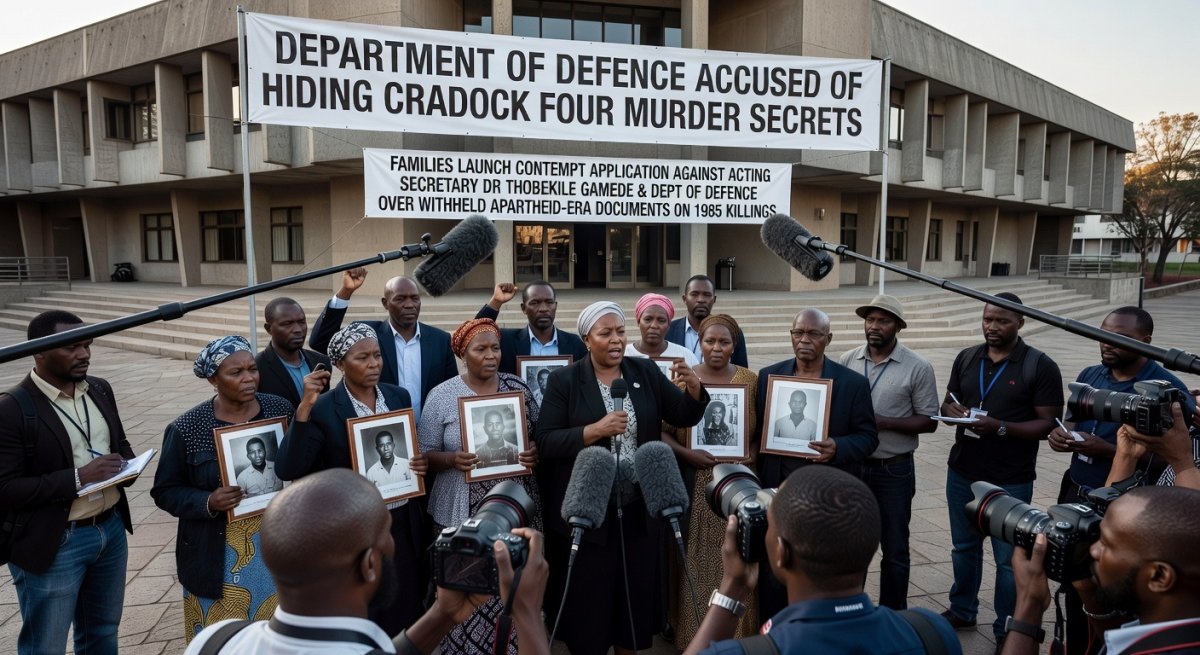
The families of the Cradock Four activists have launched a contempt of court application against Acting Secretary of Defence Dr Thobekile Gamede and the Department of Defence, accusing the state of deliberately withholding critical apartheid-era documents tied to the 1985 killings. This move comes at a moment when South Africa continues to grapple with incomplete accountability for state-sponsored violence during the final years of white minority rule, raising fresh questions about whether institutions are truly committed to transparency decades after the end of apartheid.
The application alleges that the Department of Defence has failed to comply with prior court orders requiring the release of records that could shed light on the planning and execution of the murders. Families argue that this obstruction prevents closure and undermines the very principles of justice that the post-apartheid state claims to uphold. At stake is not only historical truth but the credibility of mechanisms designed to address past atrocities.
The Legal Frontline
The contempt application represents a direct challenge to the Department of Defence’s handling of sensitive historical records. Court documents claim that despite repeated directives, key files remain inaccessible, effectively shielding individuals or structures that may have authorised or executed the operation against the activists. Legal experts note that contempt proceedings carry serious implications, including potential sanctions against officials, yet enforcement in cases involving state departments has historically been uneven.
This development forces a re-examination of how government agencies manage archives from the apartheid security apparatus. The Department of Defence, as custodian of military and intelligence-related materials, holds a unique position. Delays or refusals to release documents can be framed as administrative inertia, but the families contend the pattern suggests something more deliberate.
Apartheid’s Unfinished Business
South Africa’s transition to democracy included the Truth and Reconciliation Commission, which aimed to establish a comprehensive record of gross human rights violations. While many stories emerged, significant gaps remain, particularly around covert operations involving the defence and intelligence communities. The Cradock Four case sits at the centre of these gaps, symbolising the intersection of rural activism and state repression.
The current application highlights how access to records continues to determine whether families can obtain full narratives. Without the withheld documents, the precise chain of command and operational details stay obscured. This matters because incomplete records allow narratives of the past to remain contested, affecting public understanding and the possibility of institutional reform.
Institutional Resistance and Accountability
Critics argue that the Department of Defence’s approach reflects broader institutional reluctance to confront its apartheid legacy. Successive post-1994 administrations have faced accusations of slow progress on declassification, often citing national security or privacy concerns. In this instance, the families maintain that such justifications no longer hold after judicial rulings have already addressed those concerns.
The contempt application therefore tests the limits of executive compliance with judicial authority. If the court finds in favour of the applicants, it could set precedents for how other state departments handle similar requests. Conversely, a ruling that excuses further delays risks reinforcing perceptions that powerful institutions remain above full scrutiny.
Pathways Forward
The immediate next steps involve the court’s consideration of the contempt motion, which could result in orders compelling production of documents, fines, or other remedies. Beyond the courtroom, the case draws attention to ongoing calls for a more robust national archive policy that prioritises public access to apartheid-era records. Civil society organisations monitoring transitional justice issues will likely use this litigation as a reference point in future advocacy.
Ultimately, the families seek more than documents; they seek confirmation that the democratic state will not replicate the secrecy of its predecessor. How the Department of Defence and the judiciary respond will signal whether South Africa is prepared to close remaining chapters of its violent past or allow them to linger unresolved.
By Dante Williams, Staff Writer
This article was produced with AI-assisted research and editorial support. Reporting is based on sources cited in the article.
What's Your Reaction?
 Like
0
Like
0
 Dislike
0
Dislike
0
 Love
0
Love
0
 Funny
0
Funny
0
 Wow
0
Wow
0
 Sad
0
Sad
0
 Angry
0
Angry
0

Dante Williams
Breaking News and Investigations Correspondent at Global1.News. Based in London, covering global breaking news, security, and investigative stories. Known for digging deeper and connecting the dots across continents.















Comments (0)