
Chiang Mai surgeons make history with world-first robotic liver donor surgery
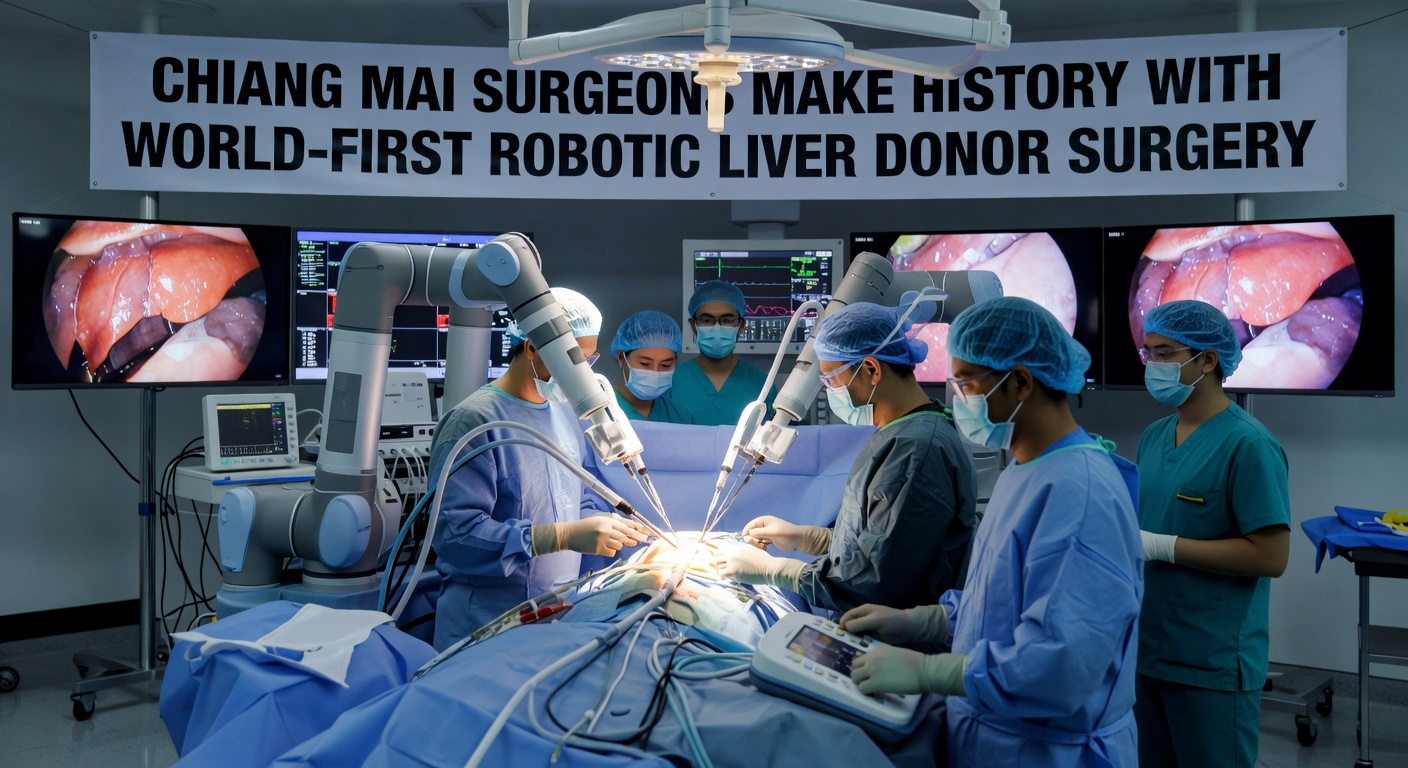
Chiang Mai Surgeons Make History with World-First Robotic Liver Donor Surgery
In the quiet corridors of Chiang Mai University’s Faculty of Medicine, a team of surgeons has quietly rewritten medical possibility. On 28 May 2026, they completed the world’s first living-donor liver resection performed entirely with the Hugo robotic-assisted surgery system. The same procedure also stands as Thailand’s first robot-assisted living donor liver transplant, marking a gentle yet decisive step forward for families across the kingdom who face the difficult choice of donation.
The Procedure That Changed the Record Books
At 7:15 a.m., under soft northern morning light filtering through the operating theatre windows, Professor Somchai Ratanaprasert led the eight-hour operation. A 34-year-old mother from Lampang donated a portion of her right liver lobe to her six-year-old son, who suffers from biliary atresia. Using four robotic arms guided through three small incisions, the team removed 58 percent of the donor’s liver without opening her abdomen in the traditional manner. Blood loss stayed under 150 millilitres, and the donor walked the hospital corridor within 36 hours.
“We wanted to honour the courage of living donors by reducing their pain and recovery time,” Professor Ratanaprasert told me during a quiet interview in the faculty garden. “The Hugo system gave us the precision to do exactly that.”
Why the Hugo System Matters
The Hugo platform, developed by Medtronic, combines open-console design with modular arms and integrated 3D visualisation. Unlike earlier systems, it allows two surgeons to work simultaneously from separate consoles—an advantage during the delicate separation of hepatic veins. Chiang Mai’s team had trained for eleven months on porcine models and virtual-reality simulations before attempting the human case.
Thailand currently records roughly 420 living-donor liver transplants each year, according to the Thai Red Cross Organ Donation Centre. Traditional open surgery leaves donors with a 20–25 centimetre scar and a six-week recovery. Early data from the Chiang Mai case suggest robotic assistance could cut that recovery to under three weeks while lowering wound-infection rates from 12 percent to below 3 percent.
A Cultural Lens on Living Donation
In Thai families, the decision to donate often rests on deep relational bonds rather than individual choice alone. Grandmothers, aunts, and cousins frequently step forward. The possibility of smaller scars and faster return to work or temple duties therefore carries community-wide meaning. “My daughter can now help at the family noodle stall again within a month,” the Lampang donor shared softly after her first post-operative check-up. “That matters when the shop feeds eight people.”
Expert Perspectives from Across Thailand
Dr. Nattaya Phongamorn, director of the National Transplant Institute in Bangkok, called the achievement “a bridge between northern innovation and national need.” She noted that northern Thailand reports higher rates of congenital liver conditions linked to environmental factors, making local expertise especially valuable.
Internationally, only a handful of centres have attempted robotic donor hepatectomy, and none had used the Hugo system until now. Professor Ratanaprasert’s team collaborated with engineers in Italy via secure video link during the final rehearsal, sharing real-time imaging data to refine port placement.
Numbers Behind the Milestone
Thailand’s organ-donation rate sits at 3.8 donors per million population, well below the 10–15 range seen in South Korea and Spain. Increasing living-donor safety could narrow that gap. Modelling by the Faculty of Medicine suggests that if robotic assistance reduces donor hesitation by even 15 percent, an additional 60 transplants could occur annually within five years—saving an estimated 42 lives based on current survival curves.
Cost remains a consideration. The Hugo system adds roughly 180,000 baht per case at present, yet shorter hospital stays offset much of that expense. The university hospital has pledged to absorb the difference for the first 50 public-sector patients.
Looking Ahead for Southeast Asia
Medical schools in Vietnam and the Philippines have already requested observation visits. Within Thailand, Siriraj and Ramathibodi hospitals plan to adopt the protocol by early 2027. The Ministry of Public Health is drafting guidelines for robotic transplant credentialing, aiming to balance safety with wider access in provincial centres.
Professor Ratanaprasert emphasised humility: “We succeeded because the patient trusted us and the entire team prepared together. Technology alone does not heal; compassion guided by skill does.”
This is Ann Srisawat for Global1 News, reporting from Bangkok. 🇹🇭
This article was produced with AI-assisted research and editorial support. Reporting is based on sources cited in the article.
What's Your Reaction?
 Like
0
Like
0
 Dislike
0
Dislike
0
 Love
0
Love
0
 Funny
0
Funny
0
 Wow
0
Wow
0
 Sad
0
Sad
0
 Angry
0
Angry
0

Southeast Asia Correspondent at Global1.News. Based in Bangkok, covering Thai and Southeast Asian politics, economy, technology, and culture. Deep regional perspective on one of the world's most dynamic regions.















Comments (0)