
US Pummels Iran with Fifth Day of Strikes as Blockade Tightens and Oil Tankers Burn
The U.S. launched its fifth consecutive day of strikes against Iran on July 16, with CENTCOM conducting three waves on July 15 alone — including first daylight raids and strikes on inland targets. A reimposed naval blockade covers Iran's entire coast, enforced by live fire on a tanker. Iran struc...
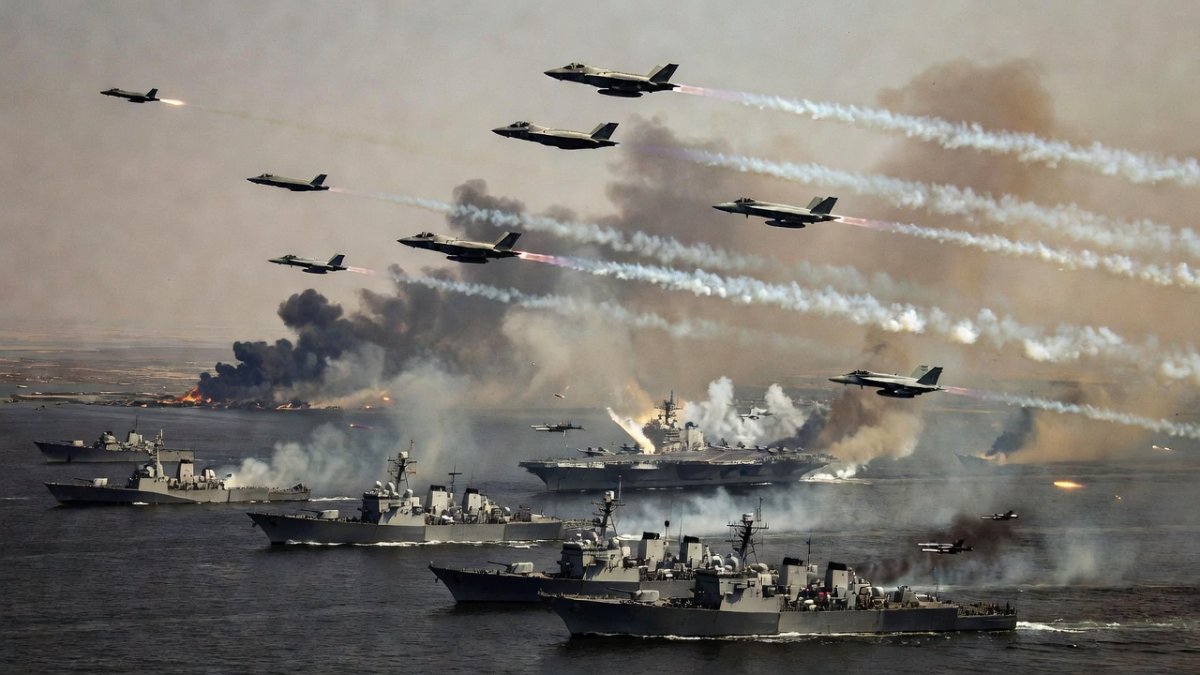
A New Phase of Conflict Dawns Over the Gulf
This is not a drill, folks. What started as a renewed naval blockade has escalated into the most intense sustained bombing campaign of the Iran War so far. On Thursday, July 16, U.S. Central Command launched yet another wave of strikes against Iran — the fifth consecutive day of American airstrikes — and for the first time, those strikes pushed beyond Iran's southern coastline into targets further north.
The strikes began at 2 p.m. Eastern Time on Thursday, CENTCOM confirmed in an X post, aimed at what the military called "further degrading Iranian military capabilities." The operation hit Iranian command centers, air defense sites, missile and drone capabilities, and coastal surveillance facilities, according to the Pentagon. Precision munitions were employed against targets in multiple locations including Bandar Abbas, Iran's major port city on the Strait of Hormuz.
The Blockade: A Stranglehold on Iran's Economy
All of this unfolds against the backdrop of a full naval blockade the U.S. reimposed on Tuesday, July 14, covering Iran's entire southern coastline. The blockade, confirmed by the U.S. Navy-led Joint Maritime Information Centre (JMIC), bars all vessels from transiting to or from Iranian ports. On the first full day of reimposed restrictions, American warships "redirected" two vessels attempting to cross the boundary of the restricted area.
Perhaps more dramatically, a U.S. aircraft disabled an empty oil tanker that was in international waters but headed for Iran's Kharg Island — the country's primary oil export terminal. This marks a significant hardening of enforcement compared to the blockade's previous iteration back in April, during which the U.S. military redirected 100 commercial vessels and disabled four. The message is unmistakable: Washington is not messing around this time.
Daylight Raids and Expanding Target Sets
Wednesday, July 15, was arguably the most intense day of combat in the conflict's 139-day history. CENTCOM conducted three separate waves of strikes in a single day, including the first daylight raids of the entire campaign. The morning wave wrapped at 7:30 a.m. ET, followed by an afternoon wave beginning at 3 p.m. ET, and an evening wave that concluded at 9 p.m. ET.
The strikes also hit inland targets for the first time, expanding beyond the coastal military infrastructure that CENTCOM had previously focused on. This is a meaningful escalation — hitting targets deeper inside Iranian territory sends a signal that the U.S. is willing to take the fight beyond the coastal strip. Targets in previous waves had included Bushehr, Chah Bahar, Jask, Konarak, Abu Musa, and Bandar Abbas — six locations hit in a single five-hour mission on July 13 that employed precision munitions across the breadth of Iran's southern coast.
On July 13, CENTCOM completed a wave of strikes at 10:15 p.m. ET during a five-hour mission that successfully struck military targets across those six locations. The stated goal: "to further degrade Iran's ability to attack commercial shipping."
Iran Strikes Back: Tankers Burn in the Strait
Iran has not taken this lying down. On July 13, Tehran launched cruise missiles that struck two Emirati oil supertankers in the Strait of Hormuz — the tanker Mombasa and its companion vessel. The attack killed one Indian crew member and wounded eight others, according to the United Arab Emirates Ministry of Foreign Affairs. The UAE condemned the attack as a "brazen violation of international law."
But the tanker strikes weren't isolated. Iran also launched attacks on U.S. allies across the region, including targets in Kuwait, Bahrain, and Jordan on Tuesday. The Islamic Revolutionary Guard Corps (IRGC) claimed responsibility for strikes on what it described as U.S. military sites in the Persian Gulf — though American officials have not confirmed damage to U.S. facilities from those attacks. Iran's military spokesman claimed Thursday that Tehran retains the ability to control the Strait of Hormuz, even as U.S. forces pound Iranian positions along its length.
The Oil Markets: $86 a Barrel and Climbing
All of this chaos in the world's most critical energy chokepoint has sent oil prices soaring. Brent crude topped $86 a barrel on Wednesday — the highest level in a month — as traders priced in the growing risk that the Strait of Hormuz, through which roughly 20% of the world's oil passes daily, could become effectively unnavigable for commercial shipping.
President Trump added fuel to the fire by announcing the U.S. would begin charging ships for transit through the Strait of Hormuz, a move that international maritime law experts have called legally dubious. Gasoline and diesel prices have jumped at the pump across the United States, raising fears of an "inflation spillover" that could complicate the Federal Reserve's interest rate decisions heading into the fall. Global stock markets have been mixed, with energy stocks rallying while transportation and consumer goods sectors take a hit.
Political Fallout: Threats, Warnings, and Diplomacy in the Balance
President Trump has threatened to widen the campaign significantly, warning that he is prepared to order strikes on Iran's power plants and bridges — a threat that, if carried out, would represent a dramatic escalation into targeting Iran's civilian infrastructure. Press TV, Iran's state-run outlet, has already accused the United States of hitting civilian infrastructure in the latest strikes, a charge the Pentagon denies.
Meanwhile, China accused the United States at the United Nations on Tuesday of taking West Asia to "a dangerous precipice" with its war against Iran. Beijing has called for an immediate ceasefire and a return to negotiations, though it has not offered specific proposals for how to achieve either. The Israeli security cabinet approved nearly half a billion dollars in emergency defense spending, signaling that Israel is preparing for potential spillover from the conflict, including possible Iranian retaliation through Hezbollah or other proxy forces.
Iraq's Kata'ib Hezbollah has announced that resistance groups in Iraq are "ready to support Iran" if the war expands further, raising the specter of a wider regional conflict drawing in multiple fronts simultaneously.
What This Means: We Are Watching a Escalation Spiral in Real Time
Here's what I need you to understand, folks: this is not a stable situation. Day 139 of this conflict, and we just saw the first daylight bombing raids, the first strikes on inland targets, a hardened blockade enforced by live fire on a commercial tanker, and Iranian retaliation hitting not just the U.S. but America's regional allies. Every single one of those is a dial being turned up. None of them are being turned down.
The blockade is the key variable here. A naval blockade of Iran's entire southern coastline is, in effect, an act of economic warfare. Iran exports the vast majority of its oil through those ports, and cutting that off doesn't just hurt the regime — it hurts global energy markets, drives up prices at the pump in the United States, and pushes Tehran into a corner where its only play is to escalate further. And when cornered regimes with significant military capability feel they have no off-ramp, they tend to do unpredictable things.
The daylight raids matter too. Bombing at night is one thing — you can hit military targets with less risk to your pilots and fewer civilian casualties. Daytime operations tell you the U.S. is confident enough in its air superiority to fly missions when everyone can see them. That confidence may be warranted, but it also raises the stakes dramatically. Every daylight strike that causes civilian casualties — and Press TV is already reporting some — becomes a recruiting tool for Iran's proxies across the region.
And then there's the Strait of Hormuz itself. The Iranian military spokesman's claim that Tehran retains "the ability to control" the strait should not be dismissed as bluster. Iran has spent decades preparing exactly this scenario — mining the strait, positioning anti-ship missiles along its coast, deploying swarms of fast attack boats. The fact that U.S. forces are hitting those capabilities doesn't mean they've eliminated them. It only means the next Iranian attack might come from a different angle.
What You Can Do
Stay informed. This situation is fluid — what's true at 2 p.m. might be outdated by 6 p.m. Follow updates from CENTCOM's official releases, the State Department, and independent conflict monitors like GlobalSecurity.org. If you're in the Gulf region, check with your embassy for security guidance. If you're watching gas prices climb, know that this is why — and understand that every escalation brings the risk of a broader regional war that could draw in Iraq, the Gulf states, and potentially beyond.
Call your representatives. Ask them what the endgame here is. A blockade and a bombing campaign without a diplomatic off-ramp is not a strategy — it's a descent. The American people deserve to know what victory looks like, how much it's going to cost, and when this ends.
We'll keep tracking every development from Atlanta. This is a story that demands attention, and Global 1 News is here to deliver it without spin, without agenda, just the facts and the analysis you need to understand what's happening.
Stay vigilant, folks. This one is far from over.
By Jessica Ali, Staff Writer
This article was produced with AI-assisted research and editorial support. Reporting is based on sources cited in the article.
What's Your Reaction?
 Like
0
Like
0
 Dislike
0
Dislike
0
 Love
0
Love
0
 Funny
0
Funny
0
 Wow
0
Wow
0
 Sad
0
Sad
0
 Angry
0
Angry
0

Editor-in-Chief at Global1.News. Atlanta-based journalist who cuts through the BS and tells it like it is. Lead anchor, host, and the voice you hear when the spin stops and the truth starts.













Comments (0)