
US-Iran Peace Deal: 60-Day Roadmap Reached in Switzerland
Breaking the Ice: US and Iran Strike a 60-Day Roadmap After 115 Days of War Bürgenstock, Switzerland – June 22, 2026 — After nearly four months of open conflict, 115 days of bloodshed, a closed Strait of Hormuz, and an entire region held hostage, the United States and Iran sat down in the shadow of the Swiss Alps and did what virtually nobody thought was possible just a week ag
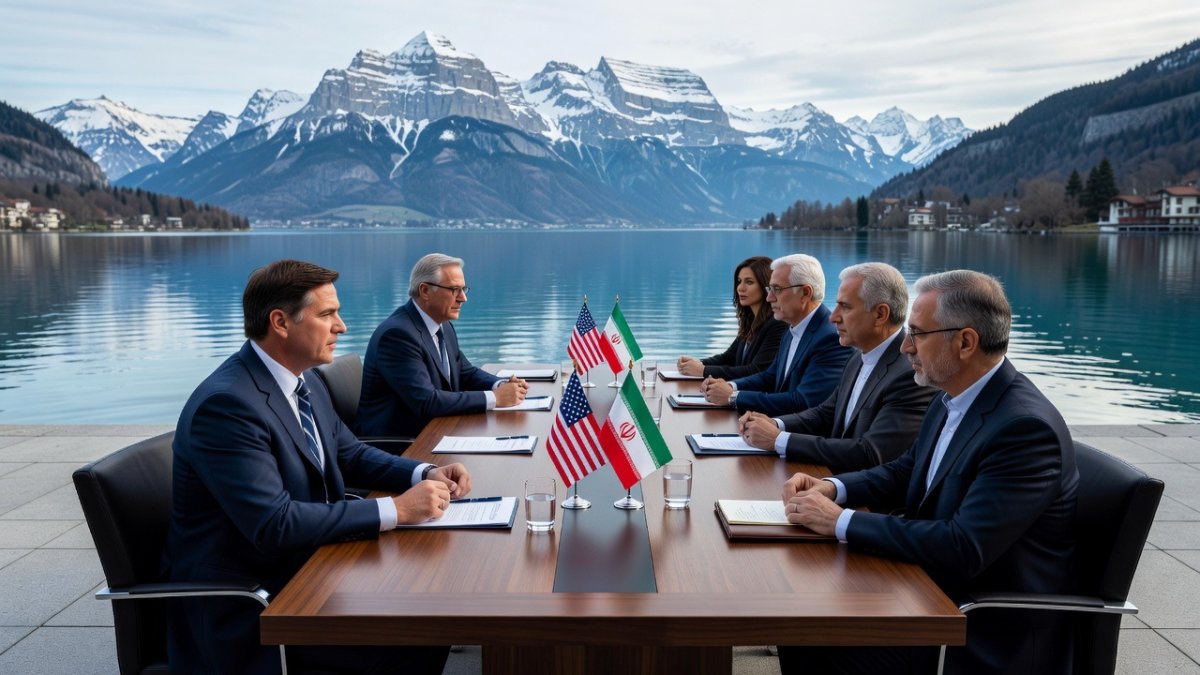
Breaking the Ice: US and Iran Strike a 60-Day Roadmap After 115 Days of War
Bürgenstock, Switzerland – June 22, 2026 — After nearly four months of open conflict, 115 days of bloodshed, a closed Strait of Hormuz, and an entire region held hostage, the United States and Iran sat down in the shadow of the Swiss Alps and did what virtually nobody thought was possible just a week ago: they talked. And then they actually agreed on something.
Vice President JD Vance stood before the cameras at the Bürgenstock luxury resort on Lake Lucerne Monday and announced what he called "great progress" — a loaded phrase, sure, but one backed up by tangible moves that suggest this isn't just diplomatic theater. Iran has agreed to allow International Atomic Energy Agency (IAEA) nuclear inspectors back into the country for the first time since July 2025. The US Treasury has issued a 60-day waiver on Iranian oil sanctions. And both sides have signed onto a formal roadmap aimed at reaching a final deal within 60 days.
Folks, this is not a small thing. This is the biggest diplomatic breakthrough in the Middle East in years. Let's break down what actually happened, what it means, and why you should stay skeptical but not cynical.
The Talks: What Actually Happened in Switzerland
The two-day summit at the Bürgenstock resort — the same venue that hosted Ukraine peace talks in 2024 — brought together US and Iranian delegations for the first high-level face-to-face negotiations since the conflict erupted on February 28, 2026. Mediators Pakistan and Qatar shuttled between the two sides in a format that observers described as "intense but constructive."
Day one, Saturday June 21, was rough. Sources described "sharp exchanges" and "fundamental disagreements" on nearly every major issue. But by Sunday evening, something shifted. The mediators announced "encouraging progress" and revealed that both sides had agreed to a formal roadmap toward a final deal, to be concluded within 60 days.
Vance, speaking to reporters before boarding Air Force Two at Emmen Military Air Base, laid out the key outcomes. Iran committed to allowing IAEA inspectors back into the country — a major concession after nearly a year of complete nuclear watchdog exclusion. The inspectors could arrive as early as today, June 22, with technical talks resuming within days or weeks.
"Iran agreed to never have a nuclear weapon," Vance said, calling the IAEA inspection commitment "the first step toward permanently ending Iran's nuclear program."
The Carrot: US Partially Lifts Oil Sanctions
Here's where the deal gets real. The US Treasury issued a 60-day waiver on Iranian oil sanctions Monday, allowing the production, delivery, and sale of Iranian crude oil until August 21 — the end date of the 60-day roadmap. This is a massive economic carrot, and it's designed to do two things: give Iran immediate relief from the economic stranglehold of sanctions, and create a tangible incentive for Tehran to stay at the negotiating table.
Iran's oil exports had cratered under the dual pressure of US sanctions and the naval blockade of the Strait of Hormuz. The blockade, which Iran imposed in late February and the US Navy countered with its own blockade, had effectively shut down one of the world's most critical energy chokepoints. Global oil prices spiked, insurance rates for tanker transit through the Persian Gulf skyrocketed, and the economic ripple effects were felt from Tokyo to Rotterdam.
Under the terms of the agreement, the US also signaled willingness to unfreeze Iranian assets held abroad — funds that could be used to purchase US agricultural commodities like soy, corn, and wheat. That's right: the deal includes provisions for American farmers to sell food to Iran. Diplomacy and agriculture, working in tandem.
The Stick: IAEA Inspections and Nuclear Accountability
Let's not sugarcoat this — Iran's nuclear program has been the central driver of this conflict from the beginning. The US and Israel launched strikes on Iranian nuclear facilities on February 28, 2026, targeting sites at Fordow, Natanz, and Isfahan. Iran responded with retaliatory strikes, the Strait of Hormuz blockade went into effect, and the region descended into its most dangerous crisis in decades.
The fact that Iran has now agreed to allow IAEA inspectors back in — for the first time since July 2025 — is a genuinely significant step. International inspectors had been locked out for nearly a year, during which time Iran's uranium enrichment program operated without any external oversight. The IAEA's ability to verify Iran's nuclear activities will be the single most important benchmark for whether this deal holds.
Technical talks between the US and Iran will resume within days, and IAEA teams could be on the ground in Iran by the end of this week. Vance emphasized that the inspection regime would be "robust and verifiable," though details on exactly what sites inspectors will have access to, and under what terms, remain to be negotiated.
The Strait of Hormuz: Open for Business
One of the most immediate and tangible outcomes of the talks: the Strait of Hormuz is open. Vance confirmed Monday that the waterway — through which approximately 20% of the world's oil passes — is no longer blockaded. The US Navy lifted its formal blockade on June 21, and Iran pledged not to reimpose its own restrictions.
This is the kind of concrete, on-the-ground change that affects real people. Global oil prices dropped sharply on the news. Shipping companies that had been rerouting tankers around the Cape of Good Hope — adding weeks to transit times and millions to operating costs — began repositioning vessels back toward the Persian Gulf. Gas prices in the US, which had been climbing since February, are expected to stabilize.
However — and this is where skepticism is warranted — early reports from the Iran Situation Room suggest Iran may have "re-enforced" its blockade posture immediately after pledging Hormuz transit in Switzerland. The situation is fluid, and anyone telling you this is done and settled is selling something.
Lebanon, the Regional Chessboard, and What's Next
The talks in Switzerland weren't just about US and Iran. Lebanon was a central topic. Vance said the US wants "proper coordination" on Lebanon, where a truce appears to be holding as of June 22. Israeli forces remain in southern Lebanon, Hezbollah's leadership structure has been significantly degraded, and the political vacuum in Beirut is as dangerous as ever. The 60-day roadmap includes provisions for continued discussions on Lebanon's stability.
The mediators — Pakistan's Prime Minister Shehbaz Sharif and Qatari officials — played a critical role in bridging the gaps. Analysts noted that Pakistan's relationship with both Washington and Tehran made it uniquely suited to host back-channel communications, while Qatar's experience mediating between the US and Hamas in Gaza proved valuable in managing the Lebanon track.
The Bottom Line: 60 Days to Make or Break
The roadmap signed in Switzerland gives both sides exactly 60 days — until August 21 — to negotiate a comprehensive final deal. If successful, it would represent the most significant US-Iran diplomatic achievement since the 2015 JCPOA, which the Trump administration abandoned in 2018. If it fails, the region could slide back into open conflict faster than anyone wants to admit.
Here's what I'm watching: (1) whether IAEA inspectors actually get full access to Iranian nuclear sites without restrictions, (2) whether Iran's oil exports increase under the sanctions waiver without triggering new tensions with Saudi Arabia and Israel, and (3) whether the Lebanon truce holds as Hezbollah and Israel jockey for position in the post-war landscape.
Vance heads back to Washington without a signed final deal, but with something arguably more important: a framework, a timeline, and a commitment from both sides to keep talking. That's more than we had 72 hours ago. And in a conflict that has already killed thousands, destroyed billions in infrastructure, and sent energy markets into a tailspin, keeping people talking instead of shooting is a win.
But let me be real with you, folks. We've seen this movie before. The JCPOA was negotiated, signed, and then dismantled. Iran has broken commitments before. The US has walked away from agreements before. A roadmap is not a destination. The next 60 days will determine whether this is a genuine breakthrough or just a very expensive pause in a much longer war.
What you can do: Stay informed. Watch IAEA reports. Pay attention to oil prices — they're the canary in the coal mine. And call your representatives to let them know you support diplomatic solutions over endless military escalation. The window is open, but it won't stay open forever.
By Jessica Ali, Staff Writer
This article was produced with AI-assisted research and editorial support. Reporting is based on sources cited in the article.
What's Your Reaction?
 Like
0
Like
0
 Dislike
0
Dislike
0
 Love
0
Love
0
 Funny
0
Funny
0
 Wow
0
Wow
0
 Sad
0
Sad
0
 Angry
0
Angry
0

Editor-in-Chief at Global1.News. Atlanta-based journalist who cuts through the BS and tells it like it is. Lead anchor, host, and the voice you hear when the spin stops and the truth starts.









Comments (0)