
US-Iran Talks Advance in Switzerland — Diplomats Agree on 60-Day Roadmap to Final Deal
In a recent BBC News report, an update on the US-Iran peace process revealed that the first round of face-to-face negotiations between the two sides concluded with significant progress, as mediators Qatar and Pakistan announced a 60-day roadmap toward a final agreement. The talks, held at the Bürgenstock luxury resort overlooking Lake Lucerne in Switzerland, marked the first di
In a recent BBC News report, an update on the US-Iran peace process revealed that the first round of face-to-face negotiations between the two sides concluded with significant progress, as mediators Qatar and Pakistan announced a 60-day roadmap toward a final agreement. The talks, held at the Bürgenstock luxury resort overlooking Lake Lucerne in Switzerland, marked the first direct engagement since the landmark memorandum of understanding signed last week, and set the stage for what could become the most consequential diplomatic realignment in the Middle East in decades.
US-Iran Talks Advance in Switzerland — Diplomats Agree on 60-Day Roadmap to Final Deal
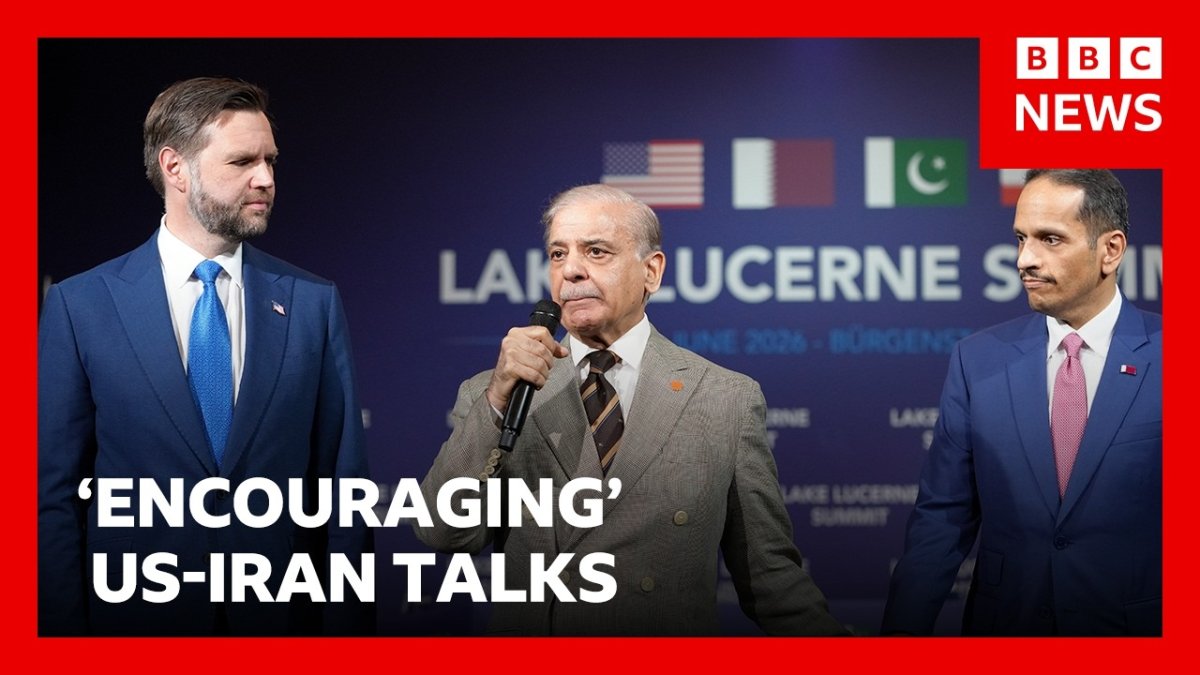
Bürgenstock, Switzerland – 22 June 2026 — The first round of direct negotiations between the United States and Iran ended on Monday with both sides reporting measurable progress, as Qatari and Pakistani mediators announced a structured timeline for reaching a comprehensive peace accord. The talks, hosted at the historic Bürgenstock resort complex overlooking Lake Lucerne, brought together delegations led by US Vice-President JD Vance and Iran's lead negotiator Mohammad Bagher Ghalibaf, alongside representatives from Pakistan, led by Prime Minister Shehbaz Sharif, and Qatari mediators.
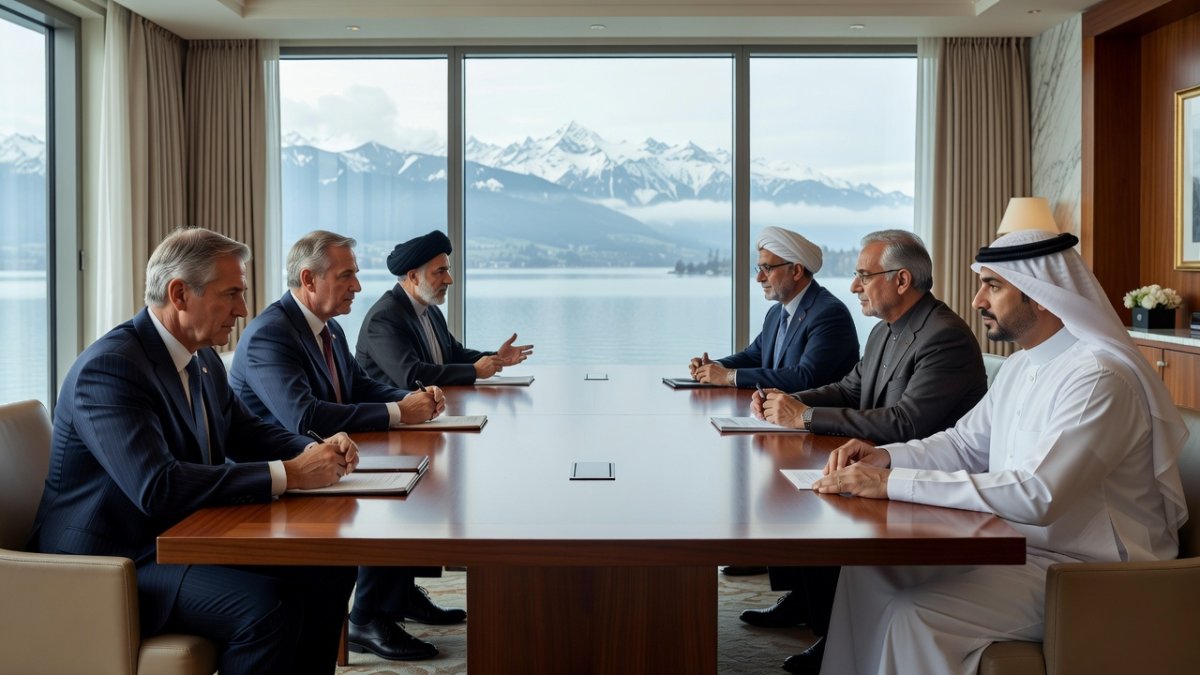
The 60-Day Roadmap and Its Core Elements
Mediators from Qatar and Pakistan issued a joint statement early Monday outlining the 60-day roadmap. The framework focuses on implementing the memorandum of understanding signed last week, which calls for ending fighting on all fronts and reopening the Strait of Hormuz.
Key steps include establishing a communication line for safe passage through the strait and forming a de-confliction cell involving the United States, Iran, and Lebanon to halt military operations. Both sides described the initial discussions as having produced encouraging progress toward a final deal. The roadmap’s architecture is deliberately sequenced to prioritize immediate de-escalation measures before tackling more intractable issues. By front-loading the Strait of Hormuz reopening and the Lebanon de-confliction cell, negotiators aim to generate early confidence-building outcomes that can sustain political momentum inside both Washington and Tehran. The Bürgenstock venue itself carries symbolic weight; its history as a site for high-stakes European diplomacy lends an aura of seriousness that both delegations have publicly welcomed. Structurally, the 60-day timeline divides into three overlapping phases: verification of initial ceasefires, operationalization of maritime safety protocols, and preparation of a monitoring mechanism for the de-confliction cell. Analysts interpret this sequencing as an attempt to insulate the process from domestic spoilers on either side. While the precise mandate of the de-confliction cell remains under negotiation, its tripartite composition signals an effort to embed Lebanese authorities directly in day-to-day risk management rather than treating Lebanon as a passive arena. Such design choices reflect lessons from earlier, less durable truces that collapsed when local actors were excluded from implementation structures.

Strait of Hormuz Reopening and Energy Market Effects
Iran announced closure of the Strait of Hormuz on Saturday, yet tracking data indicates vessels continue to pass through the waterway that carries 20 percent of the world's oil and gas. The roadmap addresses this by lifting the blockade and waiving restrictions on oil and petrochemical exports.
Frozen Iranian assets would be released under the plan, alongside a $300 billion reconstruction package. These measures could stabilize global energy supplies if fully implemented, though officials in Washington DC and Tehran have yet to confirm timelines for asset transfers. Market participants are already pricing in the possibility of sustained Iranian crude returning to global markets. Should the roadmap hold, analysts expect downward pressure on Brent crude benchmarks, particularly if the $300 billion reconstruction package accelerates Iranian export capacity. The energy dimension also intersects with broader geopolitical calculations: Russia and China have watched the Bürgenstock process closely, concerned that renewed Iranian supply could erode their own market leverage. From Tehran’s perspective, the waiver of export restrictions represents a pragmatic lifeline after years of sanctions pressure, while Washington views the same provisions as leverage to encourage Iranian restraint elsewhere. The de-confliction cell’s maritime component is expected to include real-time vessel tracking shared among the three parties, reducing miscalculation risks that have historically spiked insurance premiums. If operationalized effectively, this mechanism could serve as a template for future chokepoint management. Yet the absence of confirmed timelines for asset unfreezing continues to inject uncertainty; traders remain wary that political reversals could re-trigger volatility. In this sense, the roadmap’s energy provisions function simultaneously as economic relief valve and geopolitical signaling device.
Lebanon Ceasefire Developments and Hezbollah-Israel Dynamics
A Hezbollah-Israel ceasefire was declared on Friday, but clashes persist in southern Lebanon. Iran's Foreign Minister Seyed Abbas Araghchi stated there had been major progress toward ending the Lebanon conflict during the Bürgenstock sessions.
Israeli Prime Minister Benjamin Netanyahu has indicated that military forces will remain in southern Lebanon as long as necessary. Lebanese President Joseph Aoun has been referenced in de-confliction efforts, while health ministry figures report at least 4,106 killed in Lebanon since March 2, with Israel stating 36 soldiers and 4 civilians killed on both sides. The persistence of low-level clashes underscores the fragility of any arrangement that does not address Hezbollah’s forward deployments. The proposed de-confliction cell is intended to create a standing channel through which Iranian, American, and Lebanese representatives can adjudicate incidents before they escalate. This mechanism represents a structural innovation compared with previous monitoring arrangements that relied on UNIFIL alone. Israeli insistence on maintaining a security buffer reflects deep skepticism that Hezbollah will fully withdraw from the border zone without sustained external pressure. From Tehran’s vantage point, progress on Lebanon is framed as validation that its regional posture can be defended without direct confrontation. Lebanese President Joseph Aoun’s inclusion in the cell is viewed by some analysts as an attempt to restore state authority over southern territory, though the practical reach of Beirut’s writ remains limited. The casualty figures cited by both sides illustrate the human cost that continues to shape domestic political constraints on all parties. Any durable ceasefire will therefore require not only military de-escalation but also credible economic incentives tied to the broader reconstruction package.
Iranian Perspective from Lead Negotiators
Mohammad Bagher Ghalibaf, Iran's lead negotiator, participated directly in the Bürgenstock meetings alongside Prime Minister Shehbaz Sharif of Pakistan. Iranian officials emphasized that the talks represent a pragmatic step without yielding core positions.
Seyed Abbas Araghchi highlighted the major progress achieved on Lebanon-related issues. Tehran maintains that its nuclear programme remains peaceful, separating this topic from the current roadmap. Iranian commentary has stressed that engagement at Bürgenstock does not signal a wholesale strategic pivot but rather a tactical recalibration aimed at relieving immediate economic pressure. By securing a seat at the table for Pakistan and Qatar, Tehran has diversified its diplomatic channels beyond traditional European intermediaries. This approach aligns with a long-standing preference for multipolar mediation that dilutes American unilateral leverage. Ghalibaf’s direct participation alongside Prime Minister Sharif signals the importance Tehran attaches to Islamabad’s role in balancing Gulf and South Asian interests. Meanwhile, Foreign Minister Araghchi’s emphasis on Lebanon progress is calibrated for domestic audiences who view Hezbollah support as a core element of regional deterrence. The decision to bracket nuclear questions for later rounds further protects Iranian negotiators from accusations of compromising on sovereignty. In this framing, the 60-day roadmap functions as a limited instrument for crisis management rather than a comprehensive settlement. Observers note that such calibrated messaging allows Tehran to maintain internal cohesion while testing whether Washington can deliver tangible sanctions relief.
Nuclear Programme Set Aside for Later Negotiations
The nuclear issue was explicitly left for future rounds under the 60-day framework. Iran continues to insist its programme serves only peaceful purposes, while US Vice-President JD Vance expressed willingness to fundamentally transform the bilateral relationship if Iran ceases to act as a driver of regional instability.
This separation allows immediate focus on the memorandum of understanding provisions, including the Strait of Hormuz measures and Lebanon de-confliction cell, without immediate entanglement in nuclear verification questions. The deliberate sequencing reflects recognition that nuclear verification poses uniquely complex technical and political challenges. Past attempts to link maritime and regional security issues directly to enrichment limits have repeatedly stalled. By isolating the nuclear file, negotiators hope to accumulate sufficient trust through smaller agreements before confronting the verification regime required by any renewed JCPOA-style arrangement. US Vice-President Vance’s conditional offer of a transformed relationship underscores Washington’s insistence that behavioral change in Lebanon, Iraq, and Yemen must accompany any nuclear understanding. Iranian officials, for their part, have reiterated that enrichment activities remain under IAEA safeguards and are not subject to the current roadmap. This stance preserves negotiating space for future rounds while shielding the programme from immediate concessions. The verification challenge will likely center on access modalities, centrifuge counts, and stockpile monitoring—issues that historically required protracted technical talks. Keeping these questions bracketed for now reduces the risk that early disagreements derail the more achievable elements of the 60-day plan.
Regional Geopolitical Shifts and External Implications
The Bürgenstock outcome could reshape energy corridors and influence power balances involving multiple regional actors. Pakistan's role through Prime Minister Shehbaz Sharif underscores its mediating position, while Qatari involvement highlights ongoing Gulf diplomatic channels.
Analysts suggest these developments may affect Russia's strategic calculations in energy markets and Middle East influence, given longstanding Kremlin interests in alternative supply routes and alliances. Perspectives from Washington DC and Tehran indicate cautious optimism, balanced against Israeli concerns voiced by Prime Minister Netanyahu about security guarantees in Lebanon. The re-emergence of direct US-Iran channels also carries implications for China’s regional posture, as Beijing has cultivated economic ties with Tehran that could be affected by any sanctions relief. Pakistan’s mediation role further illustrates its desire to project influence beyond South Asia, leveraging its relationship with both Riyadh and Tehran. From Moscow’s perspective, any sustained reopening of Iranian oil exports risks undercutting Russian market share in Asia, particularly if reconstruction funds accelerate Iranian production capacity. Israeli caution, meanwhile, centers on ensuring that Lebanese border arrangements do not evolve into a de-facto Iranian foothold. The Bürgenstock process thus sits at the intersection of energy security, alliance management, and great-power competition. Its success or failure will be measured not only by whether the 60-day roadmap produces a signed accord but also by whether the resulting equilibrium accommodates the interests of secondary actors whose cooperation will ultimately determine durability.
By Irina Volkov, Staff Writer
This article was produced with AI-assisted research and editorial support. Reporting is based on sources cited in the article.
What's Your Reaction?
 Like
0
Like
0
 Dislike
0
Dislike
0
 Love
0
Love
0
 Funny
0
Funny
0
 Wow
0
Wow
0
 Sad
0
Sad
0
 Angry
0
Angry
0

Russia/Eastern Europe Correspondent at Global1.News. Covering Russian politics, energy, security, and the shifting dynamics of the post-Soviet space. Provides clear-eyed analysis on one of the world's most opaque regions.










Comments (0)