
The Yazidi Genocide and the Doctor Who Refuses to Look Away
The Yazidi Genocide and Its Enduring Shadow The attack on Sinjar began on 3 August 2014 when Islamic State militants overran the northern Iraqi town and surrounding villages in a coordinated assault that targeted one of the region's oldest religious minorities. Within days, at least 12,000 Yazidis were killed or kidnapped as part of a systematic campaign that the United Nations
The Yazidi Genocide and Its Enduring Shadow
The attack on Sinjar began on 3 August 2014 when Islamic State militants overran the northern Iraqi town and surrounding villages in a coordinated assault that targeted one of the region's oldest religious minorities. Within days, at least 12,000 Yazidis were killed or kidnapped as part of a systematic campaign that the United Nations has designated an ongoing genocide. The militants specifically targeted the Yazidi community for its faith, which centres on belief in Yasdan and the reverence of the Peacock Angel Melek Tawwus — doctrines IS fighters denounced as devil worship to justify mass killing and enslavement.
Yazidi families were separated at gunpoint across Sinjar mountain and the surrounding plain. Men and older boys were executed in summary killings while women and girls were taken into captivity, transported to IS-held cities such as Mosul and Tal Afar, and sold in slave markets. The scale of the assault displaced tens of thousands who fled without water or shelter across the mountain into the Kurdistan Region of Iraq. Many survivors remain in camps around Duhok to this day, their lives defined by unresolved loss and the absence of formal accountability mechanisms for the crimes committed against them.
The genocide's effects continue to shape daily existence for the community. Economic disruption, restricted access to ancestral lands around Sinjar, and the systematic destruction of Yazidi religious sites have compounded the psychological trauma. International recognition of the events as genocide by the United Nations, the European Parliament, and the United States has not yet translated into comprehensive reparations programmes or the safe return of all displaced families to their original homes. Without meaningful accountability and reconstruction, the damage inflicted in 2014 continues to reverberate through every aspect of Yazidi life.
Shireen's Ordeal as a Window into Captivity
Shireen was nineteen years old when Islamic State militants seized her from her home in Sinjar during the coordinated assault that began on 3 August 2014, an event that tore apart countless Yazidi families in a matter of hours and initiated a period of systematic enslavement for thousands of women and girls. She was transported first to Tal Afar where she was sold in a market that treated human beings as commodities, and then she was moved onward to the house of a fighter identified as Abu Omar in Mosul, where she endured two full years of captivity marked by isolation and repeated violations of her autonomy. During this time she was subjected to forced conversion to the militants' interpretation of Islam, a process imposed through coercion and surveillance that aimed to erase her Yazidi identity and religious practices that had sustained her community for generations.
Two young Yazidi girls were also brought to the same household in Mosul, creating a small circle of shared suffering in which the captives attempted to maintain fragments of their cultural memory despite constant threats and restrictions on movement or communication. The presence of these children underscored the breadth of the targeting that extended even to the youngest members of the Yazidi population, whose futures were interrupted by the same machinery of abduction and sale that had claimed Shireen. Conditions inside the house combined physical confinement with psychological pressure, leaving little room for resistance or escape until external military operations altered the balance of control in the region.
Liberation arrived for Shireen in 2016 when advancing forces reached the area and enabled her removal from the house, yet the transition to freedom brought its own challenges including profound depression that settled over her daily life and complicated efforts to rebuild a sense of normalcy. Many of her family members remained missing after the initial separations on Sinjar mountain, their fates unknown and their absence creating a persistent void that no amount of physical safety could immediately fill. The combination of trauma from captivity and the uncertainty surrounding relatives has continued to shape her recovery, illustrating how individual stories reflect the wider pattern of loss that defines the Yazidi experience years after the peak of the violence.
Dr Nagham Nawzat's Care at the Duhok Survivors' Centre
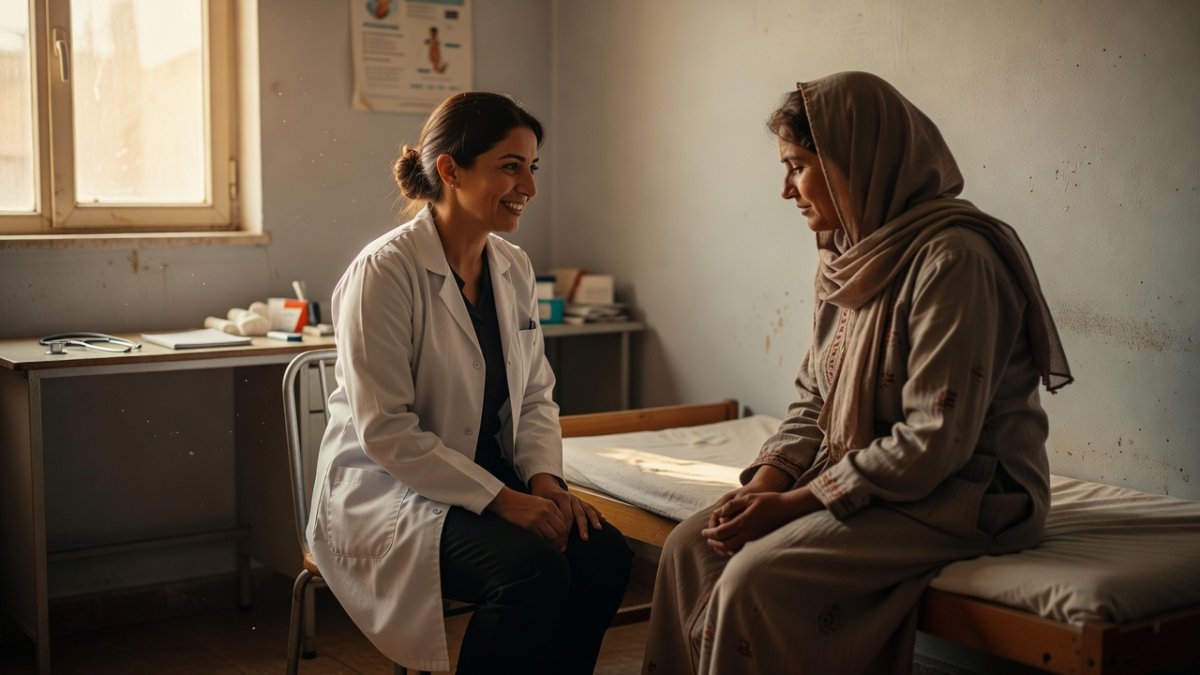
Dr Nagham Nawzat, a forty-two-year-old Yazidi gynaecologist, has dedicated her professional efforts to addressing the medical and psychological consequences of sexual violence experienced by survivors who escaped Islamic State captivity, employing a post-traumatic approach that prioritises both physical examinations and attentive listening during each consultation. Her work at the Duhok Survivors' Centre recognises that recovery requires more than clinical treatment alone, as many women arrive carrying the weight of experiences that affect their ability to trust medical personnel or articulate their needs without fear of judgment. This integrated method allows patients to receive care in an environment designed to restore dignity while documenting the health impacts that persist long after liberation from captivity.
The centre stands as the only facility in Iraq specifically equipped to handle cases of gender-based violence arising from the conflict, offering specialised services that are otherwise unavailable in the country's fragmented health system still recovering from years of instability. Funding from the United Nations Population Fund has enabled the centre to operate consistently, providing resources for examinations, counselling, and follow-up support that address both immediate injuries and longer-term reproductive health concerns. Without this dedicated space, many survivors would lack access to providers who understand the cultural context of the Yazidi community and the specific forms of trauma inflicted during the 2014 attacks.
Since its establishment the centre has treated approximately 1,200 survivors, a figure that reflects both the scale of the violence and the gradual process through which women have come forward to seek assistance despite ongoing stigma and logistical barriers to travel from displacement camps. Each case requires careful attention to individual histories, and the staff maintain detailed records that support future accountability efforts while ensuring that care plans remain responsive to changing needs over time. The presence of a Yazidi gynaecologist in this role has helped build trust among patients who might otherwise hesitate to disclose sensitive information to outsiders unfamiliar with their community's traditions and recent history.
International Recognition for Sustained Advocacy
In March 2016 Dr Nagham Nawzat received the International Women of Courage Award from then United States Secretary of State John Kerry, an honour that acknowledged her persistent efforts to provide medical care and advocate for survivors of the Yazidi genocide amid ongoing displacement and limited institutional support. The recognition highlighted the importance of specialised services in post-conflict settings where conventional health infrastructure often overlooks the needs of women who have endured sexual enslavement and forced conversion. Such awards draw global attention to the work being done in northern Iraq, yet they also underscore the gap between international acknowledgment and the sustained funding required to expand similar facilities across the region.
Figures compiled by Hussein al-Qaidi indicate that 2,023 women had been liberated by July 2018, a statistic that demonstrates the partial success of rescue operations while revealing how many individuals remain unaccounted for years after the initial abductions from Sinjar. These numbers serve as a reminder that liberation represents only the beginning of a complex recovery process that involves medical treatment, psychological support, and efforts to locate missing relatives scattered across multiple countries. Dr Nawzat's advocacy has consistently emphasised that statistical progress must be matched by concrete improvements in services available to those who return.
Born in Mosul in 1976, Dr Nawzat completed her medical training at Mosul Medical College in 2002 before the escalation of conflict forced many professionals to relocate and adapt their practices to emergency conditions in the Kurdistan Region. Her background in gynaecology equipped her to address the reproductive health consequences of captivity, and her decision to focus on Yazidi survivors reflects a commitment to serving her own community during a period when displacement had severed many families from their traditional support networks. This combination of personal heritage and professional expertise has positioned her as a central figure in documenting and treating the long-term effects of the violence that began in 2014.
The Ongoing Crisis Facing the Yazidi Community
Many Yazidi families continue to search for relatives who were separated during the 2014 attacks on Sinjar, with the absence of formal mechanisms for tracing missing persons leaving survivors in a state of prolonged uncertainty that affects mental health and community cohesion. Displacement in camps around Duhok has become a semi-permanent reality for tens of thousands of people whose ancestral lands remain insecure or inaccessible due to ongoing political and security challenges in the region. Limited services in these camps, including shortages of specialised mental health care and educational opportunities, compound the difficulties of rebuilding lives interrupted by genocide and enslavement.
Economic conditions in the camps and surrounding areas remain strained, with restricted access to employment and agricultural land preventing many families from achieving self-sufficiency years after their displacement. The destruction of religious sites and homes in Sinjar has further complicated return efforts, as communities weigh the risks of resettlement against the safety provided by established camp infrastructure. Without targeted investment in reconstruction and livelihood programmes, the economic marginalisation that followed the genocide threatens to extend the humanitarian crisis into future generations.
Calls for additional survivors' centres have grown louder as existing facilities reach capacity and new cases continue to emerge from remote areas or from women who initially hesitated to seek care. The need extends beyond medical treatment to include legal support for documenting crimes and pursuing accountability, areas where international recognition of the genocide has yet to produce comprehensive national mechanisms. Addressing these gaps requires coordinated action from Iraqi authorities, Kurdish regional institutions, and international partners to ensure that the Yazidi community receives the sustained assistance necessary for meaningful recovery.
A Legacy of Resilience
The experiences of survivors such as Shireen and the dedicated work of professionals like Dr Nagham Nawzat illustrate the broader human cost of the Yazidi genocide, where individual stories of captivity and recovery reveal patterns of violence that demand sustained international attention and accountability. Documentation of these experiences serves both to preserve evidence for potential legal proceedings and to inform the development of care models that can address similar atrocities elsewhere. The insistence on specialised facilities underscores a recognition that generic humanitarian responses often fail to meet the complex needs created by systematic sexual violence and cultural erasure.
Resilience within the Yazidi community manifests through continued advocacy for services, efforts to maintain religious and cultural practices despite displacement, and the determination of survivors to rebuild despite missing family members and uncertain futures. This resilience does not erase the trauma but demonstrates the capacity of individuals and communities to organise around shared needs when external support remains inconsistent. The legacy of the 2014 events therefore includes both the enduring damage inflicted by Islamic State militants and the persistent efforts to secure recognition, reparations, and resources that honour the dignity of those affected.
Ultimately the work at centres such as the one in Duhok points toward a future in which survivors receive care that acknowledges the full scope of their experiences, from the initial abductions in Sinjar through years of captivity and the challenges of reintegration. Such an approach requires ongoing commitment from governments and international organisations to translate statements of recognition into concrete programmes that address health, economic, and legal dimensions of recovery. The Yazidi community's insistence on these measures reflects a determination that the genocide will not define their future solely through loss but also through the pursuit of justice and healing.
By Fatima Al-Rashid, Staff WriterThis article was produced with AI-assisted research and editorial support. Reporting is based on sources cited in the article.
What's Your Reaction?
 Like
0
Like
0
 Dislike
0
Dislike
0
 Love
0
Love
0
 Funny
0
Funny
0
 Wow
0
Wow
0
 Sad
0
Sad
0
 Angry
0
Angry
0
Gulf/MENA Correspondent at Global1.News. Based in Doha, covering Gulf politics, energy markets, diplomacy, and development across the Middle East and North Africa. Tracks the economic transformation of the Gulf states.












Comments (0)