
Pointe Fire Erupts in Santa Clarita Amid Brutal Heat Wave
A brush fire dubbed the Pointe Fire erupted in Santa Clarita, California on July 15, 2026, scorching 30+ acres and threatening homes amid a record-breaking heat wave. Nearly 200 firefighters with air support battled the blaze as temperatures hit 107°F. Evacuation warnings were issued for Zone SCL-CARLBOYER, Metrolink service was suspended, and a reunification center opened at the Santa Clarita Aquatic Center. The National Weather Service issued Red Flag Warnings for the I-...
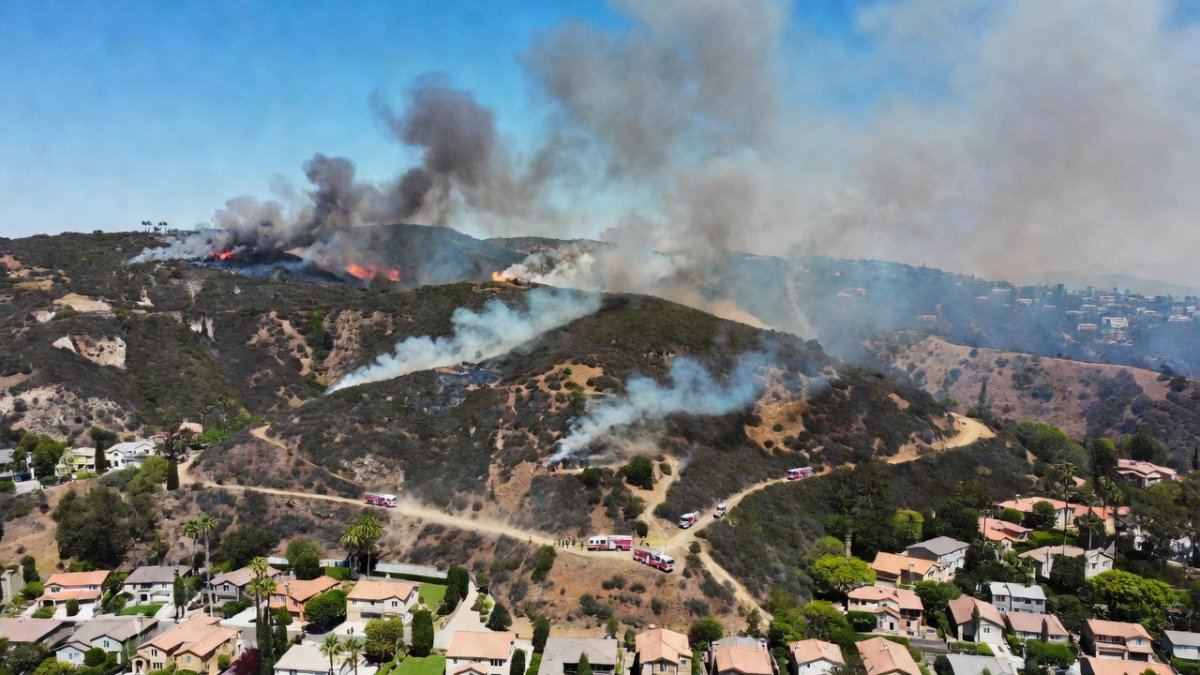
Southern California is burning — and baking — as a brutal July heat wave collides with peak fire season, producing exactly the kind of explosive wildfire conditions that firefighters dread.
Pointe Fire Explodes in Santa Clarita as Heat Wave Fuels Extreme Fire Conditions
Santa Clarita, California — A fast-moving brush fire dubbed the "Pointe Fire" erupted Wednesday afternoon in the hills of Santa Clarita, forcing evacuation warnings, shutting down Metrolink service, and sending a plume of smoke visible for miles as Southern California sweltered under its most intense heat wave of the summer.
Blaze Ignites Amid Triple-Digit Heat
The fire broke out just after 1:40 p.m. Wednesday near the 21300 block of Centre Pointe Parkway, according to the Los Angeles County Fire Department. Within minutes, flames were racing up a hillside toward homes and businesses in the area. A second alarm was requested at 2:08 p.m., bringing a surge of resources to the scene.
By 2:15 p.m., the fire had scorched approximately five acres. Incident commanders warned it had the potential to balloon to 100 acres within the hour given the extreme conditions. Radio traffic captured by local media indicated that structures along Doreen Place were immediately threatened by the advancing flames. By 2:45 p.m., the fire had grown to roughly 30 acres, though firefighters reported making "good progress" establishing and strengthening a perimeter control line.
200 Firefighters, Air Support, and a Bulldozer on the Line
Jonathan Torres of the Los Angeles County Fire Department told ABC7 Eyewitness News that just under 200 personnel were on the ground battling the blaze. The air assault included two Firehawk helicopters and two helitankers making repeated water drops on the fast-moving flames. A bulldozer was also deployed to carve out fire breaks — dirt roads that create barriers between unburned vegetation and the advancing fire.
Firefighters were aided by strategically placed fire breaks already existing in the area, which helped slow the fire's spread in critical zones. Despite the aggressive response, officials reported zero containment in the initial hours as the fire continued to challenge ground crews in rugged, hard-to-reach terrain.
Evacuation Warnings and Transportation Disruptions
The Santa Clarita Valley Sheriff's Station issued an evacuation warning for Zone SCL-CARLBOYER, covering Centre Pointe Parkway and surrounding areas. "Consider leaving now if you need more time to evacuate," the warning read. A reunification center was established at the Santa Clarita Aquatic Center at 20850 Centre Pointe Parkway for displaced residents and their families.
Metrolink suspended train service between Via Princessa and Newhall as fire crews worked in the vicinity of the rail corridor. AIR7 footage from the scene showed thick smoke billowing over Soledad Canyon Road as residents in nearby neighborhoods loaded vehicles and prepared to leave.
Heat Wave Creates 'All the Ingredients' for Fast-Growing Fires
The Pointe Fire did not ignite in a vacuum. It erupted on what forecasters called the peak day of Southern California's most punishing heat wave of the summer so far. Temperatures in Santa Clarita reached 107 degrees Fahrenheit on Wednesday. Woodland Hills was forecast to hit 105 to 110 degrees. Across the Los Angeles Basin, temperatures were running 10 to 17 degrees above normal, triggering excessive heat warnings.
Mike Wofford, a meteorologist with the National Weather Service in Oxnard, told the Los Angeles Times the heat wave "has all the ingredients" for fast-growing wildfires: bone-dry vegetation, gusty afternoon winds, and extreme temperatures that preheat fuels ahead of the flame front.
The key metric firefighters watch in conditions like these is something called the vapor pressure deficit — essentially, the atmosphere's thirst for moisture. When temperatures climb into the triple digits and humidity drops, the air aggressively pulls water out of vegetation, turning green brush into tinder in a matter of days. Southern California's current vegetation moisture content is running at levels typically seen in late August, not mid-July, meaning even healthy-looking chaparral can burn explosively.
This is not an isolated event. Since 2018, California has experienced a measurable shift toward earlier, more intense fire seasons driven by a warming climate. Research published in the journal Nature Climate Change has documented that warming trends are extending the traditional fire window by 30 to 60 days in parts of the Western United States, with Southern California among the most affected regions. The Pointe Fire, erupting in mid-July rather than late summer, fits that pattern precisely.
The National Weather Service issued a Red Flag Warning for Los Angeles County's Interstate 5 corridor and the Ventura County mountains, effective from Wednesday afternoon into Thursday morning. The warning cited strong winds and hot temperatures combining to create critical fire weather conditions — the kind of environment where any ignition can quickly explode into a major wildfire.
Monsoonal Moisture Adds Humidity but No Relief
Complicating the picture, a surge of monsoonal moisture pushed humidity levels to 50 to 55 percent in downtown Los Angeles — unusually sticky for a desert climate. While that might sound like it would help firefighters, the humidity also means nighttime temperatures are not cooling off as much as they normally would, with lows only dipping to the high 60s and low 70s in many areas.
"That's definitely one of the factors with the heat risk, is the warmer overnight temperatures," said Bryan Sinclair, a meteorologist with the National Weather Service in Oxnard. The lack of overnight cooling prolongs heat stress on both firefighters battling the blaze and residents in affected areas, depriving the human body of the recovery window it needs during extreme heat events.
Community Impact and What Comes Next
The fire's proximity to residential neighborhoods has put the Santa Clarita community on edge. Video from AIR7 showed residents calmly but quickly loading cars and preparing to leave as smoke towered over their rooftops. The bee colony discovered just outside the fire perimeter has drawn attention as well — officials confirmed they are aware of it and working to protect it as firefighting operations continue.
As of the latest reports Wednesday evening, the Pointe Fire remained active with firefighters battling through the night. Thursday is expected to bring continued excessive heat, with temperatures remaining well above normal across Southern California. The Red Flag Warning remains in effect through Thursday morning, and officials warn that any additional ignitions could rapidly escalate.
What This Means for California's Fire Season
The Pointe Fire serves as an early-season warning shot for what experts fear could be a devastating fire season across the Western United States. California has already seen an above-average number of wildfire incidents in 2026, with dry fuels and repeated heat waves creating conditions more typical of late August than mid-July.
The 2026 fire season has been punching above its weight class from the start. December 2025 through June 2026 was the driest eight-month stretch in Southern California since records began in 1895, according to the National Centers for Environmental Information. That lack of rainfall, coupled with a near-record snowpack melt-out in the Sierra Nevada, means both high-country timber and low-elevation brush are critically dry — and ready to burn.
Fire behavior experts are increasingly concerned about what they call "hybrid fires" — events driven by a convergence of extreme heat, dry fuels, and wind, rather than any single dominant factor. The Pointe Fire exhibited this hybrid behavior Wednesday, with triple-digit temperatures preheating fuels, monsoonal moisture creating erratic wind patterns, and the late-afternoon Diablo wind influence adding Gusty downhill pushes that challenged containment efforts on the northern flank.
CAL FIRE's latest seasonal outlook notes that "significant fire potential is expected to remain near normal in April before increasing to above normal from May through July, with lightning in July remaining a key forecast wildcard." The Santa Clarita fire, sparked during a human-caused heat wave rather than lightning, underscores the danger of any ignition source during these conditions.
There is also a growing concern about resource strain across the Western firefighting network. California has already deployed 85 percent of its available CAL FIRE contract air tanker fleet as of mid-July — an unusually high figure for this early in the year. If multiple large fires ignite simultaneously across different regions, the mutual aid system that California relies on could face its most severe test since the catastrophic 2020 fire season. The Pointe Fire, while moderate in size, arrived at a moment when firefighting resources are already stretched thin.
The cause of the Pointe Fire remains under investigation. No injuries have been reported, though three firefighters were treated for heat-related issues as temperatures on the fire line exceeded 100 degrees.
What You Can Do
If you or someone you know lives in the Santa Clarita area, stay aware of your evacuation zone status. Monitor the Los Angeles County Fire Department on social media, sign up for emergency alerts at ready.lacounty.gov, and have a go-bag ready. For those wanting to help, the Santa Clarita Aquatic Center reunification point is accepting donations of water and supplies for displaced residents.
Stay safe, stay cool, and stay informed. We'll keep tracking the Pointe Fire as it develops.
By Jessica Ali, Staff Writer
This article was produced with AI-assisted research and editorial support. Reporting is based on sources cited in the article.
What's Your Reaction?
 Like
0
Like
0
 Dislike
0
Dislike
0
 Love
0
Love
0
 Funny
0
Funny
0
 Wow
0
Wow
0
 Sad
0
Sad
0
 Angry
0
Angry
0

Editor-in-Chief at Global1.News. Atlanta-based journalist who cuts through the BS and tells it like it is. Lead anchor, host, and the voice you hear when the spin stops and the truth starts.











Comments (0)