
Japan Disaster Plan Upgrades Evacuation Centers with...
Japan Disaster Plan Upgrades Evacuation Centers with Satellite Communications and Climate-Protection Technology Japan's Central Disaster Management Council approved revisions to the basic disaster management plan on July 14, 2026, directing local governments to strengthen technological and logistical capacity at evacuation centers.
Japan Disaster Plan Upgrades Evacuation Centers with Satellite Communications and Climate-Protection Technology
Japan's Central Disaster Management Council approved revisions to the basic disaster management plan on July 14, 2026, directing local governments to strengthen technological and logistical capacity at evacuation centers. The changes respond directly to prolonged displacement during the July 2025 Kamchatka earthquake, when 32-hour tsunami warnings led to heatstroke cases among evacuees. Measures now coming into force prioritize satellite communications, surveillance systems, and temperature-control infrastructure as standard components of Japan's emergency response framework.
Tags: Japan disaster management, evacuation centers, heatstroke protection, satellite communications, security cameras, Central Disaster Management Council, Sanae Takaichi, Kamchatka earthquake
Government Mandates Satellite Communications and Accountability Systems
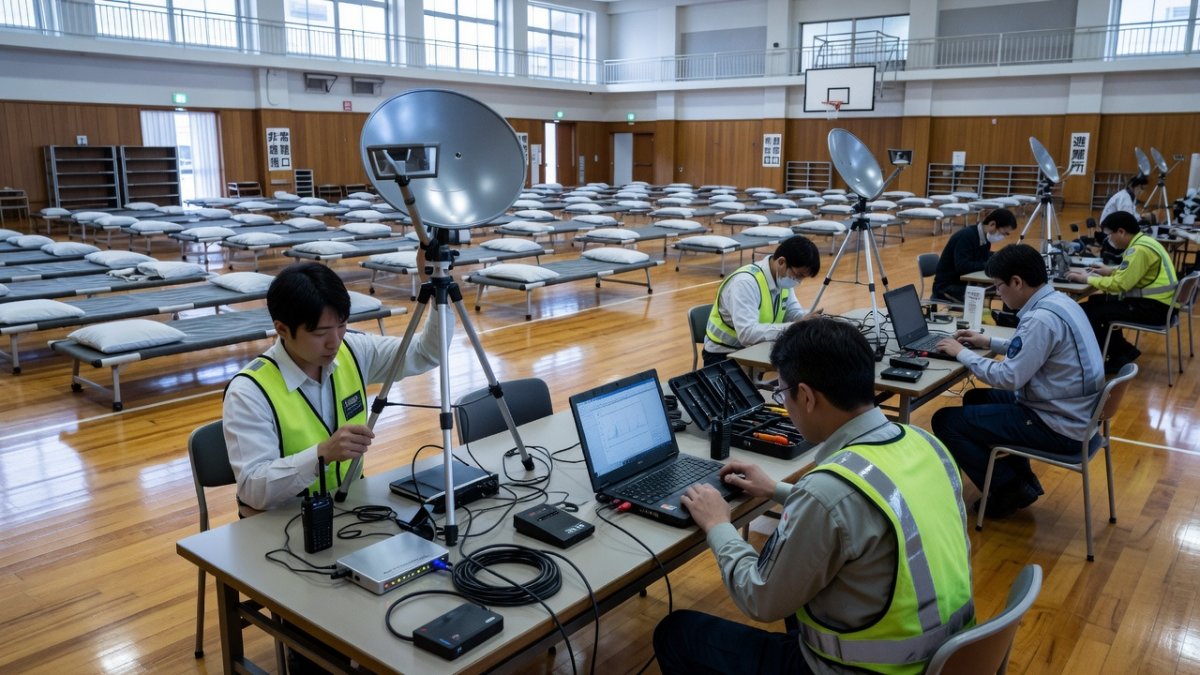
The Cabinet Office, through the Central Disaster Management Council chaired by Prime Minister Sanae Takaichi, has embedded specific technology requirements into the revised plan. Local governments must now prepare designated sites with satellite telephones to maintain contact when terrestrial networks fail. Security cameras are required to support rapid headcounts and accountability during extended evacuations. These provisions are being phased in alongside existing early-warning frameworks that have long characterized Japan's disaster resilience approach.
Japan's revised disaster framework mandates satellite telephones using L-band frequencies through the Quasi-Zenith Satellite System alongside Iridium and emerging Starlink terminals for redundancy, particularly in mountainous and island communities. These systems ensure voice and data connectivity when terrestrial networks fail, a direct response to communication blackouts experienced during the 2011 Tohoku earthquake and the 2024 Noto Peninsula disaster. Accountability mechanisms now require real-time logging of equipment deployment and response times, exceeding the decentralized reporting standards seen in U.S. FEMA operations or South Korea's integrated emergency platform.
The July 2025 Kamchatka Earthquake: A Catalyst for Change
The July 2025 Kamchatka earthquake, registering 8.7 on the moment magnitude scale, triggered Japan's most extensive tsunami warning since 2011, affecting coastal zones from Hokkaido through the Tohoku and Kanto regions. Over 420,000 residents were evacuated, with prolonged alerts lasting 32 hours that halted port operations and supply chains across multiple prefectures. The economic toll reached an estimated ¥312 billion in lost productivity and emergency logistics, according to preliminary Cabinet Office assessments — far below the ¥16.9 trillion damage from the 2011 Tohoku disaster but exceeding the ¥2.1 trillion impact of the 2024 Noto Peninsula earthquake.
The prolonged summer evacuation created a secondary public health crisis. Several evacuees required hospitalization for suspected heatstroke after spending more than a day in centers without adequate cooling or hydration logistics. This experience illustrated how extended displacement in Japan's humid summer climate quickly transforms from a simple shelter issue into a public-health technology challenge requiring integrated infrastructure solutions.
Japan's tsunami early-warning architecture has advanced markedly since 2011, incorporating denser ocean-bottom seismometer networks and AI-driven propagation modeling by the Japan Meteorological Agency. These upgrades reduced false-alarm rates and shortened initial notification times. Yet the 32-hour warning duration exposed persistent gaps in public compliance and infrastructure resilience during extended alerts. Forward-looking revisions now prioritize integrated risk communication that accounts for both seismic magnitude and secondary economic disruption.
Heatstroke Prevention and Portable Climate-Control Technology
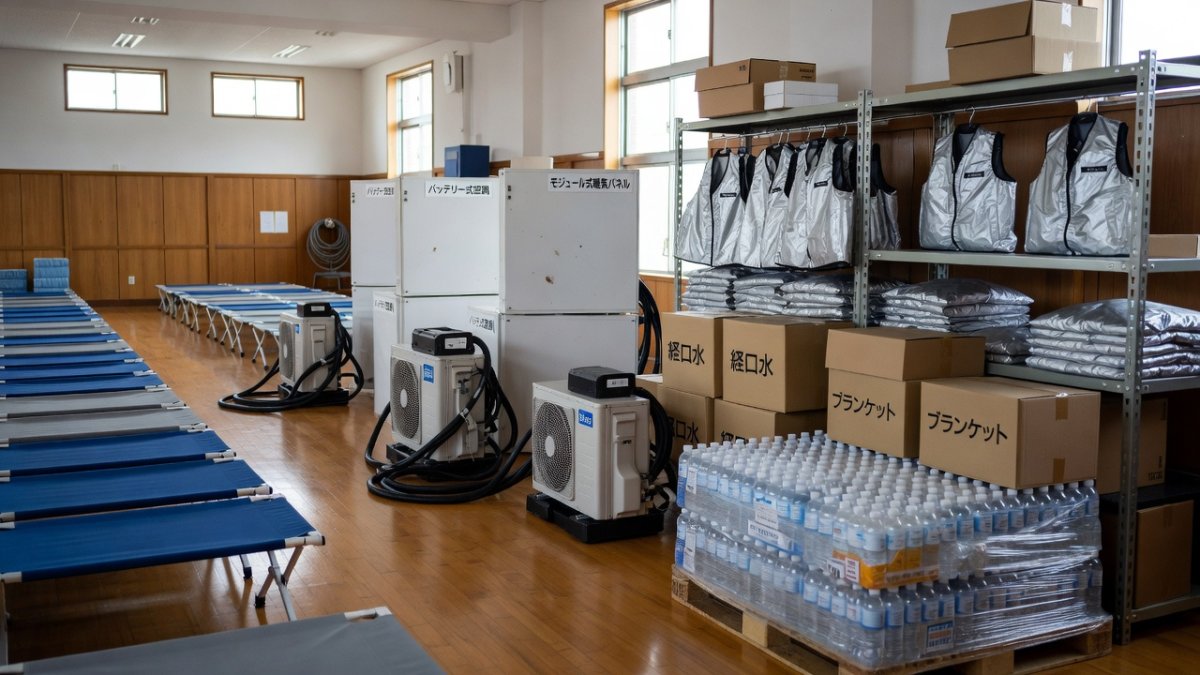
Under the revised plan, local governments are required to maintain inventories of portable climate-control equipment at designated sites. Enhanced temperature-control measures encompass both heatstroke prevention and cold-weather protection, reflecting seasonal variability across Japan's archipelago. Portable climate-control units deployed in evacuation centers include battery-powered micro air conditioners, phase-change cooling vests, and modular radiant heating panels designed for rapid assembly in gymnasiums and community halls.
These technologies build on lessons from the 2018 Western Japan floods and the 2024 Noto Peninsula response, where temperature extremes exacerbated health risks for elderly evacuees. Government data show annual heatstroke deaths averaging 1,200 to 1,500 in recent years, prompting a target to reduce fatalities below 1,000 through mandatory cooling infrastructure in all designated shelters by 2028. Japan's climate presents unique dual-season challenges: summer disasters coincide with heat indices above 35 degrees Celsius in major urban centers, while winter events in northern prefectures such as Hokkaido and Aomori expose evacuees to sub-zero conditions. The new standards integrate predictive weather modeling with equipment stockpiles, aiming to lower both heatstroke and hypothermia incidents.
Privacy, Security, and the New Accountability Framework
Security cameras installed at evacuation centers raise privacy considerations under Japan's Act on the Protection of Personal Information. Authorities address these through strict data-retention limits of 30 days, anonymized footage for training purposes, and mandatory signage at all monitored sites. International comparisons highlight Japan's cautious approach relative to Singapore's centralized surveillance model, balancing operational oversight with cultural expectations of individual privacy in public shelters.
Satellite telephones and security cameras form the core of the new accountability system. When power and cellular service are disrupted, satellite links enable authorities to confirm evacuee numbers and medical needs without delay. Camera feeds support remote oversight while preserving privacy protocols already embedded in Japan's public-safety technology standards. Deployment schedules are being coordinated with the Cabinet Office to ensure compatibility with national emergency networks.
Alignment with Japan's Digital Transformation and Aging Society
The Cabinet Office's digital transformation agenda for disaster management centers on a unified cloud platform linking local governments, the Self-Defense Forces, and private operators for real-time resource allocation. This initiative aligns directly with Japan's super-aging society, where 29 percent of the population is over 65, necessitating evacuation centers equipped with tablet-based health monitoring and automated supply tracking to support mobility-limited residents.
Japan's disaster-tech ecosystem has historically emphasized redundancy and rapid restoration. The current revisions extend this tradition by treating evacuation centers as nodes within a digitally managed emergency infrastructure. Portable climate-control units, shade structures, and sensor-linked monitoring systems are now specified as standard components rather than optional enhancements. International comparisons reveal Japan lagging behind Estonia's fully digitalized crisis systems yet advancing faster than many European peers in hardware integration. The strategy emphasizes interoperability standards that will allow AI-assisted evacuation routing and predictive demand forecasting. Analysts project these reforms will reduce response delays by 40 percent within a decade while addressing workforce shortages in an aging society.
Implementation Timeline and What to Watch For
Implementation will proceed through phased local-government procurement cycles, with the Cabinet Office monitoring compliance metrics. The first wave of equipment deployment is expected for municipalities in high-risk seismic zones along the Pacific coast, followed by inland and northern prefectures. Budget allocations for the fiscal year 2027 framework include separate line items for satellite communications hardware, climate-control equipment, and surveillance infrastructure, signaling sustained financial commitment rather than one-time emergency spending.
Observers should track integration of satellite and camera systems with existing disaster-management platforms, as well as any adjustments to temperature-control standards based on operational feedback from the upcoming summer season. Continued alignment with Japan's digital transformation policies will determine whether these measures scale efficiently across municipalities of varying size and technical capacity. The degree of coordination between the Cabinet Office, the Ministry of Internal Affairs and Communications, and prefectural governments will be a critical indicator of long-term viability.
The new framework represents a significant shift in how Japan approaches evacuation center infrastructure — from basic shelter to technologically equipped emergency hubs. As climate variability increases the frequency of compound disasters, these measures will become increasingly essential. The success of Japan's revised disaster management plan will ultimately depend on consistent procurement, workforce training, and the seamless integration of satellite, surveillance, and climate-control technologies into the nation's broader disaster resilience architecture.
By Kenji Tanaka, Staff Writer
This article was produced with AI-assisted research and editorial support. Reporting is based on sources cited in the article.
What's Your Reaction?
 Like
0
Like
0
 Dislike
0
Dislike
0
 Love
0
Love
0
 Funny
0
Funny
0
 Wow
0
Wow
0
 Sad
0
Sad
0
 Angry
0
Angry
0

Japan Correspondent at Global1.News. Tokyo-based voice covering Japanese politics, technology, economy, and culture. Tracks the intersection of tradition and innovation in one of the world's most dynamic societies.















Comments (0)