
Moscow Under Siege: Ukraine's Deep-Strike Campaign Reshapes the War Economy
Last week, Moscow endured its largest drone onslaught of the war when Ukrainian strikes hit the Kapotnya oil refinery on the capital’s outskirts. Satellite imagery confirmed at least three oil tanks destroyed at the facility, though Ukrainian officials stated that four tanks were hit. Reports from the New York Times suggested that Russia’s own air defenses may have inadvertentl
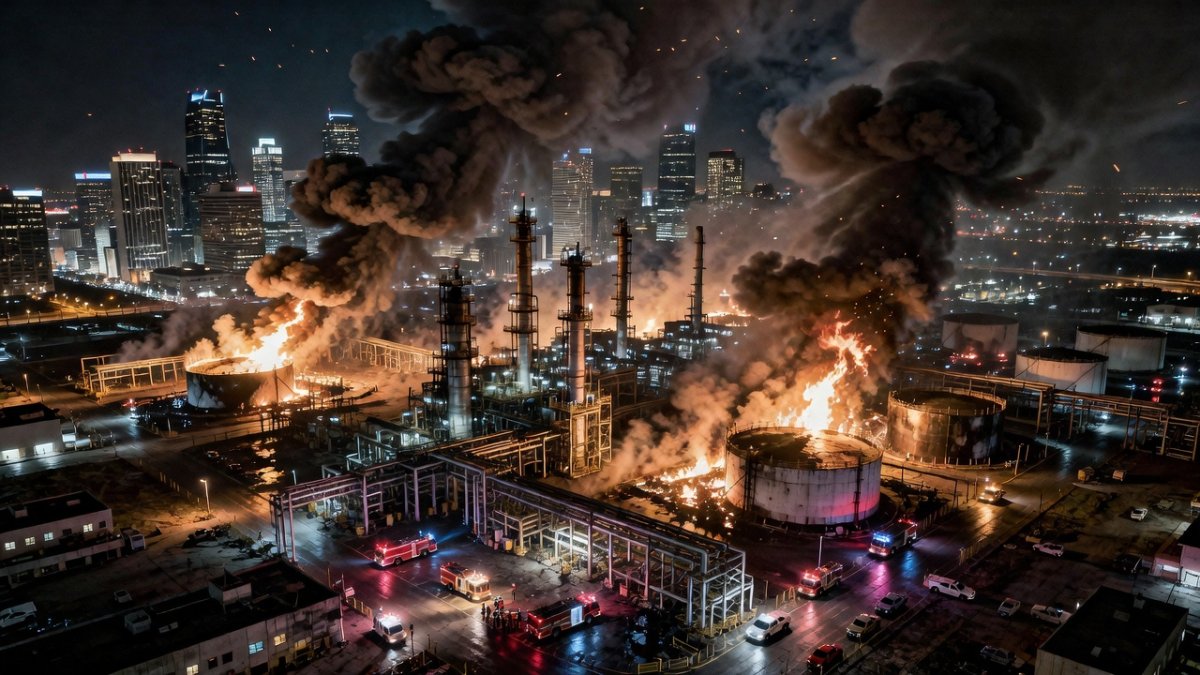
Last week, Moscow endured its largest drone onslaught of the war when Ukrainian strikes hit the Kapotnya oil refinery on the capital’s outskirts. Satellite imagery confirmed at least three oil tanks destroyed at the facility, though Ukrainian officials stated that four tanks were hit. Reports from the New York Times suggested that Russia’s own air defenses may have inadvertently contributed to the damage at the refinery during the intense barrage that also forced the suspension of flights at Moscow airports on Monday. Ukrainian military sources later claimed the operation involved more than 50 drones launched in coordinated waves from multiple directions, overwhelming local radar coverage for nearly two hours.
Independent monitoring groups recorded at least 12 separate explosions in the Moscow region that night, with debris from intercepted drones landing in residential districts of Vidnoye and Lyubertsy. No civilian casualties were reported, but the incident prompted temporary evacuation of nearby apartment blocks and highlighted the growing vulnerability of Russia’s rear-area infrastructure to low-cost, long-range Ukrainian systems.
The Expanding Geography of Strikes
Ukraine’s deep-strike campaign has dramatically expanded the geography of the conflict. Data compiled by ACLED and analyzed by The Economist shows that such strikes have more than doubled over the past year. On current trends, Ukraine is on pace for roughly 800 deep strikes in 2026 compared with 658 in 2025. At least 60 Russian regions have now been targeted, bringing the war to areas previously considered safe from Ukrainian reach.
In April, a high-rise building in Yekaterinburg was set ablaze while drones were reported near a metallurgical plant in Chelyabinsk. Both cities lie more than 1,700 kilometers from the front lines. Similar distances separate Ukraine from the chemical plant struck in the Perm region in April and the drone-component facility in Cheboksary hit by “flamingo” missiles in mid-June. These attacks demonstrate Ukraine’s growing ability to project power deep into Russian territory.
Western analysts note that the campaign forces Russia to divert air-defense assets from the front and from protecting strategic economic sites. Ukrainian officials, including President Zelensky, frame the strikes as a necessary response to Russia’s own long-range attacks on Ukrainian cities and infrastructure.
Additional strikes have reached as far as the Amur region in Russia’s Far East, where a fuel depot near Blagoveshchensk was damaged in late May, according to local emergency services. The ACLED dataset further indicates that strikes on military-industrial targets increased by 47 percent between January and June 2025, with new emphasis on electronics and missile-component factories in Tatarstan and Bashkortostan.
Energy Infrastructure Under Attack
Russian energy facilities have become primary targets. In March, the Ust-Luga port complex was devastated, with half a dozen storage tanks destroyed. The facility normally handles 700,000 barrels per day of exports. The Kapotnya strike last week added to a pattern that has already taken roughly one-third of Russia’s oil-refining capacity offline, according to Energy Intelligence.
Additional hits on a chemical plant in the Perm region and the drone-component plant in Cheboksary illustrate the broadening scope beyond traditional oil infrastructure. Crimea has also felt the effects, with local authorities banning summer camps and suspending retail gas sales amid supply disruptions. Ukrainian statements emphasize that these targets support Russia’s military logistics and war economy.
Russian authorities have acknowledged that Ukrainian drones are directly responsible for current fuel-market difficulties. The Energy Ministry has cited the strikes as a key factor behind tightening supplies and rising prices across multiple regions.
Refining throughput at the Ryazan and Yaroslavl plants has fallen by an estimated 18 percent since March due to repeated drone damage to distillation units. In Crimea, the Simferopol fuel terminal reported a 40 percent drop in deliveries, forcing the regional government to ration diesel for agricultural use during the spring planting season.
Economic Shockwaves
The cumulative impact on Russia’s economy is becoming measurable. Oil production declined for the sixth consecutive month in June. On Monday the MOEX index fell 4.42 percent, reaching its lowest level since March 2023. Year-to-date losses now exceed 14 percent, and the market has recorded a 15-week losing streak that surpasses the duration of the 2008 financial crisis.
The ruble has lost ground against major currencies while Brent crude traded at $77.63 per barrel. The Central Bank responded by cutting its key rate by only 25 basis points, a modest move that analysts interpret as a signal of persistent high interest rates ahead. Dodonov of Finam observed that Nabiullina’s hawkish rhetoric points to slower easing than investors had hoped.
Western observers highlight how sustained pressure on energy infrastructure could constrain Russia’s ability to finance its military operations. Ukrainian sources argue that the economic damage is a legitimate consequence of Russia’s invasion and ongoing strikes against Ukrainian civilian targets.
Russia’s federal budget deficit widened to 3.8 percent of GDP in the first half of 2025, driven partly by lower export revenues from refined products. Economists at Sberbank estimate that each additional 10 percent loss in refining capacity could reduce annual tax receipts by 420 billion rubles, tightening fiscal space for defense procurement.
Fuel Crisis Spreads Across Russia
Fuel shortages are spreading beyond the directly hit regions. In Crimea, authorities have banned summer camps and suspended gas sales at some stations. Gasoline prices have risen 6.6 percent year-to-date, prompting the Federal Antimonopoly Service to open probes into two Moscow gas-station chains for alleged price gouging and three fuel traders for possible cartel activity.
The FAS is also working with major online platforms including Avito, Ozon, and Wildberries to block speculative fuel resales. These regulatory steps reflect growing concern that localized shortages could escalate into broader supply disruptions if strikes continue at the current pace.
Energy Ministry statements have explicitly linked the “difficulties” in the fuel market to Ukrainian drone strikes. The combination of lost refining capacity and logistical strain has forced regional authorities to implement ad-hoc restrictions that affect daily life and seasonal activities.
In the Rostov and Krasnodar regions, long queues formed at remaining operational stations, with some drivers reporting waits of up to four hours. The government has begun importing small volumes of gasoline from Belarus and Kazakhstan to stabilize southern markets ahead of the summer holiday period.
The Kremlin's Response
President Putin stated that Ukraine’s goal is “to create a split in Russian society, sow confusion and inflict economic damage.” The Defense Ministry reported that 301 drones were intercepted nationwide overnight, including 80 around Moscow. These figures underscore the scale of the defensive effort now required on a near-daily basis.
The Energy Ministry has formed a task force to address supply shortfalls, while the FAS intensifies market oversight. Officials have avoided detailed public discussion of how air-defense performance may have contributed to damage at sites such as Kapotnya, preferring to emphasize successful interceptions.
Russian state media continues to portray the strikes as terrorist acts, yet the breadth of affected regions and the visible impact on fuel prices make it increasingly difficult to downplay the campaign’s reach.
Putin also ordered an increase in electronic-warfare units around key energy hubs and directed the Defense Ministry to accelerate deployment of new S-500 systems near Moscow and St. Petersburg. Regional governors have been instructed to prepare emergency fuel reserves sufficient for at least 30 days of critical services.
Analysis and Implications
Sam Bendett of the Center for Naval Analyses observed that Ukraine is “bringing the war home in a way it hasn’t been before.” The sustained deep-strike effort challenges the Kremlin’s narrative that the conflict remains distant from most Russian citizens and raises questions about the long-term resilience of the war economy.
Analysts suggest that continued pressure on refining capacity could force Russia to import more refined products or reduce exports further, tightening fiscal space for military spending. Ukrainian leadership maintains that the campaign constitutes a just response to Russia’s brutal attacks against Ukrainian people and infrastructure.
Whether the current pace of strikes can be maintained remains uncertain, but the data show a clear escalation in both frequency and geographic reach. The resulting economic friction, visible in stock-market losses, fuel-price increases, and regulatory interventions, indicates that Ukraine’s deep-strike campaign has become a central factor shaping Russia’s wartime calculations.
Some Western defense analysts argue that the campaign’s success depends on Ukraine’s ability to sustain drone production and secure continued Western components. If Moscow can harden key sites and replenish interceptor stocks, the tempo of strikes may plateau; however, the demonstrated reach into Russia’s industrial heartland has already altered strategic calculations in both capitals.
By Irina Volkov, Staff WriterThis article was produced with AI-assisted research and editorial support. Reporting is based on sources cited in the article.
What's Your Reaction?
 Like
0
Like
0
 Dislike
0
Dislike
0
 Love
0
Love
0
 Funny
0
Funny
0
 Wow
0
Wow
0
 Sad
0
Sad
0
 Angry
0
Angry
0

Russia/Eastern Europe Correspondent at Global1.News. Covering Russian politics, energy, security, and the shifting dynamics of the post-Soviet space. Provides clear-eyed analysis on one of the world's most opaque regions.












Comments (0)