
UAM Demo Failure Reveals Korea's Tech Readiness Gap
The July 15 Demonstration at Incheon National University The K-UAM Flight Showcase took place on July 15, 2026, at Incheon National University's INU Innovation Center.
The July 15 Demonstration at Incheon National University
The K-UAM Flight Showcase took place on July 15, 2026, at Incheon National University's INU Innovation Center. Hundreds of spectators, including air force VIPs, gathered to witness what organizers had billed as a milestone in Korean urban air mobility. Instead, the event concluded with three unsuccessful attempts to lift Sambo Motors Group's B-32-R2 aircraft off the ground.
An awkward silence fell over the crowd after the third failed attempt. The unmanned aircraft, programmed to lift vertically and hover at approximately five meters, never left the ground. Organizers eventually called off the demonstration, citing rain and suspected radio interference from an unauthorized drone that had entered nearby airspace.
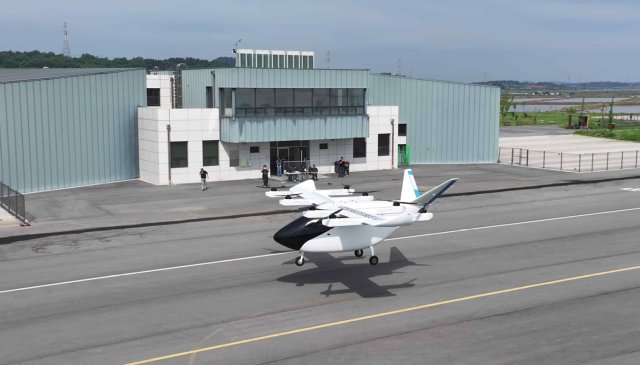
Technical Specifications of the B-32-R2 Test Vehicle
The B-32-R2 measures 10 meters wide, 6.2 meters long, and 3.2 meters high, with a maximum takeoff weight of 950 kilograms and eight electric motors. Designed as a two-seat test platform, it flew without a pilot. Joo Young-yeon, a senior research engineer at Sambo Motors, stressed that the aircraft is not intended to become the company's commercial passenger model. "This aircraft is a test vehicle," Joo said. "It is designed as a two-seat aircraft, but we are currently flying it without a pilot to verify key systems."
Prior trials occurred only in the isolated Taean region, far from the radio congestion of metropolitan areas. "Testing in a city was actually the first time for us," a Sambo Motors official told reporters. "Until yesterday, we had tested the aircraft here and it flew without problems. But just before hovering today, unexpected signals started interfering."
Three Failed Takeoff Attempts and Technical Explanations
Organizers attributed the failures to rain and suspected radio interference from an unauthorized drone. A Sambo Motors official acknowledged that the current prototype relies on communication systems similar to those used by consumer drones rather than fully aviation-grade flight-control networks. That admission highlighted one of the least visible but perhaps most fundamental obstacles facing the urban air mobility industry.
If a nearly one-ton unmanned prototype can be grounded by unexpected radio interference during a controlled public demonstration, commercial aircraft carrying passengers will require multiple layers of redundancy and significantly more robust aviation-grade systems before regulators allow routine operations.
Gap Between Government Ambitions and Demonstrated Readiness
South Korea's Ministry of Land, Infrastructure and Transport continues to target initial UAM services for 2028. Yet the ministry's own operational constraints reveal the distance between policy goals and present engineering maturity. Early operations would be limited to sightseeing flights, daylight hours, favorable weather, single-aircraft corridors, a maximum of ten one-way flights daily, altitudes of 300-600 meters, and routes of roughly 50 kilometers.
The ambitious 2028 target stands in contrast to industry assessments from Sambo Motors, which projects commercial readiness no earlier than 2030 for its planned 1.7-ton, three-seat passenger model. This discrepancy echoes the protracted development of the KTX high-speed rail system, which required extensive technology transfers from France's Alstom and multiple safety validations before its 2004 launch, years after initial government pledges.
Budget allocations for K-UAM, totaling approximately 1.2 trillion won through 2027 according to the Korea Transport Institute, remain modest when benchmarked against the multi-trillion-won investments required for full-scale certification and vertiport infrastructure. The absence of dedicated long-term capital commitments comparable to those underpinning the KTX project raises questions about sustained momentum.
Korea's "Fast Follower" Strategy in Global UAM Competition
Sambo officials publicly acknowledged that Korea trails the United States, Europe, and China in UAM development. They positioned the country as a fast follower that can leverage existing strengths in battery technology and precision manufacturing. "Korea is not yet at the same level as global frontrunners," one company official said. "But we believe we can catch up as a fast follower by leveraging our strengths in batteries and manufacturing."

Chaebol Dynamics and Industry Structure
Hyundai Motor Group's Supernal subsidiary has pursued an independent trajectory with its S-A2 eVTOL aircraft, securing strategic partnerships with NASA's Advanced Air Mobility Mission Directorate and European vertiport operator Skyports. Korean Air has focused on AI-assisted pilot augmentation and UAM traffic management platforms developed with the Korea Aerospace Research Institute.
Within the broader chaebol landscape, Samsung C&T and Hanwha have adopted infrastructure-oriented postures, concentrating on vertiport construction and energy storage rather than vehicle manufacturing. This heterogeneity contrasts with the startup ecosystem, where firms struggle to access certification pathways dominated by chaebol-affiliated testing facilities. Venture capital inflows into UAM startups constitute less than 8 percent of total aerospace investment, perpetuating chaebol dominance.
Regulatory Framework and Early Route Plans
Potential early routes include Jamsil in southeastern Seoul to Incheon International Airport, covering approximately 65 kilometers. The company is also studying services in Busan, including routes linking Busan Port with Haeundae or Gimhae International Airport, where aircraft could fly largely over coastal areas with fewer obstacles than central Seoul. Officials said vertiports would function much like railway stations. Fares are projected to align with premium black-taxi rates.
The ministry's corridor rules reflect a cautious regulatory posture that prioritizes safety certification over rapid commercialization. Aircraft will operate within designated corridors at altitudes between 300 and 600 meters, with individual routes generally limited to about 50 kilometers. The 2028 milestone represents the beginning of a carefully managed aviation trial rather than the arrival of flying taxis as a routine form of urban transportation.
What This Means for South Korean Innovation Policy
The Incheon demonstration failure illuminates a structural feature of South Korea's innovation model: the persistent misalignment between centralized, politically calibrated targets and the incremental, risk-intensive realities of complex systems integration. Government roadmaps, effective in mobilizing resources for earlier catch-up industries such as shipbuilding and memory chips, prove less suited to frontier domains where certification, airspace integration, and public acceptance evolve unpredictably.
Realistic timelines suggest that Korea may achieve limited commercial operations in controlled environments by 2032-2035, contingent upon harmonizing domestic certification with FAA and EASA standards. Leadership in advanced air mobility may ultimately manifest through component supply chains — particularly batteries, avionics, and traffic-management software — rather than complete vehicle platforms. The seven-year-old spectator Yoo Hee-chan, who attended hoping to witness the future of transportation, captured the paradox aptly: "Even though it didn't take off, I still felt good. If there is really a flying taxi someday, I definitely want to ride it once." Turning that public enthusiasm into certified operational capability will require recalibrating expectations toward phased milestones rather than headline-grabbing target dates.
By Prof. David Park, Staff Writer
This article was produced with AI-assisted research and editorial support. Reporting is based on sources cited in the article.
What's Your Reaction?
 Like
0
Like
0
 Dislike
0
Dislike
0
 Love
0
Love
0
 Funny
0
Funny
0
 Wow
0
Wow
0
 Sad
0
Sad
0
 Angry
0
Angry
0

East Asia/Technology Correspondent at Global1.News. Seoul-based voice covering Korean politics, technology, business, and culture. Analyzes how technology and geopolitics intersect across East Asia.












Comments (0)