
Xi Jinping Makes Case for Global AI Governance at Shanghai Summit
Xi Jinping used his first in-person WAIC address to launch a 29-nation AI alliance, pledge 5,000 training slots for developing countries, and position China as a global AI governance leader challenging US dominance.
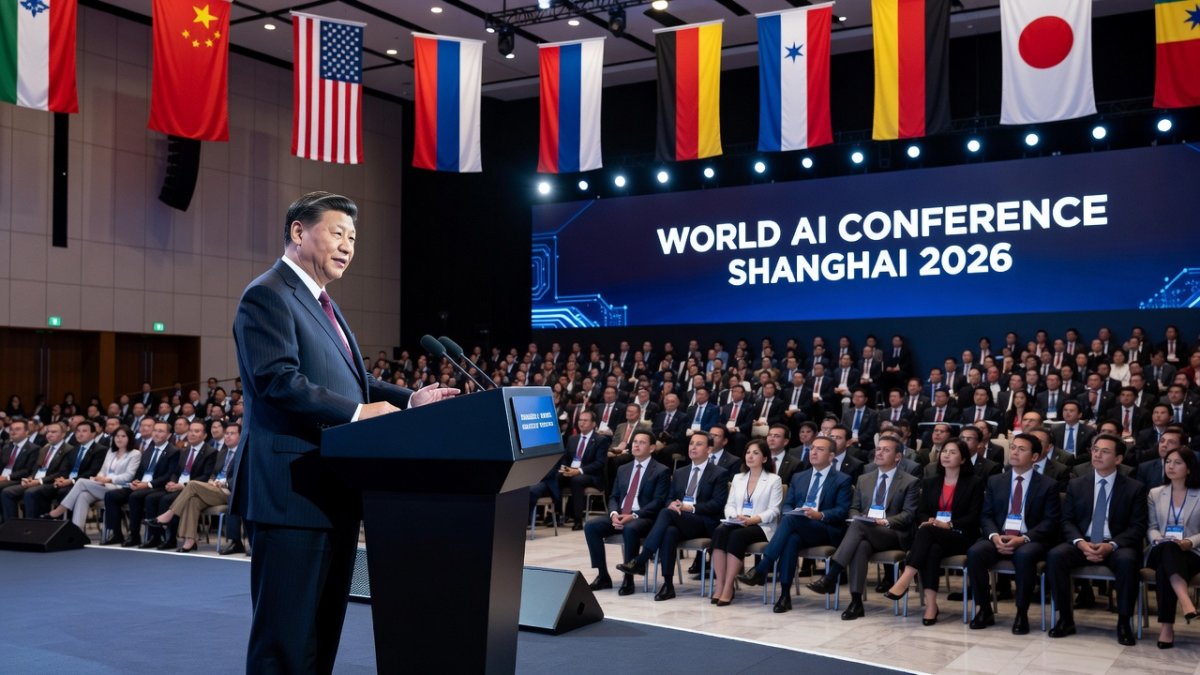
Xi Jinping Makes Case for Global AI Governance at Shanghai Summit
Shanghai — Chinese President Xi Jinping made his first in-person appearance at the World Artificial Intelligence Conference (WAIC) in Shanghai on Friday, using the platform to position China as a champion of inclusive AI governance while pushing back against US-led technology restrictions that have limited Beijing's access to advanced semiconductors and computing hardware.
In a keynote address that marked a significant escalation of China's AI diplomacy, Xi declared that artificial intelligence "should not be a solo performance by any single country but rather a symphony of global cooperation." The speech, delivered before an audience of international leaders including U.N. Secretary-General António Guterres and heads of state from Kazakhstan, Cambodia, and Thailand, comes at a pivotal moment in the intensifying US-China technology competition.
Tags: Xi Jinping, World AI Conference, WAIC 2026, China AI strategy, global AI governance, DeepSeek, US-China tech war, artificial intelligence, World AI Cooperation Organization, Global South, Huawei Atlas 950, AI diplomacy
A New Alliance for AI — The World AI Cooperation Organization
A day before Xi's address, representatives from 29 nations signed an agreement to establish the World AI Cooperation Organization (WAICO), a new intergovernmental body headquartered in Shanghai that Beijing describes as a platform for promoting global AI governance and international collaboration. The signatory list reflects China's diplomatic reach across the Global South and allied states: Russia, Belarus, Serbia, Cuba, Brazil, and Venezuela are joined by 12 Asian nations and 10 African countries.
"We should together oppose the practice of overstretching the concept of national security in the field of artificial intelligence, and of placing one's own security above that of other countries," Xi said, directly challenging the export controls and investment screening measures that the United States and European Union have implemented to restrict China's access to advanced AI chips and development tools. The remark drew implicit contrast with Washington's ongoing semiconductor sanctions, which have blocked Chinese firms from purchasing Nvidia's most advanced processors since 2022.
China's state-run Xinhua news agency described WAICO as an intergovernmental organization that will "promote international cooperation and global governance in AI." While the body's formal charter and operational framework remain to be detailed, its establishment signals Beijing's determination to create alternative multilateral institutions in the technology domain — mirroring its strategy with the Asian Infrastructure Investment Bank and the New Development Bank in finance.
China's AI Diplomacy — Targeting the Global South
Xi used the conference platform to announce a series of concrete commitments aimed at developing nations. Over the next five years, China will provide 5,000 training opportunities in artificial intelligence to professionals from developing countries. Beijing also pledged to grant 30 nations access to a Chinese-developed AI-powered meteorological early warning system, a tool that could prove critical for climate-vulnerable countries in Southeast Asia, Africa, and Latin America.
The outreach extends to regional blocs across the developing world. Xi confirmed that China will expand AI cooperation with the Association of Southeast Asian Nations (ASEAN), the League of Arab States, the African Union, the Community of Latin American and Caribbean States (CELAC), the Shanghai Cooperation Organization, and the BRICS group. This coordinated diplomatic push positions Chinese AI as an accessible, affordable alternative to Western-dominated technology ecosystems — a pitch that has gained considerable traction following the global success of open-source Chinese models like DeepSeek.
"Chinese AI models are attracting global users with lower costs as they catch up to the more expensive US AI offerings," the DW news service reported from the conference, capturing the central competitive dynamic. DeepSeek's R1 and subsequent models have demonstrated that Chinese AI can compete with frontier US systems at a fraction of the development cost, a reality that sent shockwaves through Silicon Valley when the company first burst onto the global scene in early 2025.
The Technology Showcase — Huawei's Atlas 950 and Chinese Innovation
Beyond the diplomatic theater, WAIC 2026 functions as a major showcase for Chinese technology capabilities. More than 1,100 companies and 1,400 guests are participating in the four-day event, with some 3,000 products on display. Huawei, China's telecommunications and AI hardware giant, is using the conference to demonstrate its Atlas 950 SuperPoD, a high-performance AI computing system that the company positions as a domestic alternative to Nvidia's enterprise infrastructure.
China's rapid progress in AI hardware and software has reshaped the competitive landscape. Some technology analysts now assess that China has transitioned from a technology follower to an innovator in its own right, no longer merely catching up to the United States but in certain domains — particularly open-source model development and AI application at scale — setting the pace. China's five-year plan through 2030 has prioritized breakthroughs in frontier science and technology, with artificial intelligence receiving top-level strategic backing that includes dedicated state funding, talent recruitment programs, and streamlined regulatory pathways for AI deployment.
The conference also features consumer-facing demonstrations, including smartphones capable of operating apps autonomously through AI agents, and an Apple AAPL Shanghai retail location showcasing AI-powered in-store experiences that blend on-device machine learning with the company's broader ecosystem.
The US-China AI Competition — Talks and Tensions
The WAIC gathering coincides with an equally important development in US-China relations: preparations for the first government-level AI talks under the Trump administration. These discussions, expected to take place in the coming weeks, will test whether the two sides can establish any framework for managing the risks of advanced AI development — including concerns about military applications, biosecurity, and critical infrastructure vulnerabilities — even as they compete fiercely for technological supremacy.
"We should put in place laws and regulations, technological monitoring, early warning, and emergency response systems, in order to ensure AI is always under human control," Xi said, a statement that nods to global sentiment around AI safety while positioning China's regulatory approach as measured and responsible. The reality is more complex: China's AI governance framework includes substantial state oversight and content controls that Western democracies view as incompatible with their own approaches to free expression and open innovation.
The United States and European Union have maintained export controls on advanced AI chips and semiconductor manufacturing equipment to China, citing national security concerns. These restrictions have accelerated China's push for self-sufficiency in chip design and manufacturing, with domestic firms like Huawei's HiSilicon and SMIC making incremental but significant progress in closing the gap with industry leaders TSMC and Samsung.
What This Means — Asia Pacific in the Middle of the AI Rivalry
For Japan and the broader Asia Pacific region, the escalation of China's AI diplomacy presents a complex strategic calculus. Tokyo has deepened its technology security partnership with Washington, joining export control frameworks and aligning with US-led initiatives to secure semiconductor supply chains. Japan's Ministry of Economy, Trade and Industry has been an active participant in discussions around responsible AI development, and the country has its own ambitious AI strategy, including the Noetra initiative announced this week to procure Nvidia's next-generation Rubin chips specifically for robotics AI development.
Yet Japan also maintains substantial economic ties with China, and many Japanese technology companies continue to operate in the Chinese market. The emergence of WAICO as a potential alternative to Western-led AI governance frameworks creates a diplomatic challenge for Tokyo: whether to engage with Beijing's initiative on technical cooperation while maintaining security alignment with Washington, or to treat the organization as an extension of China's strategic competition.
Several Southeast Asian nations have already signaled willingness to participate in China's AI ecosystem. Thailand's Prime Minister Anutin Charnvirakul attended the WAIC opening ceremony, and Cambodia's leadership has been among the most receptive to Chinese technology partnerships. For these countries, Chinese AI offers lower costs and fewer conditionalities than Western alternatives — a compelling value proposition for developing economies facing tight fiscal constraints.
What to Watch For
The coming months will test whether WAICO evolves into a substantive governance body or remains a diplomatic signaling mechanism. Key indicators include: the organization's charter and decision-making structure, whether additional countries — particularly major economies like India, Indonesia, or Brazil — choose to join, and how WAICO's approach to AI standards and safety frameworks aligns or conflicts with Western-led initiatives such as the Bletchley Park process and the EU AI Act.
The US-China AI talks will be equally consequential. Any agreement on risk management, even if limited in scope, could establish norms that reduce the dangers of an unconstrained AI arms race. A breakdown in talks, however, would accelerate the fragmentation of global AI governance into competing spheres of influence — one centered on the United States and its allies, the other on China and the nations that choose to align with its technology ecosystem.
China's AI moment has arrived. The question now is not whether Beijing will be a major force in shaping the technology's future, but how Washington, Tokyo, and the rest of the world will respond to a landscape in which two competing AI powers offer fundamentally different visions of how the technology should be developed, governed, and deployed.
By Kenji Tanaka, Staff Writer
This article was produced with AI-assisted research and editorial support. Reporting is based on sources cited in the article.
What's Your Reaction?
 Like
0
Like
0
 Dislike
0
Dislike
0
 Love
0
Love
0
 Funny
0
Funny
0
 Wow
0
Wow
0
 Sad
0
Sad
0
 Angry
0
Angry
0

Japan Correspondent at Global1.News. Tokyo-based voice covering Japanese politics, technology, economy, and culture. Tracks the intersection of tradition and innovation in one of the world's most dynamic societies.












Comments (0)