
Sixth Night of Strikes: US Expands Iran Campaign as Tehran Warns War 'Will Not Remain Limited'
US launched sixth night of strikes on Iran, hitting bridges, a railway station, and an airport in Bandar Abbas. Iran's IRGC retaliated by striking US facilities in Oman, Kuwait, Bahrain, and Syria. The Strait of Hormuz remains closed with Brent crude above $84/barrel as global markets brace.
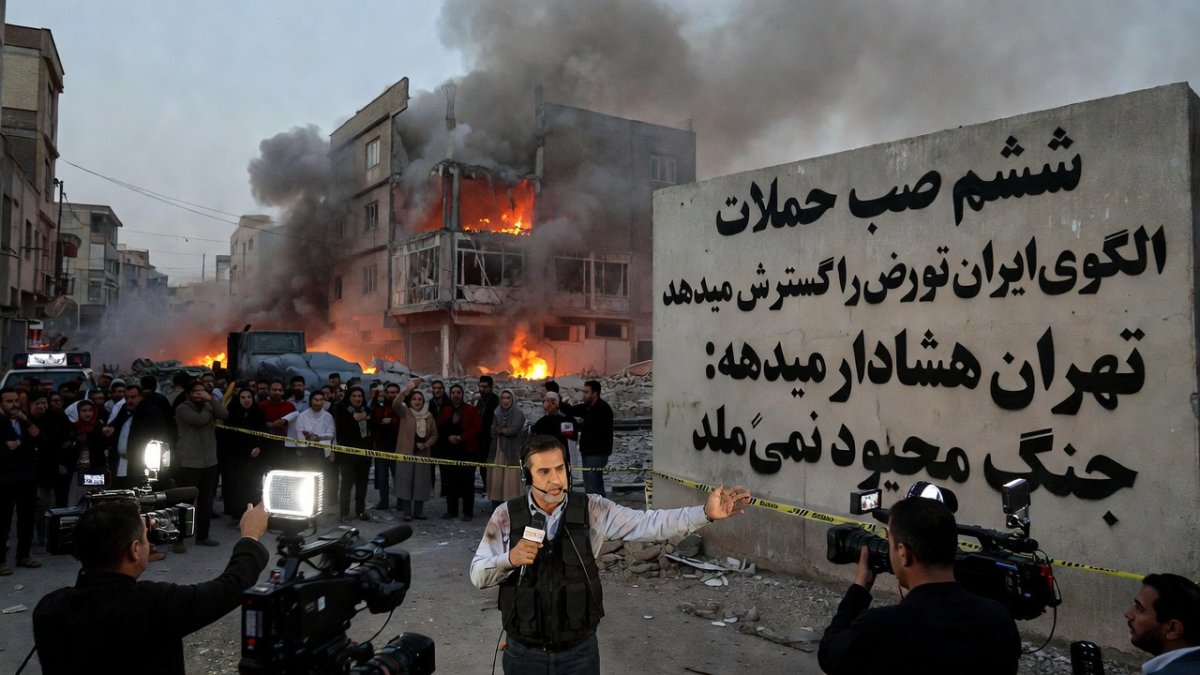
Escalation Intensifies in the Sixth Consecutive Night of Bombardment
The United States military launched its sixth consecutive night of strikes against Iran on Thursday, expanding the scope of its campaign as the two sides wage an increasingly dangerous battle for control of the Strait of Hormuz. US Central Command, or Centcom, confirmed that the fresh wave of attacks targeted what it described as "dozens of Iranian military targets" across southern Iran, including coastal surveillance systems, air defense sites, military logistics infrastructure, and naval capabilities.
But on the ground in Iran, the picture looks very different. Iranian state media reported that the strikes hit civilian infrastructure — bridges, a railway station, and even a civilian airport. The BBC has independently verified an attack on a bridge west of Bandar Abbas in Hormozgan province, a key transportation artery in the region. State news agency IRNA reported at least seven people were killed in the overnight strikes, bringing the total death toll to 38 since the latest round of fighting resumed, with more than 400 injured according to Iran's health ministry.
Centcom, however, did not mention bridges or civilian infrastructure in its official list of targets. It said jets, drones, and ships had been used in the operation. The BBC has asked Centcom for clarification on the reported civilian infrastructure strikes.
What Was Hit? A Detailed Look at Thursday Night's Targets
Iranian state media painted a stark picture of the damage. According to reports from IRNA and the semi-official Fars News Agency, US missiles struck Iranshahr Airport in southeastern Iran, a railway branch station in the coastal city of Bandar Khamir, and at least five bridges in the port city of Bandar Abbas. Power lines in Bandar Abbas and surrounding villages were also damaged, according to Iranian officials.
The Bandar Khamir bridge — a critical overpass linking Bandar Abbas to the city of Lar — was hit while vehicles were crossing, reportedly leaving at least one person dead and several injured on the bridge itself. In Bandar Abbas, a railway station was struck, injuring two employees, according to Iranian state television. The city sits at the narrowest point of the Strait of Hormuz and houses the headquarters and main base of the Iranian Navy.
Strikes also hit close to the island of Qeshm and the southern coastal cities of Bushehr — the site of Iran's Bushehr Nuclear Power Plant — raising concerns about the potential for a catastrophic accident should any stray munitions hit the facility. Russia's state nuclear agency Rosatom, which operates the plant, has not commented on the proximity of the strikes.
Iran Retaliates: IRGC Launches Multi-Front Response
Iran's Islamic Revolutionary Guard Corps (IRGC) did not take the strikes lying down. In a coordinated multi-front response, the IRGC announced it had struck US maritime surveillance radar sites in Oman, as well as American military facilities in Kuwait and Bahrain. The IRGC also claimed to have attacked a US Special Operations command center at al-Tanf in Syria, near the border with Jordan.
The IRGC said the al-Tanf strike was specifically in retaliation for the killing of Iranian soldiers two days earlier. "You failed to learn your lessons," the IRGC said in a statement carried by Iran's Press TV. Neither Syria nor the United States has commented on the claim of an attack at al-Tanf.
Jordan's military said it shot down three Iranian missiles overnight, with no casualties or damage reported. Kurdish forces in Iraq also confirmed they had shot down eight drones over the city of Erbil, with no casualties. The multi-front nature of Iran's response signals that Tehran is willing and able to project force across the region, even as it absorbs heavy bombardment at home.
The Strait of Hormuz: A Chokepoint Under Siege
At the center of this escalating conflict lies the Strait of Hormuz — the narrow waterway connecting the Persian Gulf to the Gulf of Oman through which roughly 20% of the world's oil passes. The strait has been effectively closed to commercial shipping for weeks. On July 17, live trackers showed just 10 ships transiting the waterway, compared to a normal daily average of approximately 88 vessels.
Centcom announced Friday that US Marines had boarded an oil tanker in the Gulf of Oman as part of the renewed blockade of Iranian ports that began Tuesday night. The command also said it had "redirected 3 commercial vessels trying to run the blockade." During the previous blockade from April 13 to June 18, Centcom said US forces disabled nine ships and redirected more than 140 vessels.
The United Kingdom Maritime Trade Operations reported that a tanker was hit by an unknown projectile on Thursday while sailing near Khasab in Oman. All crew members were reported safe, but the incident underscores the risk to commercial shipping in a waterway that has become a war zone.
Global Economic Fallout: Oil Markets Under Pressure
The closure of the Strait of Hormuz is sending shockwaves through global energy markets. Brent crude oil, the international benchmark, rose to $84.63 per barrel on July 17, up 0.47% from the previous day. Over the past month, Brent has risen nearly 6%, and it is up more than 22% compared to the same period last year. West Texas Intermediate crude also rose, hitting $79.45 per barrel.
The head of the International Energy Agency, Fatih Birol, expressed deep concern about global energy supplies. "We should be worried, and I am worried, if the situation does not improve in the next few weeks," Birol said on Thursday night. His warning comes as European and Asian economies — already grappling with inflation — face the prospect of sustained high energy prices if the Strait remains closed.
Iran has threatened to halt all Middle East energy exports if the conflict continues to escalate, a threat that would devastate global oil markets and send prices well above $100 per barrel. The IEA has been in contact with member nations about potential strategic petroleum reserve releases, though no formal announcement has been made.
International Diplomacy Stumbles as Fighting Intensifies
Diplomatic efforts to halt the fighting have so far failed to gain traction. On Friday, Chinese Foreign Minister Wang Yi and Pakistani Foreign Minister Bilawal Bhutto Zardari jointly called for the US and Iran to stop fighting and resume negotiations. But the call has gone largely unheeded as both sides double down on military action.
White House press secretary Karoline Leavitt said on Thursday that President Donald Trump "remains open to talks with Iran," even as US bombs continue to fall on Iranian cities. That mixed messaging has frustrated international mediators, who point out that the administration has not put forward any concrete proposal for a ceasefire.
The conflict has also strained US relations with Gulf allies. Iran's IRGC has repeatedly struck US military facilities in Kuwait, Bahrain, Qatar, and Oman, putting Washington's Gulf partners directly in the crossfire. While the US maintains military bases in all four countries, each faces domestic pressure to distance itself from a war that is drawing retaliatory strikes onto their soil.
Earlier this week, Trump had threatened to strike Iran's bridges and power plants if the country did not return to talks — a threat he first made in April. The UN human rights chief, Volker Türk, responded by warning that "deliberately attacking civilians and civilian infrastructure is a war crime." Those warnings now appear prescient, as Iranian officials report precisely those types of targets being hit.
What This Means: The War Is No Longer Limited
This is the critical point that cannot be overstated: the conflict has crossed a threshold. When a US military campaign hits civilian infrastructure — bridges, railway stations, airports — and when Iran responds by striking targets in five different countries simultaneously, the word "limited" no longer applies.
The strikes on Bandar Abbas and Iranshahr Airport represent a significant expansion of targeting. In previous rounds, the US focused on military installations, air defense systems, and naval assets. Hitting transportation infrastructure signals a strategic shift toward economic warfare — degrading Iran's ability to move goods, people, and military supplies within its own borders. Trump's explicit threat to target power plants suggests this may not be the ceiling.
For Iran, the calculus is equally dangerous. The IRGC's ability to strike US allies across the Gulf demonstrates that Tehran retains significant offensive capability despite weeks of bombardment. But each Iranian retaliation gives Washington more justification to expand its targeting further. This escalation spiral has no obvious off-ramp.
The closure of the Strait of Hormuz — now in its critical phase with only a fraction of normal traffic — is a self-imposed wound for both sides. Iran loses its primary source of revenue from oil exports, while the global economy absorbs the shock of higher energy prices. Neither side appears willing to blink first.
The Human Cost: Behind the Numbers
Amid the strategic analysis and military assessments, it's worth remembering what these numbers represent. Thirty-eight dead and more than 400 wounded since fighting resumed — these are not just statistics. They are families in Bandar Abbas waking up to find their neighborhood bridge destroyed. They are railway employees in Bandar Khamir injured while going to work. They are the thousands of residents in southern Iran who have now lived through six consecutive nights of bombardment.
And the war is not confined to Iran. Civilians in Kuwait, Bahrain, and Jordan have faced incoming missiles and drones. Commercial sailors in the Gulf of Oman now navigate waters where tankers are being hit by projectiles. The human toll of this conflict is spreading across the region, and there is no end in sight.
The IEA chief's warning — "if the situation does not improve in the next few weeks" — carries an implicit acknowledgment that the world may be facing a prolonged crisis. Weeks, not days. The question nobody has answered yet: what comes after "weeks"?
By Jessica Ali, Staff Writer
This article was produced with AI-assisted research and editorial support. Reporting is based on sources cited in the article.
What's Your Reaction?
 Like
0
Like
0
 Dislike
0
Dislike
0
 Love
0
Love
0
 Funny
0
Funny
0
 Wow
0
Wow
0
 Sad
0
Sad
0
 Angry
0
Angry
0

Editor-in-Chief at Global1.News. Atlanta-based journalist who cuts through the BS and tells it like it is. Lead anchor, host, and the voice you hear when the spin stops and the truth starts.











Comments (0)