
South Korea's Prosecution Overhaul: Reining In a Once-Untouchable Institution
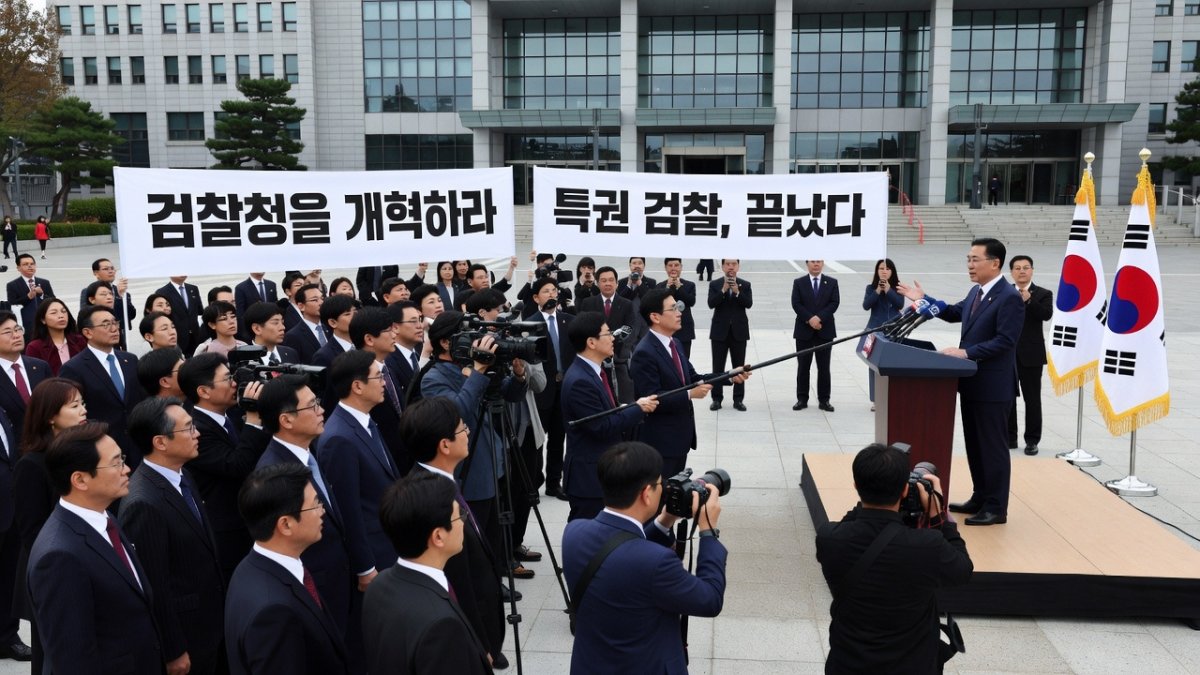
From Monopoly to Institutional Division South Korea is implementing one of the most far-reaching legal reforms in its modern history. In September 2025, the National Assembly passed and the Cabinet approved an amendment to the Government Organization Act that abolishes the 78-year-old Prosecutors' Office. The reform, which is coming into force on October 2, 2026, divides prosecutorial and investigative powers between two new institutions: the Public Prosecution Service under the Ministry of Ju
From Monopoly to Institutional Division
South Korea is implementing one of the most far-reaching legal reforms in its modern history. In September 2025, the National Assembly passed and the Cabinet approved an amendment to the Government Organization Act that abolishes the 78-year-old Prosecutors' Office. The reform, which is coming into force on October 2, 2026, divides prosecutorial and investigative powers between two new institutions: the Public Prosecution Service under the Ministry of Justice and the Serious Crimes Investigation Agency under the Ministry of the Interior and Safety. This restructuring marks a decisive break with a postwar institutional model that concentrated coercive legal authority in a single, highly centralized body.
For decades, South Korea's prosecution system combined investigation and indictment in ways more commonly associated with autocratic legal orders than with consolidated democracies. Prosecutors exercised powers that in many jurisdictions are reserved for the police, and they used those distended capabilities to shape political outcomes as well as criminal cases. The reform now being phased in seeks to dismantle that monopoly and to reassign functions along clearer institutional lines. Whether the redesign will deliver accountability without sacrificing investigative capacity remains the central question facing policymakers, courts, and the legal profession as the October 2026 transition approaches.
Why Prosecutorial Power Became a Political Problem
The Prosecutors' Office long occupied a singular place in South Korea's constitutional order. Its monopoly on both investigation and prosecution allowed it to initiate, expand, and terminate cases with limited external constraint. That concentration of authority produced a recurring pattern of political entanglement. Each of the past five presidents was investigated by prosecutors after leaving office, a cycle widely described as "revenge politics." The practice reinforced public suspicion that the institution functioned less as a neutral guardian of legality than as an instrument of factional score-settling.
The problem was not merely episodic. Prosecutors' coercive tools — search, seizure, detention requests, and the ability to steer investigations — gave them leverage over political actors, business elites, and media narratives. Criminal charges brought against current President Lee Jae-myung during his candidacy were paused while he serves in office, illustrating how prosecutorial timing itself can become a political variable. In comparative terms, few advanced democracies have allowed a single office to hold such simultaneous control over fact-finding and charging decisions. The Korean model therefore stood as an outlier, and its political consequences accumulated across successive administrations.
Institutional dynamics within the prosecution further amplified these risks. Hierarchical command structures and a culture of internal loyalty made independent oversight difficult. When political incentives aligned with prosecutorial ambition, the result was often selective enforcement rather than even-handed application of the law. Reformers have long argued that only structural separation — not personnel changes or rhetorical commitments — could interrupt this pattern.
A Long Trail of Incomplete Reforms
Efforts to constrain prosecutorial power are not new. President Roh Moo-hyun, who governed from 2003 to 2008, initiated reforms aimed at rebalancing investigative authority but encountered strong resistance from within the legal bureaucracy and from political opponents who benefited from the status quo. The incomplete nature of those early attempts left the core monopoly intact and set a precedent for subsequent half-measures.
The Moon Jae-in administration, in office from 2017 to 2022, pursued a more ambitious agenda. It created the Corruption Investigation Office for High-Ranking Officials as a check on prosecutorial monopoly in cases involving senior public figures. That institutional innovation was intended to introduce external scrutiny and to reduce the prosecution's exclusive gatekeeping role. Yet the reforms provoked fierce opposition. Then-Prosecutor General Yoon Suk-yeol denounced the changes, defied the Moon administration, resigned in 2021, and was elected president in 2022. His trajectory from chief prosecutor to head of state underscored how thoroughly prosecutorial politics had become intertwined with national leadership contests.
Yoon himself is now standing trial for insurrection after being impeached for declaring martial law in December 2024. The irony is difficult to ignore: a figure who rose by defending prosecutorial prerogatives now faces the criminal process under a system whose legitimacy remains contested. The sequence of events from Roh through Moon to Yoon demonstrates that personal leadership alone cannot resolve structural concentration of power. Only durable institutional redesign, backed by legislative majorities and administrative preparation, can alter the underlying incentives.
How the New Dual Structure Will Function
The reform's architecture is deliberately dual. The prosecutor general, historically a ministerial-level official, will give way to two vice-ministerial positions. The Serious Crimes Investigation Agency, placed under the Ministry of the Interior and Safety, is charged with handling major crime investigations. The Public Prosecution Service, under the Ministry of Justice, is to focus solely on prosecution — indictments, courtroom advocacy, and warrant applications. In principle, this separation removes the prosecution's ability to both gather evidence and decide whether to charge, a combination that previously invited abuse.
The division of labor is intended to create mutual checks. Investigators in the new agency will develop cases without the immediate prospect of controlling the charging decision, while prosecutors will evaluate evidence assembled by a separate body. Warrant applications will still require judicial approval, preserving a third institutional layer. The design draws on comparative experience in systems that distinguish police investigation from prosecutorial review, though South Korea's version is tailored to its own history of prosecutorial dominance.
Implementation, however, depends on more than organizational charts. Coordination protocols between the Serious Crimes Investigation Agency and the Public Prosecution Service will determine whether cases move efficiently or stall in bureaucratic friction. Resource allocation, personnel transfers, and the rewriting of internal regulations all remain works in progress. A Prosecution Reform Task Force launched on October 1, 2025, is preparing over a thousand related legal and regulatory provisions, an indication of the scale of the administrative undertaking required before the October 2, 2026 effective date.
Lessons from Wrongful Prosecution
The case of Yu Woo-sung has become emblematic of the pathologies the reform seeks to correct. Yu was wrongfully charged with espionage on the basis of fabricated evidence and was later re-indicted on minor charges in a sequence widely condemned as retaliatory. The episode illustrated how a prosecution vested with both investigative and charging powers could manufacture a narrative, sustain it through institutional inertia, and then pivot to lesser accusations when the original case collapsed. Such conduct eroded public trust and demonstrated that internal professional norms were insufficient safeguards.
Wrongful prosecution of this kind is not merely an individual injustice; it is a systemic signal. When an institution can fabricate, charge, and re-charge without effective external constraint, the rule of law becomes contingent on the self-restraint of those who hold the monopoly. The Yu Woo-sung case therefore supplied reformers with a concrete, publicly understood example of why structural separation was necessary. It also highlighted the human costs of delayed reform: years of legal jeopardy, reputational harm, and the broader chilling effect on political and civic activity.
By separating investigation from prosecution, the new framework aims to make fabrication and retaliatory re-indictment more difficult. Evidence assembled by one agency must survive scrutiny by another before charges are filed. That additional filter does not eliminate error or malice, but it raises the institutional cost of both. Whether the filter will function as intended depends on the independence and professional culture of the two successor bodies — questions that will only be answered after the reform is phased in.
Courts, Lawyers, and the Remaining Controversies
As of July 2026, the Supreme Court expressed its first-ever opinion on a proposed amendment to the Criminal Procedure Act that would completely abolish the prosecution's right to supplementary investigations. The National Court Administration stated that "complementary measures to prevent side effects must be prepared alongside the reform." The Korean Bar Association has also weighed in, reflecting professional concern that abrupt curtailment of residual prosecutorial tools could produce gaps in case preparation or courtroom readiness.
Controversy continues over how much to shave the prosecutors' inordinate powers. Some advocates favor a clean break that leaves the Public Prosecution Service with no investigative residual whatsoever. Others warn that complete abolition of supplementary investigation rights could impair the ability to correct incomplete files or respond to new evidence emerging after initial transfer from the Serious Crimes Investigation Agency. The Supreme Court's intervention signals that the judiciary intends to shape the final contours of the reform rather than merely implement legislative text.
These debates are healthy in a constitutional democracy, but they also reveal unfinished business. The Government Organization Act amendment establishes the dual structure; the Criminal Procedure Act amendments will determine the operational boundaries of each institution. Until those boundaries are settled, uncertainty will affect training, staffing, and inter-agency protocols. The months remaining before October 2, 2026, are therefore critical for legislative fine-tuning and administrative rehearsal.
What This Means
The abolition of the Prosecutors' Office and the separation of investigative and prosecutorial powers constitute a structural rebalancing of South Korea's legal state. If successfully implemented, the reform should reduce the capacity of any single institution to weaponize criminal process against political opponents, thereby interrupting the cycle of "revenge politics" that has shadowed successive presidencies. It should also align South Korea more closely with democratic norms that treat investigation and charging as distinct functions subject to mutual oversight.
Regionally, the reform carries strategic significance. South Korea's legal institutions are watched by neighbors and partners as indicators of democratic resilience. A credible reduction in prosecutorial overreach strengthens the country's claim to rule-of-law leadership in Northeast Asia and may influence reform debates elsewhere in the region where concentrated prosecutorial power remains a concern. Domestically, the change recalibrates relations among the Ministry of Justice, the Ministry of the Interior and Safety, the courts, and the political branches, creating new veto points and new coordination requirements.
Yet the implications are not uniformly positive. Critics warn of investigative efficiency losses, coordination failures between the Serious Crimes Investigation Agency and the Public Prosecution Service, and the risk that the new investigation agency could itself become an unaccountable authority. Administrative readiness for the October 2, 2026 transition remains an open question despite the work of the Prosecution Reform Task Force. If complementary measures are inadequate, the reform could produce fragmented case management, delayed indictments, or gaps in the handling of complex financial and security crimes.
For President Lee Jae-myung's government, successful implementation would represent a lasting institutional legacy and a partial answer to the charges that once shadowed his own candidacy. For the broader public, the test will be whether high-profile cases after the transition appear fairer, more transparent, and less politically timed. Academic observers should track not only formal compliance with the new statutes but also informal practices — personnel networks, case-selection patterns, and inter-agency negotiation — that will determine whether the dual structure functions as designed or reverts to old hierarchies under new names.
In historical perspective, the reform closes a chapter that began with the establishment of the Prosecutors' Office in the early years of the Republic and that matured into a system capable of investigating every recent former president. Ending that monopoly is a necessary condition for a more balanced constitutional order. It is not a sufficient condition. Sustained oversight, professional culture change, and careful calibration of residual powers will decide whether October 2, 2026, is remembered as a genuine turning point or as another incomplete reform in a long sequence of attempts.
Preparing for the October Transition
The immediate challenge is administrative and legal readiness. Over a thousand related legal and regulatory provisions are being prepared by the Prosecution Reform Task Force. Training programs for personnel moving into the Public Prosecution Service and the Serious Crimes Investigation Agency must be completed. Information systems that once served a unitary prosecution must be divided or rebuilt to support two separate chains of command. Budgetary allocations, office space, and security clearances all require resolution before the effective date.
Political management of the transition is equally important. Stakeholders who benefited from the old monopoly retain influence and may seek to preserve informal channels of control. Transparent reporting on implementation milestones, combined with legislative oversight hearings, can reduce the space for quiet re-concentration of power. The judiciary's insistence on complementary measures should be heeded: efficiency safeguards and clear protocols for evidence transfer will determine whether the dual system can handle serious crime without reverting to prosecutorial self-help.
South Korea's prosecution overhaul is therefore both a legal event and a test of state capacity. The statutes are in place; the institutions are being stood up; the effective date is fixed. What remains is the disciplined work of making the separation real in daily practice. If that work succeeds, a once-untouchable institution will have been brought within the bounds of democratic accountability. If it falters, the country may discover that abolishing an office is easier than abolishing the habits of power that office once embodied.
By Prof. David Park, Staff Writer
===SUMMARY=== South Korea is abolishing its 78-year-old Prosecutors' Office, splitting investigative and prosecutorial powers between two new agencies by October 2026. The landmark reform aims to end a monopoly that fueled political revenge cycles against five former presidents.This article was produced with AI-assisted research and editorial support. Reporting is based on sources cited in the article.
What's Your Reaction?
 Like
0
Like
0
 Dislike
0
Dislike
0
 Love
0
Love
0
 Funny
0
Funny
0
 Wow
0
Wow
0
 Sad
0
Sad
0
 Angry
0
Angry
0

East Asia/Technology Correspondent at Global1.News. Seoul-based voice covering Korean politics, technology, business, and culture. Analyzes how technology and geopolitics intersect across East Asia.












Comments (0)