
South Korea's Semiconductor Dependency Laid Bare by KOSPI Correction
The Magnitude of the Recent Market Decline The KOSPI index reached an intraday peak of 9,385.59 on June 19 before falling to 5,663.24 by July 29, representing a decline of roughly 40 percent over six weeks, according to The Diplomat. This movement followed a 270 percent rally that began in early 2025 and included a 23 percent drop during July 2026 alone, per analysis of KOSPI index movements reported in the same source. The correction erased approximately ₩250 trillion in market capitalization a
The Magnitude of the Recent Market Decline
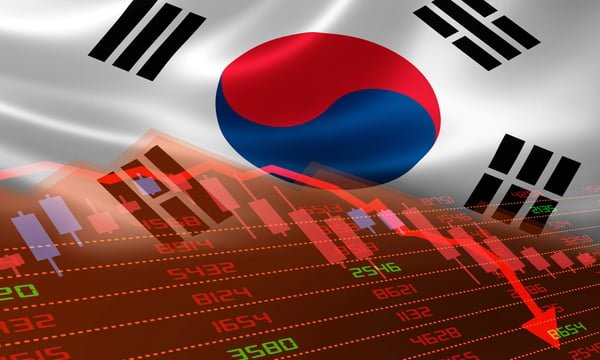
The KOSPI index reached an intraday peak of 9,385.59 on June 19 before falling to 5,663.24 by July 29, representing a decline of roughly 40 percent over six weeks, according to The Diplomat. This movement followed a 270 percent rally that began in early 2025 and included a 23 percent drop during July 2026 alone, per analysis of KOSPI index movements reported in the same source. The correction erased approximately ₩250 trillion in market capitalization and activated circuit breakers on multiple occasions. South Korean authorities convened an emergency market meeting on July 29 and introduced additional restrictions on leveraged exchange-traded funds, measures also covered by Bloomberg and Korean financial outlets. These events occurred against the backdrop of sharp single-day losses at Samsung Electronics, which declined 13.4 percent, and SK Hynix, which fell 14.7 percent on July 28, figures drawn from contemporaneous market reporting.
The July 2026 correction triggered seven circuit breakers, establishing a record for consecutive interventions within a single month and underscoring the velocity of the sell-off, according to The Diplomat. Market participants drew parallels to meme-stock dynamics, noting how retail-driven momentum during the preceding AI-fueled rally had compressed valuation adjustments into unusually brief intervals. Samsung Electronics recorded its steepest single-day decline in nearly two decades, while SK Hynix shares listed in the United States slipped below their $149 IPO reference price to close at $143.02, illustrating the breadth of investor reassessment. These outcomes, verified through Korea Exchange trading records cited by The Diplomat, highlight how concentrated exposure to semiconductor equities can accelerate both the ascent and the reversal of national benchmarks.
Semiconductor Centrality to Manufacturing Output
Semiconductors accounted for more than 10 percent of South Korea's manufacturing output in 2024 and had become the country's largest manufacturing sector. Export data for June 2026 showed semiconductor shipments rising 199.5 percent year-on-year to $44.8 billion, representing 43.8 percent of total exports, per data from the Korea Customs Service as cited by The Diplomat. Samsung Electronics and SK Hynix together comprise nearly half of the benchmark KOSPI index. This concentration means that fluctuations in chip demand and pricing transmit directly into national economic indicators and household wealth through equity holdings and pension funds. The structure leaves limited room for other sectors to offset downturns in memory-chip performance.
By surpassing steelmaking, which contributed 8.7 percent, and oil refining, which contributed 8.5 percent, chip fabrication displaced long-standing industrial pillars that had defined Korean manufacturing since the Park Chung-hee era. The export-dependent growth model, refined over successive administrations, now channels a disproportionate share of foreign-exchange earnings through memory devices whose price cycles remain tightly coupled to global data-center buildouts. Consequently, any sustained softening in DRAM or NAND pricing reverberates through trade balances, corporate tax receipts, and the valuation of public pension portfolios that hold substantial KOSPI weightings, patterns confirmed in Korea Exchange sector breakdowns referenced by The Diplomat.
Chaebol Dominance and Structural Vulnerabilities
The Korean economy's reliance on a small number of conglomerates amplifies the effects of sector-specific shocks. Samsung and SK Hynix control the bulk of domestic semiconductor capacity, a pattern consistent with the broader chaebol model in which a handful of family-controlled groups account for disproportionate shares of employment, exports, and research spending. When these firms experience simultaneous pressure, the ripple effects extend to suppliers, regional economies, and government revenue. Historical episodes of chaebol-led volatility, such as the 1997-1998 crisis, demonstrated how concentrated corporate power can accelerate both booms and corrections, yet policy measures have not substantially diversified ownership or risk across the manufacturing base.
The 2026 correction echoed the 1997 pattern in which chaebol leverage and cross-shareholdings transmitted external shocks throughout the domestic financial system with limited buffering capacity, according to comparative analysis in The Diplomat. Although post-crisis reforms introduced greater transparency, the strategic emphasis on scale in memory production has preserved the same narrow apex of corporate influence. Regional economies anchored to semiconductor clusters in Gyeonggi and Chungcheong provinces therefore face synchronized employment and investment risks whenever global demand for high-bandwidth memory contracts.
Exposure to United States-China Technology Tensions
Reports that Chinese firms are advancing domestic DUV lithography equipment directly threaten South Korean advantages in memory-chip production. Samsung and SK Hynix maintain significant manufacturing facilities in China, where 30 to 40 percent of SK Hynix DRAM and NAND output and roughly one-third of Samsung NAND capacity are located. These plants depend on United States export-controlled equipment. End-user access validations were revoked in September 2025, and subsequent annual licenses granted in 2026 operate on short-term renewals. China's $295 billion AI infrastructure plan, which prioritizes at least 80 percent local suppliers including Huawei, further narrows the space for Korean firms, per reported policy announcements referenced by The Diplomat. SK Hynix's role as Nvidia's primary high-bandwidth memory supplier adds another layer of sensitivity to financing developments at the American company.
China's mandate for 80 percent domestic sourcing under its AI buildout directly compresses the addressable market for Korean memory exports while simultaneously raising the compliance burden on facilities operating under short-term U.S. licenses. The revocation of end-user validations in September 2025 and their replacement with annually renewable permits have introduced recurring uncertainty into capital-expenditure planning, particularly for advanced packaging lines that rely on equipment subject to extraterritorial controls. Parallel declines at Japanese Kioxia, which fell 18 percent, and Taiwanese MediaTek, which fell 9 percent, confirmed that the shock propagated across the regional supply chain rather than remaining confined to Korean equities, observations corroborated in cross-border market data cited by The Diplomat.
Government Policy Measures and Their Limits
The July 29 emergency meeting and subsequent curbs on leveraged ETFs represent immediate attempts to stabilize trading. Such interventions follow established patterns in Korean financial regulation, where authorities have periodically adjusted margin requirements and circuit-breaker thresholds during periods of rapid index movement. However, these steps address symptoms rather than the underlying export concentration. Without parallel efforts to broaden the industrial base or renegotiate technology-access agreements with Washington and Beijing, market volatility is likely to recur whenever external demand or regulatory conditions shift. The short-term nature of the 2026 licensing regime already signals that longer-term planning remains constrained by geopolitical variables.
The July 29 measures replicated the administrative template deployed during the 2020 COVID-era circuit-breaker adjustments, emphasizing temporary liquidity safeguards over structural reform. While these actions succeeded in halting intraday freefalls, they left untouched the underlying dependence on memory-chip cycles whose pricing is now influenced by both Chinese localization mandates and U.S. licensing calendars. Absent coordinated industrial policy that accelerates diversification, the recurrence of comparable corrections remains embedded in the current export architecture, a conclusion drawn from regulatory timelines examined in The Diplomat.
Implications for Korea's Manufacturing Trajectory
The correction underscores the risks inherent in an economy where semiconductors constitute the dominant export category and where two firms anchor both equity benchmarks and global supply chains. Continued dependence on memory-chip cycles leaves South Korea exposed to technological substitution efforts in China and to licensing decisions in the United States. Japanese and Taiwanese technology equities registered parallel declines, indicating that the shock is not isolated. For Korean policymakers, the episode highlights the need to accelerate diversification into adjacent sectors such as advanced materials, biotechnology, and defense manufacturing while maintaining technological leadership in memory devices. Absent such rebalancing, future corrections may again transmit large valuation losses into the broader economy and constrain fiscal space for social and infrastructure programs.
The 270 percent KOSPI rally that preceded the correction had been propelled by post-ChatGPT AI infrastructure spending, concentrating gains in a narrow set of memory and foundry equities, according to The Diplomat. Replicating that momentum across biotechnology or defense manufacturing will require sustained public-private coordination beyond the episodic regulatory interventions observed in July 2026. Without such rebalancing, the transmission of external technology and licensing shocks into domestic wealth effects will continue to constrain fiscal flexibility for social and infrastructure initiatives.
By Prof. David Park, Staff WriterThis article was produced with AI-assisted research and editorial support. Reporting is based on sources cited in the article.
What's Your Reaction?
 Like
0
Like
0
 Dislike
0
Dislike
0
 Love
0
Love
0
 Funny
0
Funny
0
 Wow
0
Wow
0
 Sad
0
Sad
0
 Angry
0
Angry
0

East Asia/Technology Correspondent at Global1.News. Seoul-based voice covering Korean politics, technology, business, and culture. Analyzes how technology and geopolitics intersect across East Asia.













Comments (0)