
New U.S. bans to take effect Tuesday: Here’s what’s affected
U.S. import bans on a select group of Canadian products are set to take effect early Tuesday, marking the latest escalation in a trade dispute that has already seen both sides impose tariffs and counter‑measures.
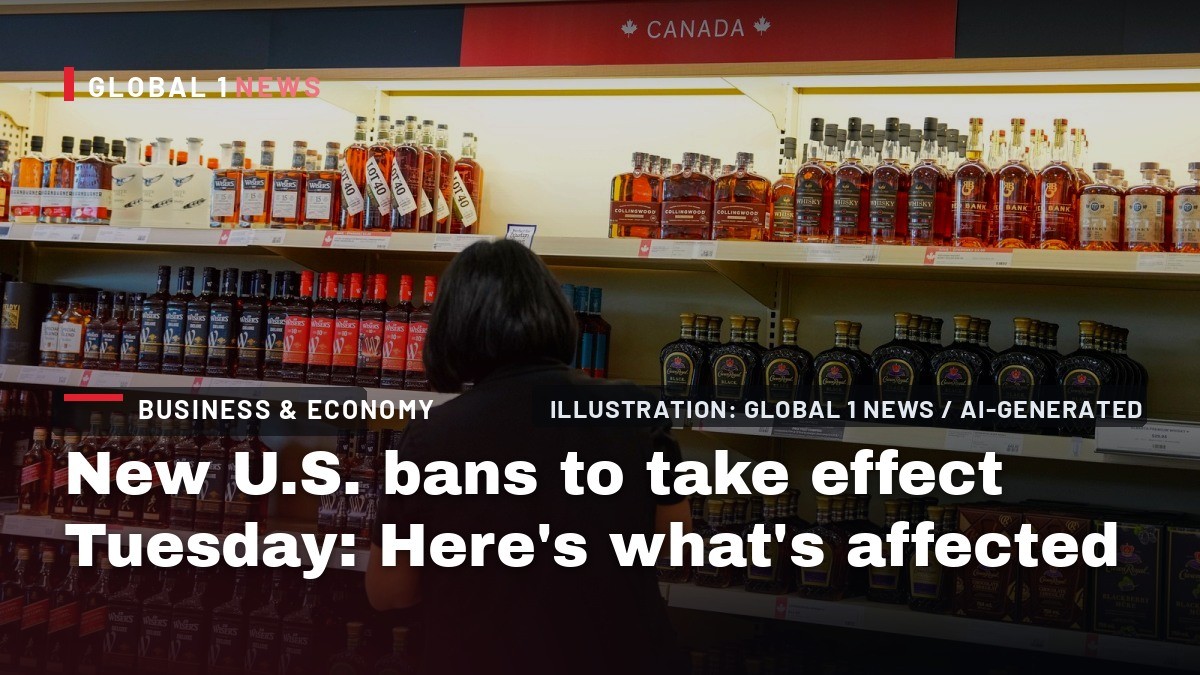
U.S. import bans on a select group of Canadian products are set to take effect early Tuesday, marking the latest escalation in a trade dispute that has already seen both sides impose tariffs and counter‑measures. The bans, which will be enforced at 12:01 a.m. local time, target Canadian‑made cheese and other whey‑derived dairy items, a range of alcoholic beverages, and motorcycles equipped with internal‑combustion engines over 800 cc. As the restrictions come into force, Canadian officials are urging calm while maintaining open lines of communication with their American counterparts.
Scope of the new bans
The executive orders signed on 8 September outline a full import ban on Canadian cheese and whey products, a category that includes whey protein and other by‑products of cheesemaking. The ban also extends to alcoholic beverages, encompassing rye, whisky, wine, beer, vermouth, tequila, vodka and rum, in both packaged and unpackaged forms. Motorcycles, mopeds and other cycles with a reciprocating internal‑combustion engine exceeding 800 cc are likewise prohibited from entering the United States.
Notably, the White House fact sheet excludes cane and invert molasses from the ban, indicating that not every sugary product is caught up in the new restrictions. While the list of items is limited compared to earlier tariff rounds, the sectors affected—dairy, alcohol and motor vehicles—are significant exporters to the United States.
Impact on Canada’s alcohol exports
Alcoholic beverages have long been a major component of Canada’s trade with its southern neighbour. The Trade Commissioner Service reports that in 2023 Canada exported roughly $1.36 billion worth of alcoholic drinks, with ninety per cent destined for the United States. Spirits alone accounted for about two‑thirds of that total, underscoring the importance of the U.S. market for Canadian distilleries.
Industry groups provide further detail on the composition of those exports. Wine Growers of Canada noted that in 2025, about $8.3 million of wine was shipped to the United States, more than half of which—57 per cent—was ice wine, a premium product that commands a niche market. Beer Canada reported that the previous year saw $28 million in beer exports, representing roughly ten per cent of all Canadian beer production, with the United States identified as its primary export partner.
Dairy sector under pressure
Dairy has been a recurrent flashpoint in recent trade talks, and the new ban on whey products adds fresh strain to an already delicate relationship. Statistics Canada recorded that in 2024 Canadian dairy exports to the United States exceeded $700 million. While the exact share of those exports that would be affected by a full ban on whey is not quantified in the source material, the Dairy Farmers of Canada described the escalation of trade actions as “deeply concerning.” The organisation did not disclose the annual value of dairy exports or estimate the proportion of revenue at risk.
The focus on whey reflects its status as a by‑product of cheese production, linking the dairy ban directly to the broader cheese prohibition. Because whey is a key ingredient in protein powders and other processed foods, the restriction could ripple through supply chains that depend on Canadian dairy derivatives.
Motorcycle restrictions and the automotive context
The inclusion of motorcycles in the ban signals a widening of the trade dispute into the automotive arena. The White House document specifies that motorcycles, mopeds and other cycles fitted with a reciprocating internal‑combustion engine over 800 cc are prohibited. This mirrors earlier U.S. tariffs that targeted a range of Canadian goods, and follows a pattern of reciprocal measures that have characterised the trade war.
While the ban does not extend to electric or lower‑capacity two‑wheelers, the focus on higher‑capacity internal‑combustion models could affect Canadian manufacturers that specialise in performance or touring motorcycles. The sector is relatively small compared with the broader automotive industry, but the measure underscores the United States’ willingness to target niche markets as leverage in negotiations.
Political backdrop and statements from officials
President Trump framed the bans as a response to Canada’s own counter‑tariff measures, which were introduced on 8 September after the United States imposed 50 per cent tariffs on a range of Canadian goods. In his remarks, Trump argued that Canada had not ceased discriminating against U.S. autos, dairy and vehicles, and that the bans were “consistent with the interests of the United States and the public interests.”
From the Canadian side, Trade Minister Dominic LeBlanc confirmed that Ottawa “maintains ongoing communications with our American counterparts,” though he did not specify whether a formal request for a deal had been made. Trade Representative Jamieson Greer, speaking to CNBC, described the United States as “comfortable” with the current state of trade talks and highlighted that the U.S. continues to import significant volumes of oil, gas and potash from Canada. Greer also noted that Canada periodically seeks a deal, suggesting that diplomatic channels remain open despite the heightened tensions.
Economic implications for Canadian producers
The bans are likely to create immediate disruption for Canadian exporters reliant on the U.S. market. For the alcohol sector, the loss of ninety per cent of export demand could translate into excess inventory, reduced cash flow and potential job losses in wineries, breweries and distilleries that have geared production to meet American demand. Similarly, dairy processors that supply whey for protein powders and other food ingredients may face a sudden market contraction, prompting a search for alternative buyers or a reduction in output.
Motorcycle manufacturers, while a smaller slice of the export pie, could encounter order cancellations and inventory build‑up, especially for models that exceed the 800 cc threshold. The broader impact on the Canadian economy may be modest in absolute terms, given the relative size of the affected sectors, but the symbolic weight of the bans could influence investor confidence and heighten uncertainty for businesses that depend on cross‑border trade.
Looking ahead: prospects for resolution
Analysts note that the trade war is unlikely to resolve before the bans take effect, as Trade Representative Greer indicated that the United States still has “a lot of other trade” with Canada and appears satisfied with the current balance of concessions. The United States’ continued demand for Canadian oil, gas and potash suggests that both sides retain substantial interdependence, which could serve as a foundation for future negotiations.
For now, Canadian officials are urging patience and continued dialogue. The emphasis on “ongoing communications” from Trade Minister LeBlanc signals a diplomatic approach aimed at de‑escalation, even as both governments brace for the economic fallout of the new restrictions. As the bans commence on Tuesday, businesses will be watching closely for any sign of a negotiated settlement that could restore market access and ease the pressure on affected sectors.
This article was produced with AI-assisted research and editorial support. Reporting is based on the source material cited below. Sources: Global News Canada; globalnews.ca; Global1.News (27 September 2026).
By Alex Thompson, Staff Writer
What's Your Reaction?
 Like
0
Like
0
 Dislike
0
Dislike
0
 Love
0
Love
0
 Funny
0
Funny
0
 Wow
0
Wow
0
 Sad
0
Sad
0
 Angry
0
Angry
0

Canada Correspondent at Global1.News. Based in Toronto, covering Canadian politics, energy, trade, and US-Canada relations. Provides the Canadian perspective on North American and global affairs.














Comments (0)