
Turkish Parliament's recycling efforts save 1,541 trees
Turkey’s parliamentary precinct has emerged as a modest yet telling illustration of how institutional waste‑management initiatives intersect with broader regional concerns over sustainability, resource competition and public accountability.
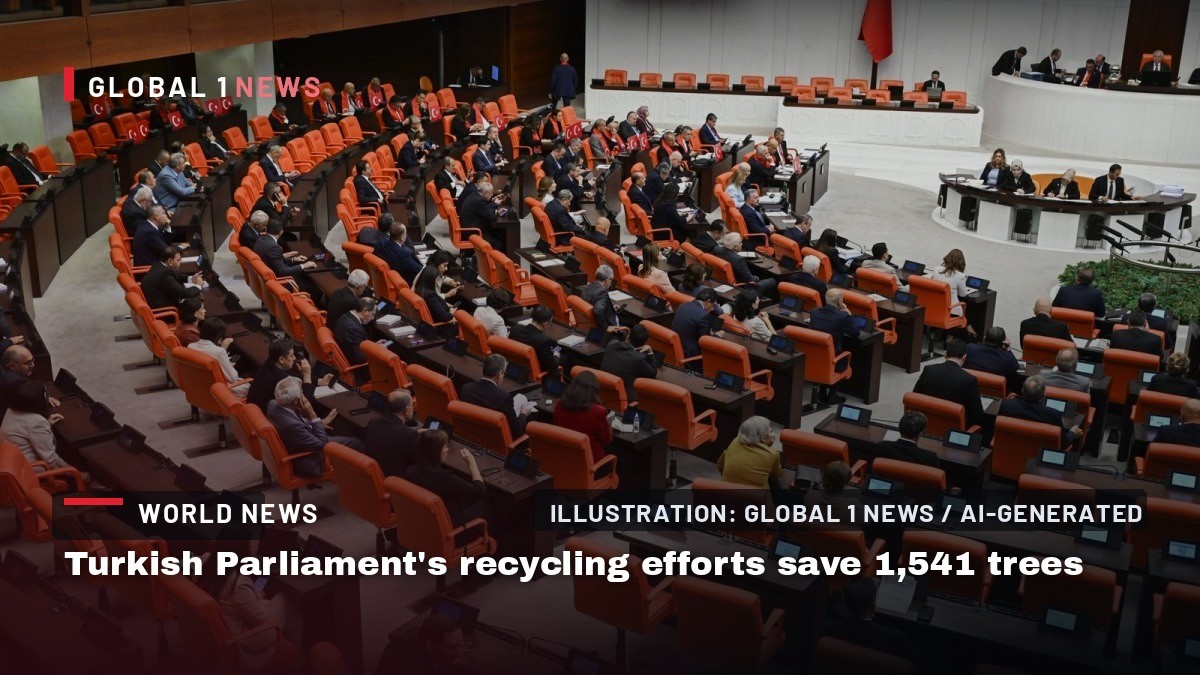
Turkey’s parliamentary precinct has emerged as a modest yet telling illustration of how institutional waste‑management initiatives intersect with broader regional concerns over sustainability, resource competition and public accountability. Between October 2025 and August 2026, the Turkish Parliament’s recycling programme reportedly prevented the felling of 1,541 trees and saved more than 35,000 litres of oil, figures that underscore a growing emphasis on environmental stewardship within state‑run entities across the Middle East. While the absolute scale of these savings is modest compared with national consumption patterns, the symbolic weight of a legislative body championing a zero‑waste ethos carries implications for policy diffusion, public perception and the strategic calculus of governments seeking to balance development with ecological responsibility.
Quantifying the environmental impact
The activity report for the 28th Term’s fourth legislative year details that 90,654 kilograms of waste paper were processed on the Parliament campus, a volume that the report equates with the preservation of 1,541 trees. In parallel, 13,667 kilograms of plastic waste were recycled, a process that the Parliament claims saved 35,643 litres of oil. Additional recycling streams included 2,109 kilograms of glass, over 5,000 kilograms of metal and 3,175 kilograms of biodegradable waste, the latter yielding 884 kilograms of organic fertilizer.
Beyond material recovery, the cumulative effect of these efforts translated into 274 cubic metres of landfill space spared, 454,177 kilowatt‑hours of energy conserved, and 2,538 cubic metres of water saved. The report also cites a reduction of 17,186 kilograms of greenhouse‑gas emissions, a figure that, while modest in the global context, signals a concrete contribution to Turkey’s broader climate‑action commitments under the Paris Agreement.
Institutional mechanisms and certification
The Parliament’s environmental performance rests on an Environmental Management System (EMS) that has been operational since 2014. This system, designed to curtail waste generation, improve resource efficiency and raise staff awareness, underwent a formal audit by the Turkish Standards Institution (TSE) in January 2026. The audit resulted in a renewed EMS certificate, valid until 8 February 2029, and a concurrent renewal of the institution’s Zero Waste Certificate for an additional five‑year term. These certifications provide an external validation that the Parliament’s waste‑handling practices meet nationally recognised standards, reinforcing the credibility of its reported outcomes.
Implementation of the Zero Waste Project on the parliamentary campus involves a segregation infrastructure that separates organic, non‑recyclable, paper, plastic, glass and metal streams. Collected waste is transferred to companies licensed by the Ministry of Environment, Urbanisation and Climate Change, ensuring that recycling and disposal adhere to regulatory frameworks. The presence of two 1,000‑litre composting machines further enables the conversion of kitchen and garden organic waste into fertilizer, closing a loop that aligns with circular‑economy principles.
Social dimensions of the recycling programme
The Parliament’s waste‑management strategy extends beyond environmental metrics to incorporate social responsibility components. Surplus food from parliamentary kitchens is regularly donated to families identified by the Provincial Directorate of Social Services, while uneaten food is collected in hygienic containers and dispatched to an animal shelter in Gölbaşı with municipal support. Moreover, 1,926 kilograms of clothing gathered from donation boxes were transferred to the Turkish Red Crescent (Kızılay) for distribution to those in need, illustrating a linkage between waste reduction and social welfare.
Another notable initiative involved the collection of 100 sacks of acorns, which were handed to the Ankara Forest Nursery Directorate for distribution across 81 provinces. This act of reintroducing native flora into the natural environment not only supports reforestation goals but also demonstrates how parliamentary waste‑reduction efforts can dovetail with national afforestation programmes.
Regional implications and comparative benchmarks
Turkey’s parliamentary recycling outcomes resonate within a regional context where Gulf states and other Middle Eastern governments have launched high‑profile sustainability campaigns. Nations such as the United Arab Emirates and Saudi Arabia have invested heavily in renewable‑energy projects and large‑scale waste‑to‑energy facilities, often framing environmental stewardship as a component of economic diversification. While the scale of the Turkish Parliament’s programme is comparatively limited, its systematic approach—anchored in certification, segregation infrastructure and social outreach—offers a model that could be emulated by other public institutions seeking to integrate environmental performance into their operational mandates.
Furthermore, the Parliament’s emphasis on reducing landfill use and conserving water aligns with broader regional challenges. Water scarcity remains acute across the Middle East, and any measurable reduction in water consumption, even at the institutional level, contributes to national resilience strategies. The reported saving of 2,538 cubic metres of water, though modest, underscores the cumulative impact of incremental efficiencies when replicated across multiple government facilities.
Strategic considerations for policy diffusion
From a strategic perspective, the Parliament’s recycling narrative serves multiple policy objectives. First, it signals to domestic constituencies that the government is attentive to environmental concerns, potentially bolstering public trust in a political climate where ecological issues are increasingly politicised. Second, it provides a tangible data point that can be leveraged in diplomatic dialogues, particularly in multilateral forums where Turkey seeks to position itself as a responsible actor on climate matters.
Third, the integration of social welfare components—food redistribution, clothing donations and animal‑shelter support—illustrates a holistic approach that merges environmental and humanitarian priorities. This synthesis may prove advantageous in negotiations with international partners who increasingly demand that climate‑action initiatives be paired with social equity considerations.
Challenges and prospects for scaling up
Despite the commendable results, the Parliament’s programme faces inherent limitations. The volume of waste processed, while notable for a single institutional campus, remains a fraction of Turkey’s total municipal solid‑waste generation. Scaling such initiatives to the national level would require substantial investment in collection infrastructure, public‑awareness campaigns and market development for recycled materials.
Moreover, the reliance on licensed private firms for waste handling introduces a dependency on market dynamics that can be volatile. Ensuring consistent quality and capacity among recyclers is essential to maintain the integrity of the EMS and to avoid bottlenecks that could undermine the system’s efficacy. Continued certification and periodic audits will be crucial to sustain credibility as the programme expands.
Looking ahead: institutional leadership in a green transition
As Turkey navigates its energy transition—balancing domestic coal reliance with burgeoning renewable‑energy projects—the Parliament’s recycling efforts represent a microcosm of how state institutions can contribute to a greener economy. By institutionalising waste segregation, securing certification, and linking environmental outcomes with social welfare, the Parliament sets a precedent for other ministries, universities and public enterprises.
In the broader Middle Eastern tableau, where great‑power rivalry and resource competition intersect with climate imperatives, such institutional exemplars may become increasingly valuable. They demonstrate that even modest, well‑documented actions can accumulate into a narrative of responsible governance, potentially influencing regional policy dialogues and encouraging a diffusion of best practices across borders. The challenge ahead lies in translating these campus‑level gains into systemic reforms that can address the scale of waste and resource pressures confronting the region.
This article was produced with AI-assisted research and editorial support. Reporting is based on the source material cited below. Sources: Daily Sabah Middle East; dailysabah.com; Global1.News (28 September 2026).
By Malik Hassan, Staff Writer
What's Your Reaction?
 Like
0
Like
0
 Dislike
0
Dislike
0
 Love
0
Love
0
 Funny
0
Funny
0
 Wow
0
Wow
0
 Sad
0
Sad
0
 Angry
0
Angry
0

Middle East Correspondent at Global1.News. Based in Beirut, covering politics, conflict, energy, and society across the Middle East. Brings context and depth to a region often reduced to headlines.














Comments (0)