
Slim slams Moody’s and S&P’s Mexico downgrades as ‘irrational,’ pledges US $5B in new investments
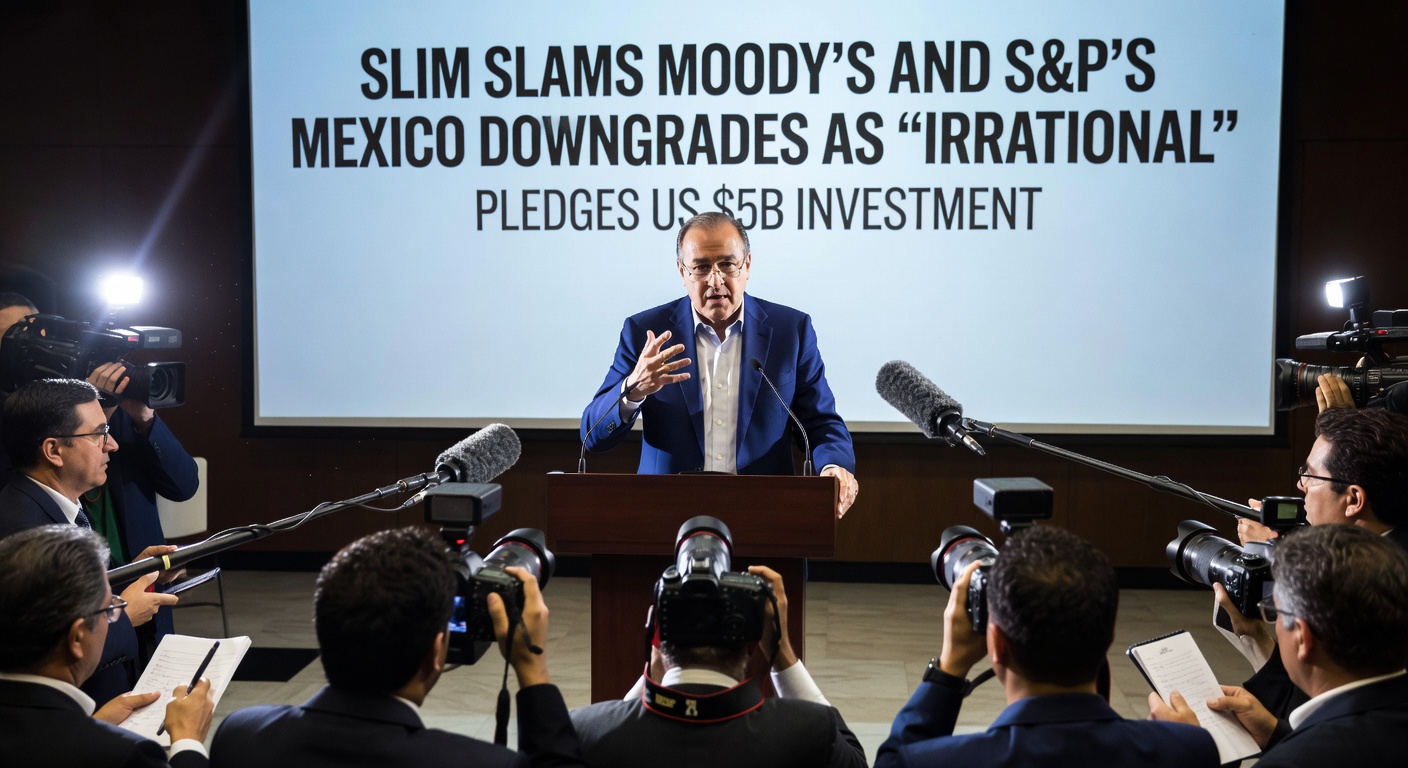
Carlos Slim Denounces Moody’s and S&P Downgrades as ‘Irrational,’ Pledges $5 Billion in Fresh Mexican Investments
Mexico City felt the weight of one man’s conviction this week when Carlos Slim Helú stepped to the podium at his annual press conference and delivered a direct rebuke to two of the world’s most powerful credit-rating agencies. Calling Moody’s and S&P Global’s recent downgrades of Mexico’s sovereign outlook “irrational and disconnected from on-the-ground realities,” the 84-year-old billionaire pledged US $5 billion in new capital through Grupo Carso and its affiliates for 2025 alone. The commitment spans infrastructure, energy, telecommunications, and retail expansion—sectors that touch millions of Mexican households every day.
The Downgrades and Slim’s Sharp Rebuttal
Moody’s lowered Mexico’s outlook to negative in late 2024, citing concerns over fiscal slippage and rising debt-service costs. S&P Global followed with a similar adjustment, pointing to political uncertainty ahead of midterm elections. Slim countered with concrete numbers: public debt remains below 50 percent of GDP, foreign reserves sit at record levels above US $220 billion, and nearshoring-driven manufacturing investment hit US $36 billion last year. “These agencies are reading spreadsheets from air-conditioned offices in New York,” he told reporters. “They are not walking the factories in Monterrey or the logistics corridors in Querétaro where new jobs are being created right now.”
His words landed with particular force because Slim’s conglomerate operates in 14 countries yet keeps the majority of its employment—more than 70,000 direct jobs—in Mexico. Grupo Carso’s diversified holdings include construction giant IDEAL, retail powerhouse Sanborns, and a growing stake in renewable energy projects. When Slim speaks, markets and communities alike listen.
Where the $5 Billion Will Land
The investment package breaks down into four clear streams. First, US $1.8 billion will accelerate toll-road and port expansions under IDEAL, including upgrades to the Manzanillo container terminal that handles 40 percent of Mexico’s Pacific trade. Second, US $1.2 billion targets fiber-optic rollout and 5G infrastructure through Telmex and related entities, aiming to connect an additional 1.2 million rural households by 2027. Third, US $1.5 billion will finance industrial parks and energy generation in the Bajío region, capitalizing on nearshoring demand from U.S. and European automakers. The remaining US $500 million supports retail and healthcare expansion, including new Sanborns stores and pharmacy chains in underserved southern states.
These figures are not aspirational; Slim’s team has already secured land permits and begun preliminary engineering. “We do not announce investments we cannot execute,” he emphasized, noting that Grupo Carso completed 87 percent of its 2024 capital-expenditure targets on schedule.
Economic Backdrop and Community Stakes
Mexico’s economy grew 2.8 percent in 2024 despite global headwinds, driven largely by manufacturing exports and record remittances of US $63 billion. Yet inflation remains sticky at 4.1 percent, and many families still feel the pinch of higher grocery and electricity bills. Slim’s pledge arrives at a moment when small and medium enterprises are hungry for supply-chain contracts. Local chambers of commerce in Puebla and Aguascalientes report that each new industrial park typically generates three indirect jobs for every direct manufacturing position—an economic multiplier that can transform entire neighborhoods.
Economist Gabriela Siller of Banco Base noted that Slim’s track record lends credibility: “When Grupo Carso commits capital, it tends to crowd in additional private investment rather than crowd it out. We saw this pattern during the 2010s telecom reforms.” She added that the $5 billion figure represents roughly 0.3 percent of Mexico’s annual GDP—an amount large enough to move regional indicators but modest enough to be absorbed without overheating.
Political and Market Reactions
President Claudia Sheinbaum’s administration welcomed the announcement. Finance Secretary Rogelio Ramírez de la O issued a brief statement praising “the confidence of Mexico’s leading entrepreneurs in our long-term stability.” Opposition lawmakers, however, questioned whether Slim’s projects would receive favorable regulatory treatment given his historical ties to state contracts. Slim addressed the concern head-on: “Every project goes through the same environmental and bidding processes as anyone else. We win on execution, not on connections.”
Markets reacted calmly. The peso held steady around 20.15 to the dollar in the hours after the conference, while Mexican equity indexes ticked up 0.7 percent. Analysts at Banorte observed that Slim’s public disagreement with the rating agencies may actually reassure foreign investors who value domestic voices over external scorecards.
Long-Term Implications for Mexican Families
Beyond macroeconomic aggregates, the investments carry tangible promise for everyday life. Expanded fiber networks can bring telemedicine and online education to villages that still rely on satellite phones. New industrial parks near Silao and Irapuato will need welders, logistics coordinators, and cafeteria staff—positions often filled by local residents rather than imported talent. Retail expansion in Chiapas and Oaxaca could introduce competition that lowers prices for basic goods in regions where one chain currently dominates.
Community leaders in these states expressed cautious optimism. “We want jobs that pay enough for families to stay together instead of migrating north,” said María Elena Cruz, a cooperative leader in Tuxtla Gutiérrez. Slim’s companies have historically offered above-average wages and training programs, though labor unions continue to press for stronger collective-bargaining rights at some subsidiaries.
Looking Ahead
Carlos Slim’s $5 billion commitment is not a silver bullet for every structural challenge Mexico faces—educational outcomes, water scarcity, and security remain pressing. Yet it signals that at least one major domestic player sees opportunity where rating agencies see risk. In a country where foreign direct investment often dominates headlines, the return of large-scale local capital carries symbolic weight.
As the sun set over the Zócalo, vendors outside the press conference venue were already discussing which neighborhoods might see new construction first. For millions of Mexicans, the coming months will reveal whether Slim’s numbers translate into paychecks, connectivity, and a sense that the economy is being built from the ground up rather than judged from afar.
This is Rosa Martinez for Global1 News, reporting from Mexico City. 🇲🇽
This article was produced with AI-assisted research and editorial support. Reporting is based on sources cited in the article.
What's Your Reaction?
 Like
0
Like
0
 Dislike
0
Dislike
0
 Love
0
Love
0
 Funny
0
Funny
0
 Wow
0
Wow
0
 Sad
0
Sad
0
 Angry
0
Angry
0

Latin America/Andes Correspondent at Global1.News. Based in Bogota, covering politics, environment, energy, and social movements across the Andean region. Passionate about environmental journalism and communities protecting their land.











Comments (0)