
Quad Activities and South Korea's Indo-Pacific Strategy
Quad Activities and South Korea's Indo-Pacific Strategy The Quad's Sustained Operational Tempo The Quad revived in 2017 after a period of dormancy, prompting Chinese Foreign Minister Wang Yi to predict that the grouping would dissipate like sea foam. Despite that forecast, the arrangement maintained consistent working-level activity even without a leaders' summit after Septembe
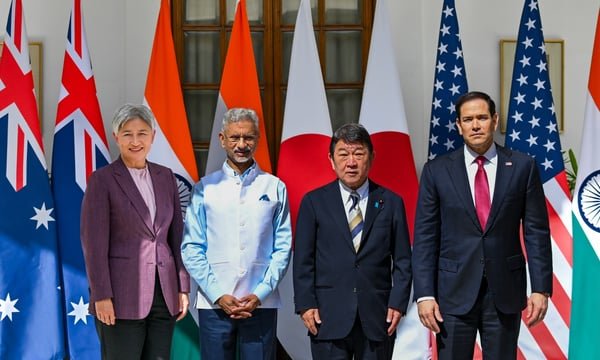
The Quad's Sustained Operational Tempo
The Quad revived in 2017 after a period of dormancy, prompting Chinese Foreign Minister Wang Yi to predict that the grouping would dissipate like sea foam. Despite that forecast, the arrangement maintained consistent working-level activity even without a leaders' summit after September 2024. In the first year of the second Trump administration, the four countries conducted at least one monthly working-level engagement, demonstrating an operational rhythm that persisted across humanitarian, maritime, and economic domains.
Concrete illustrations of this tempo include the March 2025 coordination of humanitarian support following the Myanmar earthquake, the June 2025 launch of the first collaborative coast guard efforts, and the July 2025 introduction of the Quad Critical Minerals Initiative. The Quad Counterterrorism Working Group held its third meeting during the same period, while the first Field Training Exercise of the Quad Indo-Pacific Logistics Network took place alongside a December 2025 HADR Tabletop Exercise and Strategic Meeting. These activities show a pattern of practical cooperation that continued irrespective of high-level political pauses.
The May 2026 Quad Foreign Ministers' Meeting in New Delhi produced concrete outcomes on port infrastructure in Fiji, critical minerals cooperation, and maritime surveillance enhancements. Participants also referenced the February 2026 Quad Track-1.5 Leadership Dialogue hosted in Sydney by the United States Studies Center, which identified maritime security as the Quad's most important contribution and recommended movement toward real-time data sharing. Observers noted that the Quad's thin institutional structure may actually insulate it from political volatility, allowing functional work to proceed even when leaders' summits remain absent.
South Korea's Strategic Calculus
Seoul maintains the status of a non-Quad member while pursuing its own Indo-Pacific strategy, a position that requires careful calibration between alliance commitments and regional engagement. The Ministry of Foreign Affairs' Indo-Pacific Strategy builds on the legacy of the New Southern Policy, extending economic and diplomatic outreach across Southeast Asia and the Pacific Islands. This framework allows South Korea to support Quad-adjacent objectives without formal membership, preserving flexibility in a region where minilateral arrangements have proliferated.
The Yoon administration approached U.S.-China competition by reinforcing the security alliance with Washington while managing substantial economic dependence on Beijing. This dual imperative shapes Seoul's willingness to participate selectively in Quad-related activities. North Korea's nuclear and missile programs add another layer, as any enhancement of regional maritime coordination or supply-chain resilience could indirectly strengthen deterrence calculations on the Peninsula. Policymakers therefore weigh the benefits of closer alignment against the risk of provoking Chinese countermeasures.
Analysts at the Asan Institute, the Korea National Diplomatic Academy, and the Korea Institute for Maritime Strategy have examined how South Korea might engage Quad processes without crossing explicit membership thresholds. Their assessments emphasize issue-specific cooperation that aligns with existing Korean capabilities in shipbuilding, port development, and disaster response. Such participation could complement rather than duplicate the U.S.-ROK alliance while contributing to broader Indo-Pacific stability. Seoul's approach remains pragmatic, favoring incremental steps that preserve strategic autonomy amid shifting great-power dynamics.
The Quad, China, and the Korean Peninsula
Beijing has historically opposed the Quad, viewing it as an instrument of containment. The precedent of Chinese economic retaliation following the 2016 THAAD deployment continues to inform South Korean calculations about deeper involvement in Quad initiatives. Any visible expansion of Korean participation risks renewed pressure on trade and tourism, prompting officials to favor low-profile, functional cooperation over public alignment.
North Korean perceptions of Quad activities add further complexity. Pyongyang has long portrayed U.S.-led groupings as hostile encirclement, and expanded maritime or logistics exercises could reinforce that narrative. At the same time, Quad humanitarian assistance and disaster relief mechanisms demonstrated during the 2025 Myanmar response illustrate capabilities that could prove relevant should instability on the Peninsula require coordinated external support.
The Quad Critical Minerals Initiative offers a potential avenue for supply-chain diversification that indirectly benefits Korean economic security. Reduced reliance on concentrated sources of critical inputs could lessen vulnerability to future Chinese restrictions. South Korean policymakers therefore monitor these developments closely, recognizing that functional cooperation on minerals and maritime domain awareness may yield stability dividends without triggering the full spectrum of Beijing's economic leverage.
Operational Engagement Without Membership
Realistic pathways for South Korean engagement include selective participation in working groups and Track 1.5 dialogues rather than formal accession. These formats allow Seoul to contribute expertise on specific issues such as critical minerals processing and maritime domain awareness while avoiding the political signaling associated with membership. Officials could consider seconding personnel to existing Quad technical meetings on an ad hoc basis.
Issue-specific cooperation on coast guard coordination and humanitarian exercises represents another practical entry point. Korea's experience in regional search-and-rescue operations and its established networks in Southeast Asia could add value to Quad HADR activities. Such contributions would build on the 2025 Myanmar response model without requiring new institutional commitments.
Korea's shipbuilding and port infrastructure capabilities constitute a potential Quad-adjacent contribution that aligns with the outcomes of the May 2026 Foreign Ministers' Meeting. Participation in capacity-building projects in the Pacific Islands, for example, could proceed through bilateral or trilateral channels that complement Quad efforts. This approach preserves Seoul's room for maneuver while supporting shared regional objectives.
Implications for Regional Security Architecture
The broader trend toward minilateralism in the Indo-Pacific creates both opportunities and constraints for South Korea. The U.S.-ROK-Japan trilateral framework already provides a structured channel for security cooperation, and Quad activities can complement rather than compete with that arrangement. Seoul's ability to engage selectively with Quad processes may therefore reinforce existing trilateral gains without duplication.
ASEAN centrality remains a core principle of South Korea's New Southern Policy legacy, and any Quad engagement must respect that priority. Korean policymakers have consistently advocated for inclusive regional mechanisms that avoid alienating Southeast Asian partners. This stance suggests that future cooperation would emphasize practical projects in maritime safety and disaster response over more contentious security agendas.
Quad resilience in the absence of regular leaders' summits carries implications for extended deterrence on the Korean Peninsula. Sustained working-level coordination among the Quad countries signals continued U.S. commitment to Indo-Pacific stability, which in turn shapes North Korean risk assessments. South Korean strategists therefore view functional Quad continuity as an indirect but relevant factor in the overall deterrence environment.
Assessment and Outlook
Forward-looking analysis for Seoul's policymakers centers on monitoring Quad evolution during the current period without leaders' summits. The persistence of monthly working-level engagements and concrete initiatives on critical minerals and maritime surveillance indicates that the grouping can deliver results even when high-level political attention fluctuates. Korean officials may therefore treat these functional outputs as reliable benchmarks rather than waiting for summit-level signals.
Track 1.5 participation offers a low-risk bridge for sustained engagement. By contributing to dialogues such as the Sydney meeting, South Korea can help shape discussions on real-time data sharing and maritime security without formal obligations. This channel also allows Seoul to test domestic political tolerance for deeper involvement over time.
Long-term implications for Korean strategic autonomy hinge on maintaining a balanced portfolio of alliances and minilateral ties. Selective Quad-adjacent cooperation could enhance supply-chain resilience and maritime awareness while preserving flexibility vis-à-vis China. Policymakers will likely continue to calibrate participation according to concrete deliverables rather than abstract alignment, ensuring that any steps taken reinforce rather than constrain Korea's independent strategic choices.
By Prof. David Park, Staff WriterThis article was produced with AI-assisted research and editorial support. Reporting is based on sources cited in the article.
What's Your Reaction?
 Like
0
Like
0
 Dislike
0
Dislike
0
 Love
0
Love
0
 Funny
0
Funny
0
 Wow
0
Wow
0
 Sad
0
Sad
0
 Angry
0
Angry
0

East Asia/Technology Correspondent at Global1.News. Seoul-based voice covering Korean politics, technology, business, and culture. Analyzes how technology and geopolitics intersect across East Asia.













Comments (0)