
OpenAI Just Became an Anchor Tenant in Malaysia — Compute Follows Power and Permits, Not Loyalty
OpenAI signed a multi-year deal to rent compute from two Firmus AI Factory sites in Malaysia, making the ChatGPT maker an anchor tenant as contracted capacity tops 900MW. A hosting founder on what offshore compute means for the AI buildout.
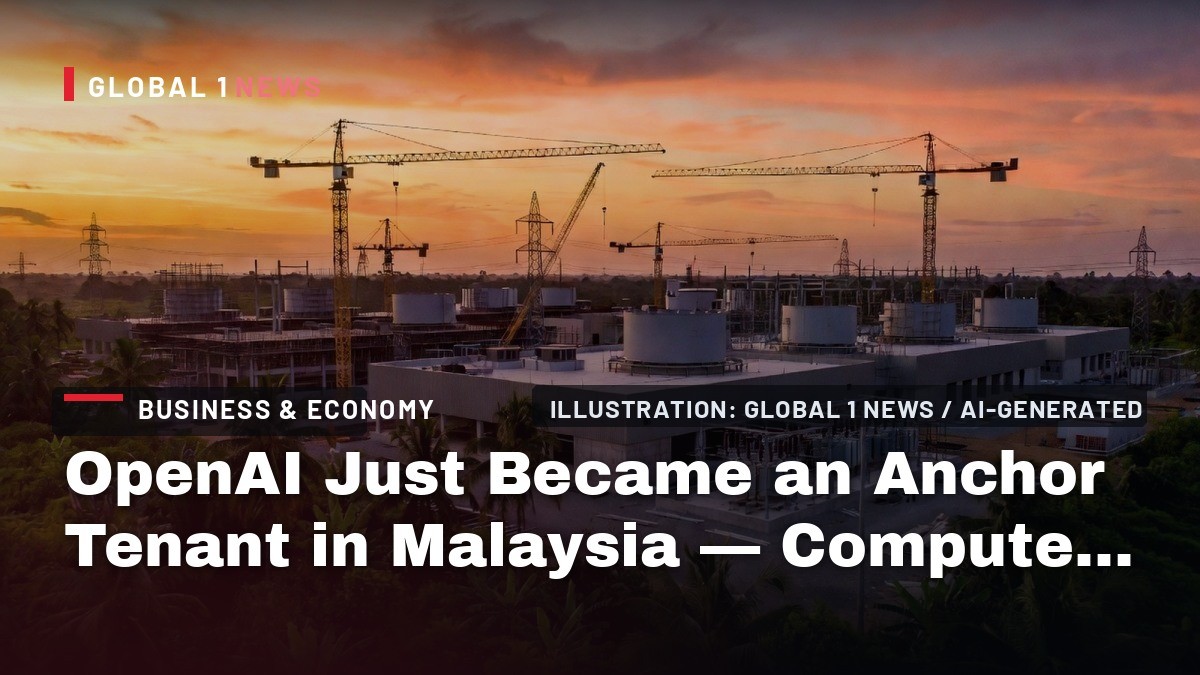
OpenAI Just Became an Anchor Tenant in Malaysia — Compute Follows Power and Permits, Not Loyalty
Let me tell you what happened this morning that should make every hosting founder sit up straight. OpenAI — the company that basically wrote the definition of American AI dominance — signed a multi-year deal to rent dedicated compute from two data centers in Malaysia. Not build. Rent. And the landlord is a seven-year-old Australian startup called Firmus that started life mining Bitcoin in Tasmania.
I wrote about Firmus back in August when it raised $2 billion and the AI infrastructure money officially went global. I said the cynics were buying in. Today is the receipt. OpenAI didn't just hand Firmus a contract — it made the ChatGPT maker an anchor tenant, which in the data center world means the customer who pays enough to justify the whole building. If you're wondering where the AI buildout actually stands, this is your answer: the most valuable AI company on Earth just decided its future capacity belongs, in part, in Southeast Asia.
What OpenAI Actually Did Today
Firmus Technologies — Firmus Grid Limited, trading as Firmus — announced on September 8 that OpenAI will contract dedicated AI compute capacity from two of its AI Factory sites in Malaysia. The deal pushes Firmus's total contracted capacity past 900 megawatts, and OpenAI becomes the anchor customer underpinning the next phase of its regional build.
Here's the portfolio math, because it matters. Firmus says it now has seven AI factories across four countries — Australia, Singapore, Indonesia and Malaysia. Two are operational today: one in Australia and one in Singapore. Five more are under development, with the company promising they'll be ready for service within the next 24 months. The hardware story is pure 2026: NVIDIA Vera Rubin NVL72 rack-scale systems, built on NVIDIA's DSX AI Factory platform, wrapped in Firmus's own HyperCube prefabricated modules manufactured in regional New South Wales.
Nico Caprez, NVIDIA's vice president of global AI infrastructure growth, called it "full-stack AI factories engineered for performance, durability, efficiency, scale and fungible workloads." Tim Rosenfield, Firmus's co-founder and co-CEO, went bigger: "This multi-year partnership marks the moment Asia-Pacific becomes a producer of intelligence, not just a consumer of it." And OpenAI's vice president of compute strategy, Sachin Katti, said the Malaysian data centers "will help us serve growing demand for OpenAI's products across the region and around the world."
The Two Readings — a Global Compute Base, or an Escape Hatch
There are two ways to read this deal, and both are true. That's what makes it interesting.
Reading one: this is a smart global compute strategy. AI inference is latency-sensitive, and a user in Singapore or Jakarta or Sydney doesn't want to round-trip to Virginia. Malaysia has power, land, and a government that says yes — the same reasons the corridor next to Singapore has become one of the fastest-growing data center markets on the planet. For OpenAI, renting regional capacity is cheaper and faster than building it. For Firmus, an anchor customer of that caliber is rocket fuel for the float the Australian Financial Review says the company is using this deal to drum up interest in — a listing later this year that would hand the public markets a piece of the AI factory story.
Reading two: this is what it looks like when the home market can't say yes fast enough. Read the last six months from a founder's chair. Texas froze new grid connections in August. PJM spent the summer drafting ride-through rules after 3,800 megawatts of Northern Virginia data center load left the grid in seconds. New York and New Jersey are fighting over moratoriums. Virginia is litigating tax bills. The result is that American compute demand is being exported to wherever the interconnection queue is short and the permitting clock is fast. OpenAI is not building in Malaysia because it loves the food. It's building there because that's where power and permission currently live.
How a Former Bitcoin Miner Got Here
And this is the part I want every small hosting operator to sit with for a second, because the money story is outrageous and it's happening in real time.
In September 2025 — one year ago — Nvidia backed an AU$330 million raise for Firmus at a valuation around AU$1.85 billion, to build a data center in Tasmania. In April 2026, Firmus was worth US$5.5 billion. In June, it signed a partnership with Nvidia that SmartCompany reported at US$30 billion for a 360-megawatt AI factory in Batam, Indonesia — 26 kilometers from Singapore — with DayOne as collaborator and up to 170,000 accelerators across the Grace-Blackwell, Vera Rubin, and Vera platforms. In August, it closed a fully subscribed US$2 billion round from Coatue, Nvidia, Blackstone Tactical Opportunities, and Jane Street at a post-money valuation above US$10.5 billion — nearly double where it stood four months earlier. Total equity raised in a year: more than US$3 billion, on top of a reported US$10 billion debt facility.
So in roughly twelve months, a former Bitcoin miner went from an AU$1.85 billion valuation to a US$10.5 billion-plus AI infrastructure group with an OpenAI anchor lease. That is the AI capex cycle in one paragraph — and the rocket the public markets are about to be asked to underwrite.
The Secondary Bottleneck Nobody's Talking About — the Offshore Drift
Every bottleneck I've written about in this buildout has been physical: GPUs, memory, power, water, transformers, grid queues. This one is different. This one is geographic — call it the offshore drift.
The constraint isn't that the world lacks compute demand. The constraint is that the places with the most demand — the United States, Europe — have made large-scale compute so hard to permit, so slow to interconnect, and so politically contested that the capacity is physically migrating to places that say yes. Malaysia doesn't have a community-consent war over every 100-megawatt building. It has an industrial policy that wants the jobs, the taxes, and the export revenue.
Now ask the uncomfortable question: what does it mean for data sovereignty, for latency, for physical security, for export policy, when a meaningful share of the world's AI inference — including inference for a flagship American company — runs from Southeast Asia? I'm not going to pretend I have clean answers. But I've been in this industry long enough to know that when compute relocates for regulatory reasons, the regulation follows it eventually — usually in the form of new rules written in a panic.
Announced vs. Energized — the 900-Megawatt Question
Here's where my founder brain kicks in, because 900 megawatts of contracted capacity sounds enormous until you check the fine print. Firmus has two sites operational today. The other five — including the two Malaysian sites OpenAI just anchored — are scheduled to come online within 24 months. Batam is still being built. The 360 megawatts and 170,000 GPUs are announcements, not electrons.
In this market, contracted megawatts are not energized megawatts. What OpenAI actually bought is a promise of future capacity — backed by a company that has yet to operate most of its portfolio at scale, that is stacking a US$10 billion debt facility on top of US$3 billion of equity, and that is about to answer to public shareholders for every megawatt that doesn't come online on schedule. Anchor tenants de-risk buildings. They don't de-risk construction timelines, transformer deliveries, or grid interconnection dates in a country Firmus just entered.
What This Means for Independent Hosting Providers
If you run an independent hosting or colo business, this deal is not a distant corporate story. It's a map of where your industry is headed. Let me give you five things to do with it.
First, read the geography like a strategy document. OpenAI just told you where a chunk of Asia-Pacific inference will be served from. If you have customers in that region, your upstream choices, your peering, and your latency story all just changed. Power-rich, permit-fast regions are the new Tier 1 markets — and they're not where the big names were five years ago.
Second, never confuse contracted with energized. When a 900-megawatt headline crosses your screen, ask how many sites are actually drawing power. Apply the same discipline to your own suppliers: a cloud provider's promise of capacity is only as real as the building that's actually running.
Third, watch the lease-don't-own model. OpenAI renting from Firmus means the anchor-tenant model works for AI at the highest level — which means more wholesale demand, more layered ownership, and more of the accountability seam I wrote about after the Lake Mariner fire. Before you put critical workloads in any facility, know who owns the building, who operates it, who answers for the power, and who answers for the fire suppression. If that takes more than one phone call, that's your risk.
Fourth, get ready for the IPO microscope. When Firmus lists, the market will finally see AI-factory utilization numbers — actual energized megawatts, actual revenue per megawatt, actual debt service — instead of press-release contracted capacity. That transparency will reset how every AI infrastructure player is valued, including the ones you buy from.
Fifth, and this is the one that keeps me up at night in a good way: if you can secure power and permission faster than the giants, you own a strategic asset. The hyperscalers are fighting four-to-six-year interconnection timelines. A regional operator who can deliver a powered, permitted facility in eighteen months isn't competing with them — they're competing with each other to buy from you. The arbitrage window is open. It won't stay open forever.
The Bottom Line
Let me be blunt. The most American company in AI just made a former Bitcoin miner its anchor landlord in Malaysia. Call it globalization, call it compute arbitrage, call it whatever makes you comfortable. What it actually is: a signal that the AI buildout has outgrown the permitting and power machinery of the countries that started it. Capacity goes where the electrons and the permission are. That's not a criticism — it's physics.
Firmus will probably have a great float. OpenAI will get its Malaysian megawatts. And somewhere in the middle, every hosting founder who bothered to read the tea leaves will realize the map of the AI world is being redrawn — and the pencil is being held by grid operators, not by governments and not by the companies with the famous logos. Ent? Plan accordingly.
— Allan Ali, Founder
This article was produced with AI-assisted research and editorial support. Sources: Reuters, Australian Financial Review, Firmus Technologies press release (September 8, 2026), Unite.AI, The Next Web, SmartCompany.
What's Your Reaction?
 Like
0
Like
0
 Dislike
0
Dislike
0
 Love
0
Love
0
 Funny
0
Funny
0
 Wow
0
Wow
0
 Sad
0
Sad
0
 Angry
0
Angry
0

Publisher of Global1.News. Automation architect, systems builder, and the guy making sure the truth gets published.















Comments (0)