
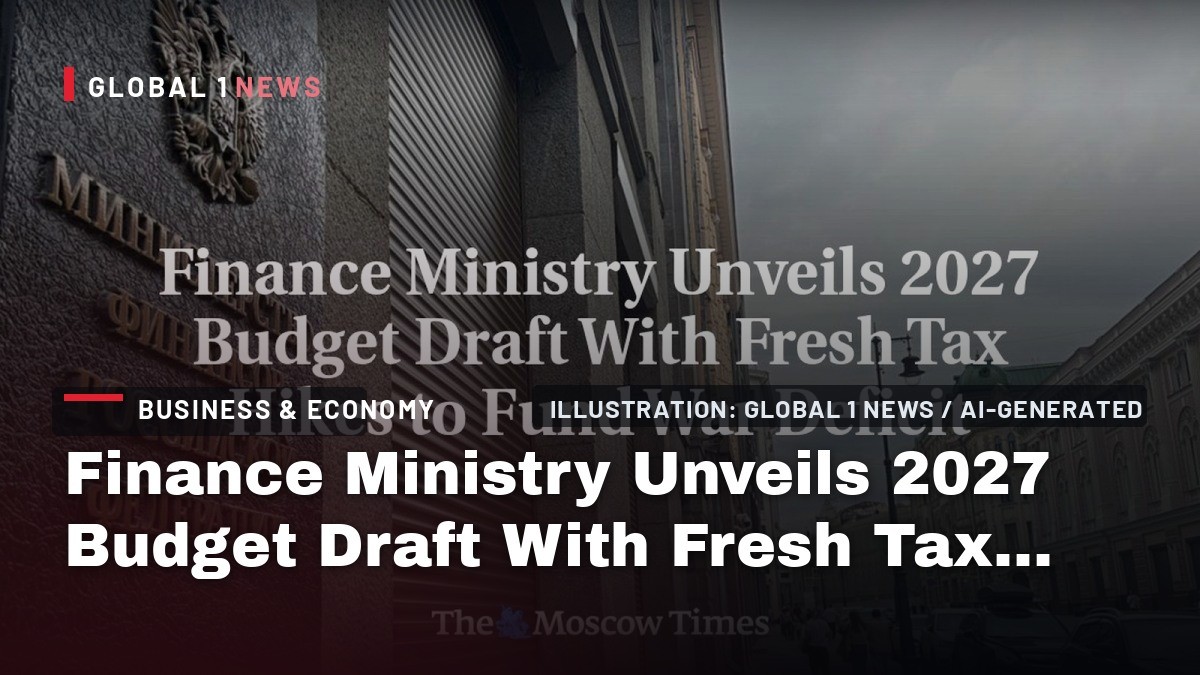
Finance Ministry Unveils 2027 Budget Draft With Fresh Tax Hikes to Fund War Deficit
The Finance Ministry’s draft budget for the 2027‑29 fiscal period, submitted on 24 September 2026, signals a new wave of tax increases aimed at shoring up a war‑driven deficit that has swollen to unprecedented levels.
The Finance Ministry’s draft budget for the 2027‑29 fiscal period, submitted on 24 September 2026, signals a new wave of tax increases aimed at shoring up a war‑driven deficit that has swollen to unprecedented levels. While the Kremlin publicly denied that any further tax hikes were under discussion, the ministry’s proposal introduces higher rates on passive income, e‑commerce, and corporate windfalls, revealing the fiscal strain caused by the sustained military campaign in Ukraine and the simultaneous decline in energy revenues.
Scope of the proposed tax reforms
The draft outlines a progressive tax scale of 13 %‑22 % on passive personal income – including bank deposit interest, stock dividends, real‑estate sales and securities trading. Current rates for these income streams sit at 13 %‑15 %, meaning the highest earners could face a modest but noticeable increase. The ministry estimates that roughly four million high‑income Russians would be affected, though military personnel would be exempt from the new levy on passive income.
In addition to the personal‑income changes, the proposal imposes a 35 % tax on dividend payouts transferred to non‑resident “Type C” bank accounts and a 15 % tax on passive earnings of mutual investment funds, effectively ending the ability of these funds to defer profit taxes indefinitely. A 22 % value‑added tax (VAT) would be applied to cross‑border online retail purchases, coupled with a flat customs fee of 100 rubles on international parcels valued under 200 euros. Finally, mining and metallurgical firms would face a 30 % tax on excess earnings generated by recent spikes in global commodity prices.
Fiscal context: war spending and shrinking energy revenues
Since President Vladimir Putin ordered the full‑scale invasion of Ukraine, government spending has surged to meet mounting military needs – from drone manufacturing and equipment purchases to lucrative payouts for contract soldiers, a strategy designed to avoid another politically risky mass mobilization. At the same time, Russia’s critical energy earnings have declined, eroding a traditional source of budgetary stability.
The ministry’s own projections place the 2027‑29 deficit at around two percent of gross domestic product (GDP) based on an assumed benchmark oil price of $50 per barrel. Yet the overall fiscal strain is already evident: the deficit is expected to reach three percent of GDP by the end of 2026, almost double the amount planned for the same period. Earlier tax hikes in 2025 and 2026 have failed to close the gap, prompting the current round of measures.
Political positioning and Kremlin messaging
Official statements from the Finance Ministry frame the tax proposal as a necessary step to “address all social obligations, support defense and security, help participants of the special military operation and their families and advance technological leadership.” This language mirrors the Kremlin’s broader narrative that higher‑earning individuals and corporations must shoulder a greater share of the war’s financial burden.
Notably, the ministry defended the reforms against recent Kremlin denials that any new tax hikes were being discussed. By positioning the proposal as a response to “defense and security” priorities, the ministry aligns itself with President Putin’s earlier description of the 2025 tax reforms as “fair,” reinforcing the image of a government compelled by external pressures rather than domestic policy choices.
Impact on the middle class and small businesses
The proposed VAT increase on cross‑border e‑commerce and the flat customs fee will affect ordinary consumers who purchase goods online, a segment that has grown rapidly in recent years. While the fee of 100 rubles is modest in absolute terms, it represents an additional cost on every small‑value parcel, potentially dampening consumer spending on imported items.
The 2026 budget already widened the VAT base from 20 % to 22 % and lowered the annual revenue threshold for VAT exemption under the simplified regime from 60 million rubles to 10 million rubles, pulling many small firms into the tax net. Although the government temporarily froze the lowered threshold through 2029 – allowing businesses using the simplified tax system to pay national VAT only if revenue exceeds 20 million rubles – the cumulative effect of these measures places additional compliance burdens on small and medium‑sized enterprises.
Targeted sectors: finance, mining, and metallurgical industries
The finance sector will feel the brunt of the new 35 % dividend tax on transfers to non‑resident accounts, a move designed to curb capital outflows and capture revenue from wealthy individuals holding assets abroad. Mutual investment funds will lose the ability to defer taxes, tightening cash flows for asset managers and potentially reducing the attractiveness of Russian‑based funds for domestic investors.
Mining and metallurgical companies, which have benefited from recent spikes in global commodity prices, will now be subject to a 30 % tax on excess earnings. This levy aims to tap windfall profits generated by higher commodity prices, redirecting a portion of these gains to the state budget. The measure reflects a broader pattern of extracting revenue from sectors that have profited from Russia’s export commodities despite the overall decline in energy earnings.
Defence spending as the budgetary driver
The draft budget’s emphasis on funding the “special military operation” underscores the central role of defence spending in shaping fiscal policy. The need to finance drone production, equipment procurement, and contract‑soldier payouts – all without resorting to a mass mobilization – has forced the government to seek new revenue streams. This fiscal pressure explains the timing of the tax proposals, arriving just weeks after the Kremlin publicly denied any discussion of further tax hikes.
By linking tax increases directly to defence and security priorities, the ministry reinforces the narrative that ordinary citizens and businesses must bear the cost of the war. This framing also serves to legitimize the measures in the eyes of a public that has already endured years of economic hardship and sanctions.
Long‑term implications for Russia’s fiscal stability
If enacted, the proposed tax regime could provide a modest boost to state revenues, but it is unlikely to fully offset the growing deficit driven by sustained war expenditures and declining energy income. The reliance on higher taxes on high‑income individuals, corporate windfalls, and e‑commerce suggests a widening fiscal base, yet the effectiveness of these measures will depend on compliance and enforcement, particularly in the face of capital flight and potential evasion.
Moreover, the continued expansion of the tax net risks further eroding business confidence, especially among small and medium‑sized enterprises already strained by previous VAT reforms. A deteriorating investment climate could hamper long‑term economic growth, limiting future revenue potential and exacerbating the fiscal dilemma.
In sum, the Finance Ministry’s 2027‑29 draft budget reflects a government grappling with the dual pressures of financing an extended military campaign and compensating for dwindling energy revenues. The proposed tax hikes, while framed as a patriotic contribution to national defence, carry significant economic and political ramifications that will shape Russia’s fiscal trajectory in the coming years.
This article was produced with AI-assisted research and editorial support. Reporting is based on the source material cited below. Sources: The Moscow Times; themoscowtimes.com; Global1.News (25 September 2026).
By Irina Volkov, Staff Writer
What's Your Reaction?
 Like
0
Like
0
 Dislike
0
Dislike
0
 Love
0
Love
0
 Funny
0
Funny
0
 Wow
0
Wow
0
 Sad
0
Sad
0
 Angry
0
Angry
0
Russia/Eastern Europe Correspondent at Global1.News. Covering Russian politics, energy, security, and the shifting dynamics of the post-Soviet space. Provides clear-eyed analysis on one of the world's most opaque regions.













Comments (0)