
Nadezhdin Banned From Leaving Russia Ahead of Court Hearing
Russian authorities banned opposition politician Boris Nadezhdin from leaving the country hours before his court hearing on extremist symbols charges. Designated a foreign agent last week, Nadezhdin's targeting signals systematic elimination of independent political competition ahead of September...
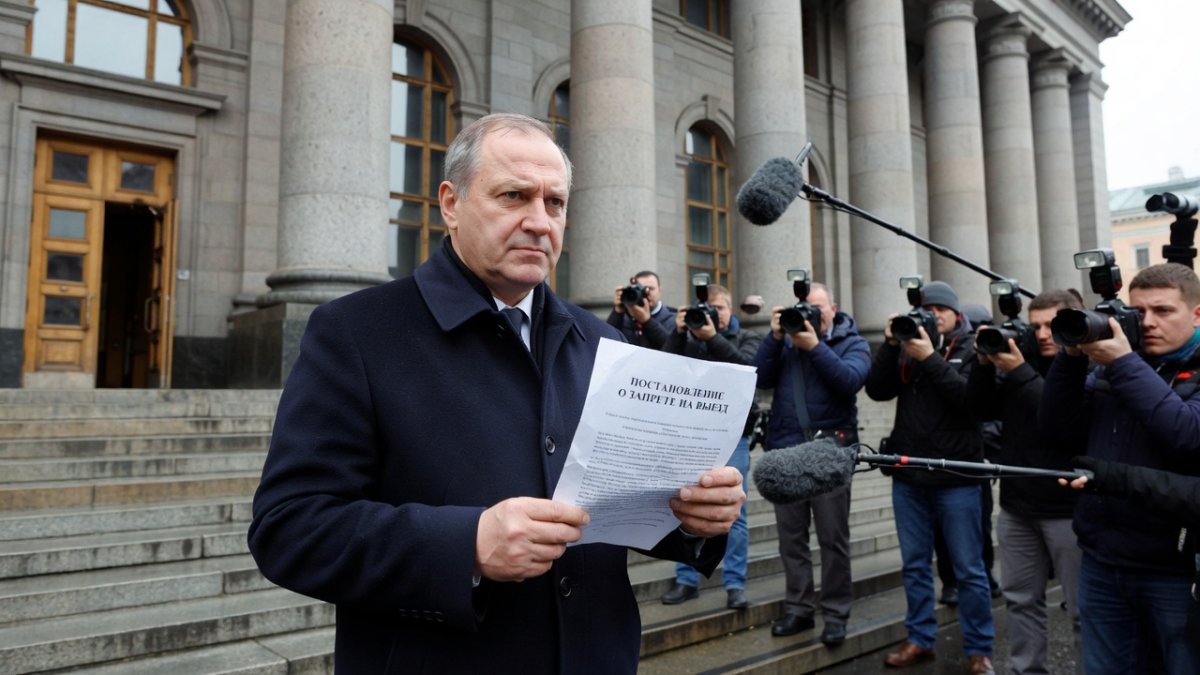
Russian authorities have imposed a travel ban on Boris Nadezhdin, the anti-war politician who challenged Vladimir Putin in the 2024 presidential election, just one day before he is scheduled to appear in court on charges of displaying so-called "extremist" symbols. The move marks the latest escalation in a coordinated campaign to sideline independent political voices ahead of September's parliamentary elections.
Nadezhdin Banned From Leaving Russia Ahead of Court Hearing
Moscow — July 16, 2026 — Boris Nadezhdin, who gained national prominence during a failed 2024 presidential bid built on a pro-peace platform, announced on Thursday that authorities have barred him from leaving the country. The travel ban comes just hours before he is scheduled to appear in court on administrative charges that could land him in prison for up to 15 days.
The Travel Ban: A Sudden and Coordinated Blow
Nadezhdin wrote on his Telegram channel Thursday that he received a travel restriction notification through Gosuslugi, Russia's state services portal. He called the ban "illegal" and said both he and his legal team plan to file an immediate appeal. According to sources close to the politician cited by the exiled news outlet Agentstvo, the travel ban stems from the sudden reopening of an old enforcement proceeding tied to a bankruptcy case that was formally closed more than a year ago.
Legal experts consulted by Agentstvo noted that declaring bankruptcy does not automatically close all enforcement proceedings against an individual, and that the bankruptcy process itself can serve as legal grounds for a travel restriction. The timing — one day before a scheduled court appearance — has raised questions about whether the move is procedurally legitimate or politically motivated.
Foreign Agent Designation: The Legal Trap
Late last week, Nadezhdin was formally designated as a "foreign agent" by the Russian Ministry of Justice, a label that carries severe restrictions under Russian law. Individuals branded as foreign agents are barred from holding public office, effectively disqualifying Nadezhdin from running in the upcoming September parliamentary elections. The designation also imposes strict financial reporting requirements and subjects recipients to heightened government scrutiny.
The foreign agent law, which has been progressively expanded since its introduction in 2012, has been used as a primary tool for sidelining independent politicians, journalists, and civil society organizations. According to human rights groups, more than 700 individuals and organizations are currently listed on the Justice Ministry's foreign agent registry, with new additions announced on a near-weekly basis.
Extremist Symbols Charge: A Growing Pattern
On Monday, Nadezhdin was charged with publicly displaying "extremist" symbols, an administrative offense under Article 20.3 of the Russian Code of Administrative Offenses. The charge carries a maximum sentence of 15 days in administrative detention. While the specific symbol in question has not been publicly identified, the charge has become a standard tool used by authorities against opposition figures in recent years.
The same charge has been leveled against a growing number of political candidates ahead of September's parliamentary elections, in a pattern that independent observers describe as "candidate filtering" — the systematic disqualification of unwanted challengers before they can reach the ballot. Nadezhdin himself acknowledged this in an interview with Meduza earlier this week, saying he believes authorities are targeting him precisely because of his efforts to register for the September vote.
A Political Journey from Yeltsin's Era to Putin's Russia
Nadezhdin's political career spans more than three decades, tracing the arc of post-Soviet Russian politics. He served as an advisor to former Prime Minister Boris Nemtsov — later assassinated near the Kremlin walls in 2015 — in the late 1990s, and subsequently worked as an assistant to Sergei Kiriyenko, who now serves as deputy first chief of staff in the Kremlin. Nadezhdin was a State Duma lawmaker from 1999 to 2003, and between 2019 and 2024, he served as a councilman in the Moscow region.
His 2024 presidential campaign, which centered on a platform of ending the war in Ukraine and restoring political competition in Russia, drew unexpectedly large crowds and widespread public support. The Central Election Commission ultimately barred him from the ballot on a technicality, a decision widely seen as politically motivated. Despite this, Nadezhdin remained politically active, positioning himself as a potential candidate for the September parliamentary elections.
The Navalny Precedent: Learning from Tragedy
In his interview with Meduza, Nadezhdin explicitly referenced the fate of Alexei Navalny, Russia's most prominent opposition figure who died in a remote Arctic penal colony in February 2024 under circumstances that remain disputed. "I learned from Navalny's mistakes," Nadezhdin told the outlet, signaling a calculated approach to navigating Russia's increasingly repressive political landscape.
Nadezhdin acknowledged that he and his family have been weighing whether to leave Russia due to mounting pressure from authorities. While he expressed a strong desire to remain in the country, he acknowledged the real threat of imprisonment — an outcome he said he is actively trying to avoid. The question of exile versus resistance has become a defining dilemma for Russia's remaining independent political figures, with many choosing to operate from abroad after facing criminal prosecution at home.
Candidate Filtering: How the Kremlin Controls the Ballot
The coordinated application of the foreign agent designation, administrative charges, and travel restrictions against Nadezhdin fits into a well-documented pattern of electoral control that political scientists call "candidate filtering." The mechanism works through multiple layers: potential challengers are first flagged through the foreign agent registry, then subjected to administrative prosecutions that create legal barriers to registration, and finally physically restrained through travel bans or house arrest.
Independent election monitoring groups have documented a dramatic reduction in genuine political competition in Russian elections since 2020, when constitutional changes reset presidential term limits and consolidated Kremlin control over the political system. The September parliamentary elections are widely expected to produce a Duma dominated by United Russia and the Kremlin's approved "systemic opposition" parties, with any genuine challengers removed from the process before voters have a chance to choose.
What This Means: The End of Independent Politics in Russia
The targeting of Boris Nadezhdin represents more than just the fate of a single politician — it signals the systematic elimination of the last remaining space for independent political activity in Russia. With the foreign agent designation now functioning as an effective ban on holding public office, and administrative charges serving as a mechanism for pre-election detention, the Kremlin has constructed a legal framework that makes it nearly impossible for genuine opposition candidates to participate in any level of electoral politics.
This analysis, based on the pattern of enforcement against multiple political figures this year, suggests that Russian authorities are not merely seeking to win the September elections but to eliminate the very concept of political competition itself. The message to any Russian citizen considering public office is stark: compliance with the system is the only safe path, and any deviation carries consequences that can destroy a career, a family, or a life.
For ordinary Russians watching these events unfold, the signal is equally clear. With independent candidates removed from the ballot, administrative detention used as a preemptive measure, and travel controls restricting even the possibility of exile, the space for political dissent continues to shrink. As Nadezhdin prepares to appear in court, his case will be watched closely — not just for its outcome, but for what it reveals about the state of Russian democracy in the summer of 2026.
By Irina Volkov, Staff Writer
This article was produced with AI-assisted research and editorial support. Reporting is based on sources cited in the article.
What's Your Reaction?
 Like
0
Like
0
 Dislike
0
Dislike
0
 Love
0
Love
0
 Funny
0
Funny
0
 Wow
0
Wow
0
 Sad
0
Sad
0
 Angry
0
Angry
0

Russia/Eastern Europe Correspondent at Global1.News. Covering Russian politics, energy, security, and the shifting dynamics of the post-Soviet space. Provides clear-eyed analysis on one of the world's most opaque regions.










Comments (0)