
Gulf States Under Fire: Iran Strikes Across the Region as US Intensifies Bombardment
Iran struck Bahrain, Qatar, Kuwait, Oman, Jordan, Iraq and Syria in retaliation as the US completed its sixth night of bombing Iranian civilian infrastructure. The Strait of Hormuz crisis threatens global energy security as the IEA issues stark warnings with 38 killed since June peace talks.
Gulf States Under Fire: Iran Strikes Across the Region as US Intensifies Bombardment
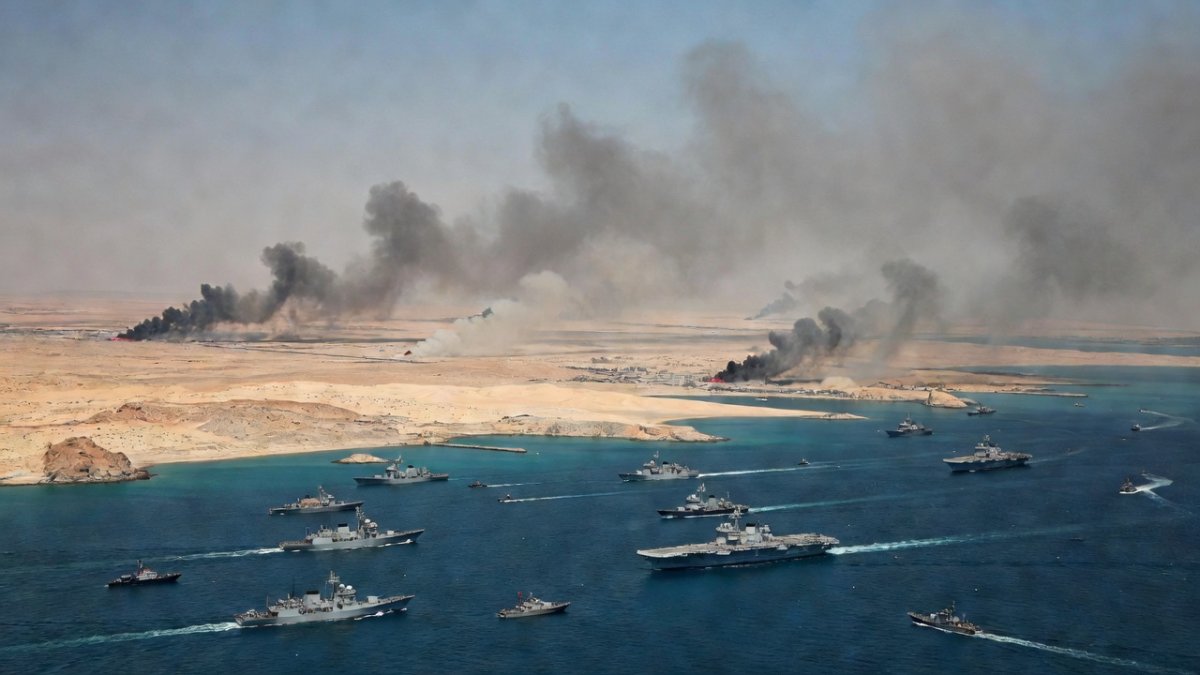
The Middle East is burning again — and this time, the fire isn't staying inside Iran's borders. Tehran launched retaliatory strikes against half a dozen Gulf states and neighboring countries overnight, as the United States military completed its sixth consecutive night of aerial bombardment on Iranian soil. What began as a narrowly-focused conflict over the Strait of Hormuz has metastasized into a sprawling regional crisis, with Bahrain, Qatar, Kuwait, Oman, Iraq, Jordan and Syria all caught in the crossfire.
The Sixth Night: US Targets Civilian Infrastructure
The United States military escalated its air campaign dramatically on Thursday night, striking civilian infrastructure across southern Iran rather than limiting itself to military targets. Local media reported that US warplanes hit telecommunications networks, railway systems, and the Bandar-e Khamir bridge in Hormozgan province — a key transit link where at least seven people were killed, according to Iran's Fars news agency.
US strikes also targeted Bandar Abbas, Ahvaz, and Iranshahr, with the Pentagon claiming it was degrading Iran's ability to threaten commercial shipping in the Strait of Hormuz. The US Navy additionally fired on a vessel it accused of attempting to break its reimposed naval blockade on Iranian ports. CENTCOM said that since the blockade was reimposed, five vessels have attempted to “run the blockade” — three were turned around, one was “disabled,” and US Marines boarded an oil tanker whose status remains unclear.
Iranian officials report that 38 people have been killed and more than 400 injured since the two sides met in Switzerland on June 22 for talks aimed at ending the war through a 60-day negotiation period. That tentative ceasefire, brokered in Pakistan a month ago, now hangs by a thread.
Iran Strikes Back: Gulf States in the Crosshairs
Tehran made good on its threats to retaliate, launching missiles and drones against multiple countries across the Gulf and wider region early Friday morning. Reports confirmed that Bahrain, Iraq, Kuwait, Oman, Qatar, Jordan, and Syria were all forced to take defensive action against incoming Iranian projectiles.
The Islamic Revolutionary Guard Corps (IRGC) claimed responsibility for targeting US helicopters and reconnaissance aircraft at the Sakhir airbase in Bahrain, according to Iran's semi-official Tasnim news agency. In a separate statement, the IRGC said it destroyed a US air control radar in the northern Ghanim region of Oman and a maritime surveillance radar positioned on rocks in the Strait of Hormuz.
The IRGC also reported striking a US military base in Kuwait early on Friday, claiming it hit a missile defense radar, several weapons depots, and two HIMARS surface-to-surface missile launchers. Video footage circulating on social media showed thick smoke rising from areas near the Kuwait-Iraq border.
Qatar Under Fire: Explosions in Doha
In Qatar, which hosts the sprawling Al Udeid Air Base — one of the largest US military installations in the Middle East — loud explosions echoed across parts of the capital, Doha, in the early hours of Friday morning. Warning sirens sounded as residents received security alerts on their mobile phones, urging them to take shelter.
Qatar's security threat level was raised twice overnight but later returned to “normal” after the threats were cleared, according to Qatari authorities. The Ministry of Interior confirmed that a child was injured by falling shrapnel during the assault and is now receiving medical care.
Notably, Qatar earlier rejected Israeli media reports claiming it had agreed to participate in military action against Iran. The Qatari government's swift denial, combined with it becoming a target of Iranian retaliation, underscores the impossible position Gulf states now find themselves in — hosting US military assets while trying to avoid being drawn into a war they never asked for.
Jordan and Iraq: Defensive Actions and Close Calls
Jordan's army announced that its air defense systems shot down three Iranian missiles transiting its airspace on Friday morning, with engineering teams dispatched to deal with falling debris. No casualties were reported.
In northern Iraq, Kurdish counterterrorism forces reported that US coalition forces shot down eight explosive drones over the city of Erbil, according to the Iraqi News Agency (INA). No casualties were reported there either, but the incident highlights how Iraq's airspace has become a contested zone between US and Iranian forces.
The IRGC additionally claimed to have attacked a US special operations command center at the al-Tanf military base in Syria, a strategically critical outpost near the Jordanian and Iraqi borders where US forces have maintained a presence for years.
The Strait of Hormuz: The Economic Flashpoint
At the heart of this escalating conflict lies the Strait of Hormuz — the narrow waterway through which approximately one-fifth of the world's seaborne oil passes daily. Iran's IRGC declared that the critical shipping channel “remains in the hands of the IRGC Navy's admirals,” a pointed assertion of control that has global energy markets on edge.
Iranian Armed Forces spokesman Abolfazl Shekarchi made Tehran's position unmistakably clear: “We insist on US not to interfere in the Strait of Hormuz, and on its withdrawal from the region. The situation in the Strait of Hormuz will not return to what it was before the war. The Strait of Hormuz is entirely within the sovereignty of Iran and Oman, and no external party has the right to interfere in its affairs, especially the United States of America.”
The International Energy Agency's executive director, Fatih Birol, warned on Thursday that global energy security is under serious threat. “Oil security is still a critical issue,” Birol said at a Council on Foreign Relations event. “We should be worried, and I am worried if the situation does not improve in the next few weeks.”
Diplomacy on Life Support: China and Pakistan Push for Ceasefire
As hostilities continue to escalate, threatening to drag the entire region into a broader war and choke the global economy, diplomatic efforts to salvage the situation are accelerating. China's Foreign Minister Wang Yi and his Pakistani counterpart Ishaq Dar called on Friday for an immediate ceasefire and the resumption of dialogue.
Both countries have sought to mediate in the months-long conflict, which reignited over the Strait of Hormuz just one month after the signing of a preliminary deal aiming to end the war. That agreement was “hard-won,” Wang Yi said, adding: “Peace is before our eyes, [we] cannot fall at the last hurdle and even more so cannot lose what we have gained.”
Meanwhile, White House Press Secretary Karoline Leavitt placed the blame squarely on Tehran. “The reason for the recent strikes is because Iran violated the MoU that we struck with them; specifically, in the MoU that they signed, they were not to fire on commercial vessels moving through the Strait of Hormuz,” Leavitt said. Despite the escalating violence, US President Donald Trump has continued to insist that a diplomatic path to ending the war remains open.
Iran, however, shows no signs of backing down — and with each night of US bombardment, the list of countries dragged into this conflict grows longer.
What This Means: A Region Trapped Between Two Fires
The expansion of this conflict beyond Iran's borders represents a dangerous new phase. Gulf states that have long tried to balance their security relationships with the United States against their geographic proximity to Iran are now paying the price for hosting American military infrastructure. Every US base in the region — from Al Udeid in Qatar to the naval facilities in Bahrain to the logistics hubs in Kuwait — has become a potential Iranian target.
The humanitarian toll is mounting. Seven dead from a single bridge strike in Hormozgan province. A child wounded by shrapnel in Doha. Thirty-eight Iranian civilians killed since the June talks. And these numbers will almost certainly rise as the US signals no intention of halting its bombing campaign.
For the global economy, the stakes couldn't be higher. A protracted closure or significant disruption of the Strait of Hormuz would send oil prices skyrocketing, triggering inflationary pressures worldwide at a time when many economies are still recovering from previous shocks. The IEA's warning should be heard in every capital — this is not just a Middle Eastern war anymore.
The question now is whether the tentative ceasefire framework brokered by China and Pakistan can survive this escalation, or whether the region is sliding irrevocably toward a full-scale war that nobody — not the US, not Iran, and certainly not the Gulf states caught in the middle — can afford.
— Jessica Ali, Global 1 News
Keywords: US-Iran war, Gulf states, Strait of Hormuz, Iran strikes Qatar, Iran strikes Kuwait, Bahrain under attack, US bombardment Iran, civilian infrastructure, global energy security, China Pakistan ceasefire, IRGC, CENTCOM
This article was produced with AI-assisted research and editorial support. Reporting is based on sources cited in the article.
What's Your Reaction?
 Like
0
Like
0
 Dislike
0
Dislike
0
 Love
0
Love
0
 Funny
0
Funny
0
 Wow
0
Wow
0
 Sad
0
Sad
0
 Angry
0
Angry
0

Editor-in-Chief at Global1.News. Atlanta-based journalist who cuts through the BS and tells it like it is. Lead anchor, host, and the voice you hear when the spin stops and the truth starts.












Comments (0)