
Philippines Demands China Daily Remove Racist Video of Filipinos
The Philippines demanded China Daily remove an AI-generated video depicting Filipinos as monkeys, with DFA and Defense Secretary Teodoro condemning it as racist propaganda. The controversy erupted as Manila marked the 10th anniversary of the 2016 arbitral ruling.
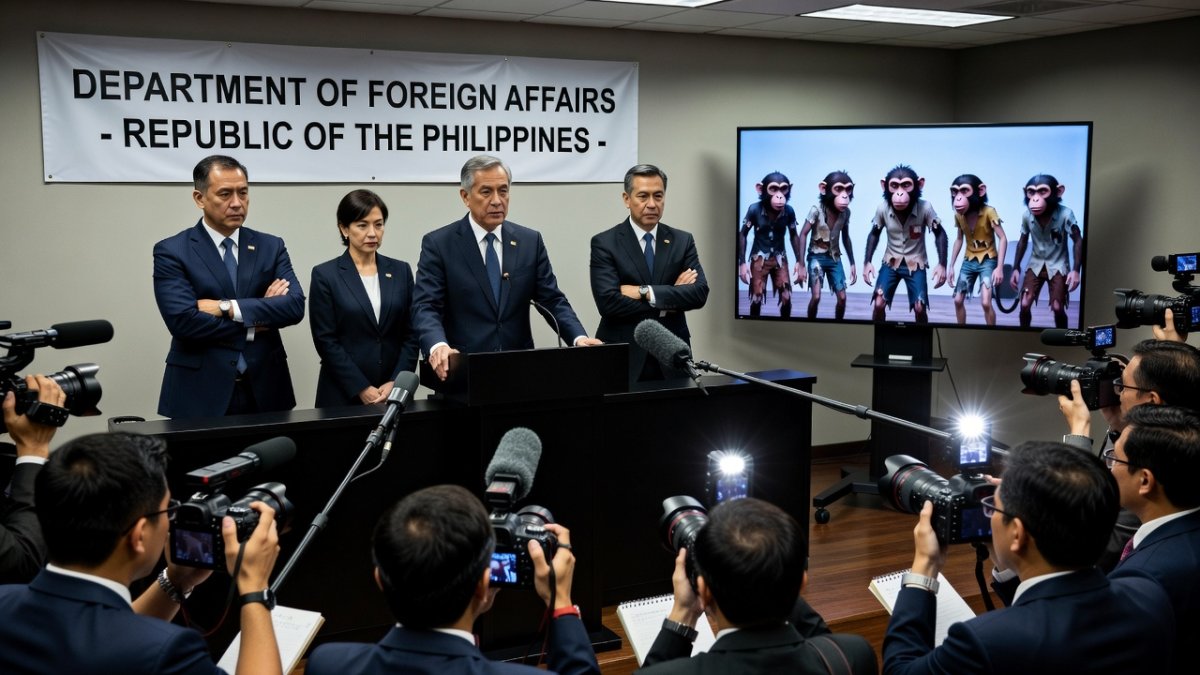
DFA Demands Takedown of 'Racist' China Daily Video
The Philippine government has formally demanded that Chinese state-run media outlet China Daily remove an AI-generated video that depicts Filipinos as monkeys, with the Department of Foreign Affairs calling the material "blatantly demeaning, dehumanizing, and racist."
In a strongly worded statement issued Thursday night, July 16, the DFA condemned the video posted on China Daily's Facebook account on July 10, saying it went "beyond legitimate political debate." The clip — part of a series of AI-generated content the outlet has published around the 2016 South China Sea Arbitral Award anniversary — shows a monkey character wearing what appears to be a Philippine barong, the national formal attire. In one disturbing segment, the monkey is shown being blasted by a water cannon.
"We draw a firm line at the depiction of Filipinos as monkeys in the 10 July 2026 video, which is deeply offensive, distressing, and unacceptable," the DFA said. "Disagreement over legal and political issues does not justify resorting to disturbing imagery, which has no place in the civil public discourse of a responsible state."
Defense Chief Slams 'Moral and Intellectual Bankruptcy'
Defense Secretary Gilberto Teodoro Jr. issued his own blistering condemnation, describing the video as a racist attack that reveals what he called the "moral and intellectual bankruptcy" of China's propaganda machine.
In a statement, Teodoro said the post offered "a revealing insight into what the Chinese communist apparatus thinks of the Filipino people." He emphasized that the content did not merely mock the Philippines' victory in the 2016 arbitral ruling — it glorified violence against Filipinos and members of the Armed Forces of the Philippines.
"This mockery of the lawful 2016 Arbitral Award and the video's glorification of violence against the Filipino people and soldiers expose the moral and intellectual bankruptcy of China's propaganda machine," Teodoro said.
The defense chief called the material "contemptible propaganda" unbecoming of any country that presents itself as a responsible regional power. "It reveals the weakness of a government that resorts to racism, threats, and manufactured hatred because it has utterly failed to defend its ridiculous claims through reason, evidence, or law," he added.
A Growing Pattern of Propaganda
The video is not an isolated incident. The DFA noted that China Daily has published multiple AI-generated videos and editorial cartoons related to the 2016 ruling, forming what Manila describes as a coordinated propaganda campaign targeting the Philippines.
This pattern extends beyond state media. Just this week, Philippine Coast Guard spokesperson for the West Philippine Sea Rear Admiral Jay Tarriela warned local government officials to exercise caution when receiving visits from Chinese Ambassador Jing Quan, pointing to what happened in Batanes after the envoy toured the province last month.
On June 30, just days after Jing's June 16-18 visit to Batanes, scholars from Nanjing University, the Chinese Academy of Social Sciences, and other institutions concluded at a symposium that Batan Island is a "natural geographical extension" of Taiwan — with sovereignty belonging to China. Tarriela publicly questioned whether the ambassador's visit was "truly made in goodwill — or whether he was surveying an island Beijing already intends to claim as its own."
The Chinese Embassy in Manila denied the connection, with Deputy Spokesperson Guo Wei accusing Tarriela of trying to "create hostility between the Chinese and Filipino peoples." But the embassy has not categorically stated whether the scholars' position reflects Beijing's official stance.
What This Means: Beyond the Offense
This is not just about one offensive video — although make no mistake, the racist imagery cuts deep. For many Filipinos, seeing their countrymen depicted as monkeys by a state-run Chinese outlet hits a raw nerve that speaks to decades of being treated as second-class in the region.
But what makes this moment significant is the coordinated response from the Philippine government. The DFA, the Department of National Defense, and even the Philippine Coast Guard are all speaking with one voice — a rare unity that signals Manila is drawing a much firmer line than before.
Teodoro was direct about the policy implications. He said the incident validates the government's existing policy of suspending ministerial-level and Armed Forces of the Philippines defense engagements with the Chinese Communist Party and its agencies. "We are justified in our policy of no Ministerial or AFP defense engagements or contacts with the CCP or any of its agencies," he said, describing Beijing's behavior as "schizophrenic" and declaring that China is "neither a secure and confident actor nor a trustworthy neighbor."
For ordinary Filipinos, this means the diplomatic temperature is rising — and it could affect everything from fuel prices to OFW remittances to the cost of goods that pass through the South China Sea. The bayanihan spirit that carried the Philippines through the 2016 arbitral victory may need to rally once more.
The Tenth Anniversary and International Response
The video controversy erupted just days after the Philippines marked the 10th anniversary of the landmark 2016 Hague arbitral ruling on July 12. Thirteen countries, including the United States and Japan, signed a joint statement affirming that the award is legally binding.
Beijing, which continues to reject the ruling outright, dismissed the joint statement as a "distortion of the facts" intended to vilify China. But the international show of support for Manila's position underscores that the Philippines is not standing alone in its maritime dispute.
The 2016 award invalidated China's sweeping claims over the South China Sea and upheld the Philippines' rights in its exclusive economic zone. It remains the legal bedrock of Manila's position in the West Philippine Sea, even as China's aggressive actions — from coast guard confrontations to the construction of artificial islands — continue to challenge its implementation.
What Filipinos Can Do
Secretary Teodoro ended his statement with a warning in Filipino that resonated across social media: "Pilipinas huwag magpalinlang! Ang nalilinlang ay nasisiil." (Filipinos, do not be deceived! Those who are deceived are oppressed.)
For the average Filipino, this moment calls for vigilance. The propaganda war is real — and it is being fought on the platforms many of us scroll through every day. Here is what you can do:
Share verified information. Before sharing content about the West Philippine Sea, check the source. State-run Chinese media outlets operate under Beijing's direction, not independent journalistic standards.
Report offensive content. Facebook and other platforms have community standards against hate speech and racist content. Reporting the China Daily video and similar material helps platform moderators take action.
Support local journalism. Independent Filipino news organizations are on the front lines of countering disinformation. Your engagement and support help keep accurate reporting alive.
Engage your local officials. Tarriela's warning to LGU executives about Chinese ambassador visits is worth heeding. Ask your barangay captain or mayor whether they have received such visits — and what was discussed.
Stay informed. The 2016 arbitral ruling is not ancient history. It remains the foundation of the Philippines' legal position in the South China Sea. Understanding it means understanding your rights as a Filipino citizen to the waters that sustain our fisheries, our trade, and our sovereignty.
Looking Ahead: The Diplomatic Fallout
The Philippines has demanded both the removal of the offensive video and "the immediate cessation of such irresponsible content," urging China to "uphold dignity, respect, and truth in public discourse."
The DFA warned that such imagery and misinformation "only serve to widen the distrust" between the Philippines and China — a relationship already strained by territorial disputes, fishing rights conflicts, and mounting naval confrontations in the West Philippine Sea.
Whether Beijing will respond meaningfully to Manila's demands remains to be seen. Similar protests in the past have often been met with silence or deflection from Chinese state media, which operates under the direct supervision of the Chinese Communist Party's propaganda apparatus.
But one thing is clear: the Philippines is no longer quietly absorbing these attacks. From the DFA to the DND to the Coast Guard to the Senate — and from the halls of government down to the barangay level — Filipinos are speaking up, standing firm, and refusing to be dehumanized.
As we say in every barrio from Batanes to Tawi-Tawi: ang hindi marunong lumingon sa pinanggalingan, hindi makakarating sa paroroonan. We remember where we came from — and we know where we are going.
By Bella Reyes, Staff Writer
This article was produced with AI-assisted research and editorial support. Reporting is based on sources cited in the article.
What's Your Reaction?
 Like
0
Like
0
 Dislike
0
Dislike
0
 Love
0
Love
0
 Funny
0
Funny
0
 Wow
0
Wow
0
 Sad
0
Sad
0
 Angry
0
Angry
0

Philippines/Southeast Asia Correspondent at Global1.News. Manila-based journalist covering Philippine politics, environment, maritime security, and social issues. Passionate about marine conservation and the communities protecting the Philippines' natural heritage.









Comments (0)