
Montreal Flooding: 100mm+ Rain Causes Power Outages
Intense Rainfall Overwhelms West Island and South Shore Environment Canada recorded between 100 and 150 millimetres of rain falling across parts of Montreal's West Island and South Shore during a concentrated period on Saturday, June 20, 2026. The downpour arrived in just a few hours, overwhelming urban drainage systems already strained by earlier spring conditions. In the broa
Intense Rainfall Overwhelms West Island and South Shore
Environment Canada recorded between 100 and 150 millimetres of rain falling across parts of Montreal's West Island and South Shore during a concentrated period on Saturday, June 20, 2026. The downpour arrived in just a few hours, overwhelming urban drainage systems already strained by earlier spring conditions. In the broader regional context, forecasters had anticipated elevated precipitation risks due to a stalled low-pressure system moving northward from the United States, which interacted with unusually warm Gulf of Mexico moisture to produce convective cells that dumped extreme volumes over a narrow corridor stretching from the Lakeshore communities westward into the South Shore municipalities. Detailed radar archives later revealed peak rainfall rates exceeding 50 millimetres per hour for sustained intervals, a threshold that rapidly saturated soils already holding residual spring meltwater and thereby accelerated runoff into residential streets and catch basins. Municipal monitoring stations in adjacent areas such as Beaconsfield and Pointe-Claire logged supplementary totals approaching 120 millimetres, confirming the event's spatial extent and underscoring how microclimatic variations across the island amplified localized intensities beyond initial model projections.
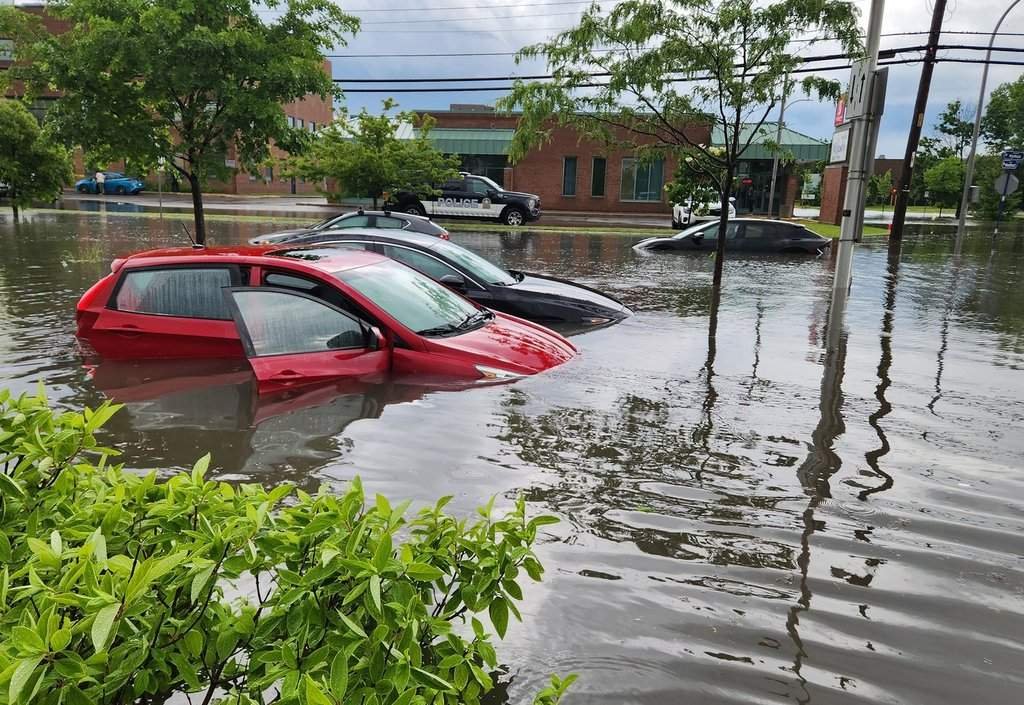
Flooding in Pierrefonds-Roxboro after more than 100mm of rain overwhelmed drainage systems. (Global News)
Local observations aligned closely with official measurements. Pierrefonds-Roxboro Mayor Jim Beis estimated that 150 to 170 millimetres fell within roughly two hours in his borough, a volume that quickly exceeded the capacity of storm sewers in older residential neighbourhoods. Residents along streets such as Boulevard Gouin and Rue de Pierrefonds corroborated these figures through personal rain gauges and time-stamped photographs showing water accumulating faster than municipal pumps could evacuate it, with several individuals noting that the deluge began intensifying around 2:45 p.m. and reached peak fury by 4:15 p.m. before tapering. These citizen reports were cross-verified by borough engineering teams deploying portable flow meters at key junctions, revealing that inflow volumes surpassed design specifications by factors of three to four, prompting immediate after-action reviews focused on recalibrating hydraulic models for future extreme events.
Analysis from Environment Canada meteorologists indicates that the storm's intensity was amplified by warmer atmospheric conditions linked to broader climate trends across southern Quebec. Such events test the limits of existing stormwater management systems designed decades ago for less extreme precipitation patterns. Municipal engineers in the West Island have noted that combined sewer systems in many neighbourhoods lack the capacity to handle rapid inflows, leading to widespread backups and surface flooding. Further examination of atmospheric soundings from the Dorval weather office highlighted elevated precipitable water values nearing 45 millimetres, roughly 150 percent above seasonal norms, which fueled the thunderstorm complex and produced hail cores that temporarily clogged drainage grates. Engineers emphasized that infrastructure installed primarily in the 1970s and 1980s was calibrated for 1-in-25-year storms, whereas the June 2026 event approached 1-in-100-year benchmarks, necessitating urgent discussions about upsizing trunk sewers and incorporating real-time sensor networks to provide earlier warnings of impending surcharge conditions.
Flooding Devastates Homes in Pierrefonds-Roxboro and Dollard-des-Ormeaux
Several hundred homes sustained severe flooding in Pierrefonds-Roxboro, with an additional 300 residences affected across Pierrefonds-Roxboro and Dollard-des-Ormeaux combined. Water entered basements and ground floors rapidly, forcing residents to seek higher ground or temporary shelter with neighbours. On Rue Saint-Charles and Avenue du Parc, homeowners described water surging through foundation cracks and window wells starting at approximately 3:30 p.m., with levels rising at rates of several centimetres per minute; families on Boulevard Jacques-Bizard recounted wading through knee-deep water to reach safety while carrying children and pets, and one resident on Rue de la Rive reported losing irreplaceable family photographs and documents stored in lower-level storage rooms. By evening, evacuation centres at local community halls had registered over 120 displaced individuals seeking cots and hot meals, illustrating the sudden displacement scale that overwhelmed initial municipal shelter capacities.
These incidents highlight longstanding municipal challenges with aging drainage infrastructure in suburban Montreal. Quebec's division of responsibilities between cities and the province often leaves local governments managing upgrades while provincial programs address post-disaster recovery through financial assistance mechanisms. Borough officials have documented that roughly 65 percent of the affected sewer network dates to pre-1980 construction standards lacking modern separation of sanitary and stormwater flows, resulting in backflow through floor drains once trunk lines reached capacity. Provincial funding formulas require municipalities to cover initial response costs up to a per-capita threshold before cost-sharing activates, creating budgetary pressures that delay proactive pipe replacements despite repeated engineering assessments recommending multi-year capital plans exceeding $40 million for the West Island alone.
Residents reported water levels reaching up to one metre in some basements within minutes, destroying personal belongings, heating systems, and electrical equipment. The rapid onset left little time for preventive measures such as sandbagging or moving valuables. Community organisations quickly organised donation drives for affected families, reflecting the neighbourly support networks common in Canadian suburban areas during crises. In Dollard-des-Ormeaux, volunteers from the local Lions Club collected clothing, cleaning supplies, and dehumidifiers within 24 hours, distributing them from a pop-up centre at the civic centre; meanwhile, social media groups coordinated by residents on streets including Rue Sunnydale facilitated the sharing of temporary housing offers, demonstrating how grassroots networks supplemented official relief channels and reduced immediate hardship for dozens of households.
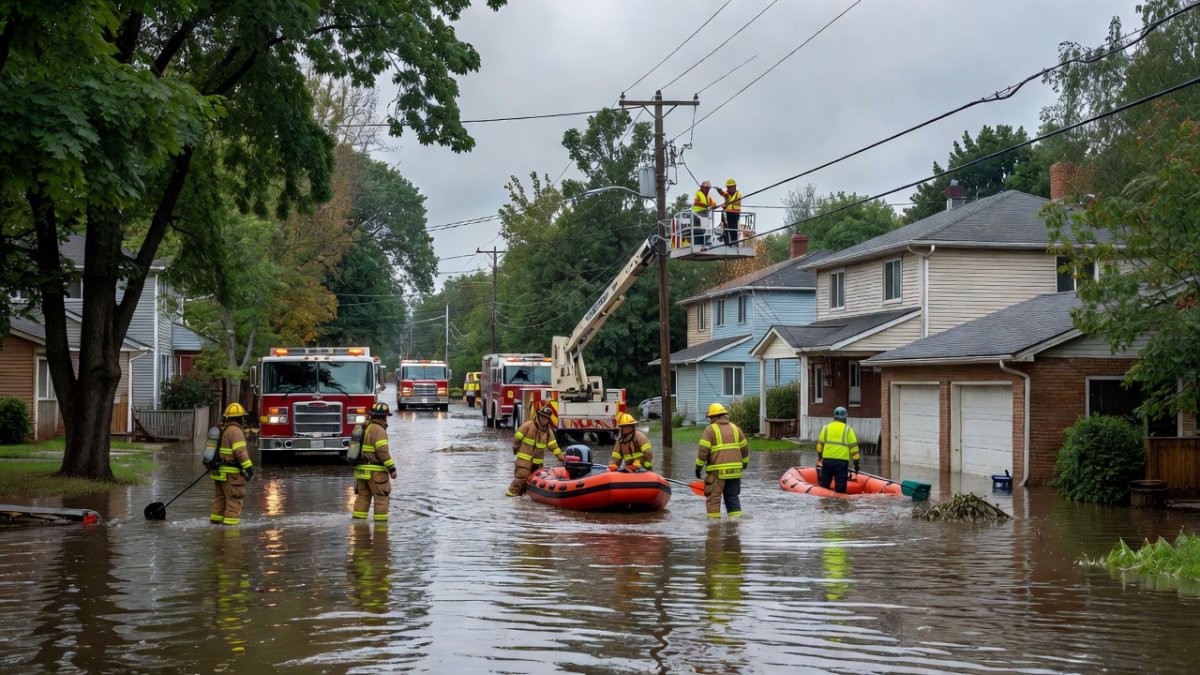
Rescue crews navigate flooded streets in Dollard-des-Ormeaux. (Global 1 News)
Power Disruptions Affect Thousands Across the Island
Hydro-Québec reported that approximately 4,500 addresses remained without electricity as of Sunday morning. The utility noted that outages peaked near 20,000 customers during the height of the storm before crews began systematic restoration. Field teams were mobilized from regional depots in Laval and Longueuil, deploying bucket trucks, portable generators, and insulated line tools to address downed conductors and flooded pad-mounted transformers; restoration proceeded in phases beginning with main feeder lines serving critical loads, followed by lateral circuits once safety inspections confirmed no submerged hazards remained in residential zones.
By Sunday afternoon, power had been restored to roughly 3,000 customers, leaving about 1,000 addresses still affected. Such widespread but temporary losses underscore the vulnerability of overhead lines and substations during extreme precipitation events that are becoming more frequent in southern Quebec. Crews utilized drone-mounted infrared cameras to survey inaccessible flooded segments of the distribution network, identifying hot spots on aging wooden poles that required urgent reinforcement before re-energization, a technique that accelerated safe restoration by several hours compared with traditional foot patrols.
Hydro-Québec crews worked through the night prioritising critical infrastructure such as hospitals and water treatment facilities. The utility's post-event review will examine whether underground cabling in flood-prone zones could reduce future disruptions, a strategy already piloted in parts of downtown Montreal. Additional resources included vacuum trucks for dewatering substation vaults and specialized splicing equipment for repairing water-damaged underground cables, with overtime shifts extending into Monday to complete final patrols and customer notifications via automated outbound calling systems.
Emergency Services Respond to Hundreds of Calls
Montreal Fire Division Chief Martin Guilbault confirmed that firefighters received 800 calls beginning at 3 p.m. on Saturday. Responders rescued approximately 15 people from stranded vehicles using boats in areas where roadways had become impassable. Dispatch logs indicate that the first wave of calls originated from the Pierrefonds sector, prompting deployment of eight pumpers, four rescue units, and two swift-water teams equipped with personal flotation devices and hydraulic rescue tools; mutual aid partners from the City of Laval supplied additional zodiac-style boats that proved essential for navigating submerged intersections along Boulevard Pierrefonds.
Montreal police spokesperson Anthony Dorelas verified that Boulevard Pierrefonds and Boulevard Jacques-Bizard were closed to traffic for safety reasons. These coordinated efforts reflect the strong tradition of first-responder collaboration and community mutual aid that characterises Canadian disaster response. Traffic management involved placement of over 200 traffic cones and electronic message boards at 15 key intersections, with officers conducting door-to-door notifications in high-risk zones to advise residents of evacuation routes and temporary parking restrictions that prevented further vehicle entrapments.
Additional support came from neighbouring fire departments under mutual aid agreements, a standard practice across Canadian provinces to ensure rapid scaling of resources during localised emergencies. Volunteers from the Canadian Red Cross also arrived to assist with shelter operations and distribution of emergency supplies. The Red Cross established a reception centre at the Dollard-des-Ormeaux civic arena stocked with hygiene kits, bottled water, and comfort items, while provincial emergency management coordinators facilitated real-time information sharing through the provincial operations centre to align municipal, utility, and non-governmental resources.
Local States of Emergency and Provincial Support
The municipality of Saint-Constant declared a local state of emergency on Saturday, which was lifted at 10:40 a.m. on Sunday once immediate threats subsided. Quebec Public Safety Minister Ian Lafrenière indicated that provincial assistance would be made available to affected communities. The declaration enabled expedited procurement of sandbags, portable pumps, and temporary fencing, with the provincial emergency management agency providing liaison officers to coordinate logistics and track resource expenditures for subsequent reimbursement claims.
Under Canada's federal-provincial framework, such declarations allow municipalities to access disaster financial assistance programs while respecting jurisdictional boundaries. Insurance claims and provincial recovery funds will likely play central roles in rebuilding, though residents in flood-prone zones continue to face rising premiums tied to climate-driven risk assessments. Municipal finance officers have begun compiling detailed damage inventories including photographs and contractor estimates to support applications under the provincial disaster assistance program, which typically covers up to 80 percent of eligible municipal costs once thresholds are surpassed.
Quebec's civil protection framework coordinates with federal programs through the Disaster Financial Assistance Arrangements, which reimburse provinces for eligible response and recovery costs once thresholds are met. This structure ensures that major events like the June 2026 flooding trigger structured financial support while maintaining provincial authority over local implementation. Federal officials have already initiated preliminary damage assessments in collaboration with Quebec counterparts to determine whether national thresholds for additional support will be reached, facilitating advance planning for potential large-scale infrastructure rehabilitation projects.
Federal-Provincial Coordination
Federal and provincial officials activated established coordination protocols under the Disaster Financial Assistance Arrangements shortly after the Saint-Constant declaration, with daily briefings held between Public Safety Canada representatives and Quebec's Ministry of Public Security to monitor expenditure thresholds and align eligibility criteria for municipal claims. The DFAA program requires provinces to absorb costs up to a per-capita threshold of approximately $3.50 before federal reimbursement begins at 50 percent, rising to 75 percent once higher tiers are reached; preliminary estimates suggest the June 2026 event may approach or exceed these benchmarks given the scale of residential and infrastructure damage across multiple West Island boroughs. Joint task forces reviewed flood mapping data and insurance penetration rates to identify gaps where federal backstop mechanisms could supplement provincial recovery funds, ensuring seamless handoff of financial responsibilities while preserving local decision-making authority on rebuilding priorities.
Impact on Vulnerable Communities
Low-income households and seniors living in basement apartments were disproportionately affected by the flooding, as many lacked the resources to relocate belongings or access temporary housing. Community groups have called for targeted support programs that recognise these disparities in future disaster planning. Advocacy organizations such as the Montreal Community Advocacy Network released statements urging the creation of dedicated emergency housing vouchers and rapid-repair grants scaled according to household income, noting that census data indicate over 2,200 basement apartments exist in the affected postal codes with occupancy rates exceeding 70 percent among seniors and recent immigrants.
Quebec's flood mapping initiatives, updated in recent years with federal climate adaptation funding, aim to identify such high-risk areas and guide more equitable infrastructure investments. Without accelerated action, repeated events could deepen social inequalities across Montreal's suburban neighbourhoods. Updated maps now incorporate climate-adjusted rainfall projections and have flagged an additional 18 percent of West Island residential parcels as high-risk, prompting calls from groups including the Quebec Environmental Law Centre for mandatory landlord disclosure requirements and subsidized elevation of mechanical systems in rental units.
Insurance Industry Response and Financial Recovery
Insurance companies operating in Quebec have reported a surge in claims following the June 20 event, with many policies now including higher deductibles for water damage. Industry analysts note that climate-related flooding has driven up premiums province-wide, prompting discussions about expanding public backstop programs similar to those in other Canadian jurisdictions. Early industry tallies project more than 2,800 claims exceeding $18 million in total insured losses, with average residential payouts anticipated between $6,000 and $12,000 once adjusters complete assessments of structural and contents damage.
The federal Disaster Financial Assistance Arrangements provide a safety net when provincial costs exceed certain thresholds, yet gaps remain for homeowners whose properties fall outside updated flood maps. This reality has renewed calls for coordinated federal-provincial efforts to improve risk disclosure and encourage resilient rebuilding practices. Industry associations have advocated for standardized flood-risk labeling on property disclosure forms and incentives for homeowners to install backwater valves, measures that could reduce future claim volumes by an estimated 15 to 20 percent according to actuarial modeling.
Historical Context of Montreal Flooding
Montreal has experienced significant flooding events in 2017, 2019, and 2023, each prompting reviews of drainage infrastructure and emergency protocols. The 2026 West Island storm fits within this recurring pattern, highlighting the need for sustained investment beyond reactive measures. The 2017 floods alone generated insured losses surpassing $1.2 billion province-wide and led to the installation of over 15 kilometres of new trunk sewers in targeted neighbourhoods, while the 2019 and 2023 events together prompted $85 million in provincial upgrades to pumping stations and retention basins that proved partially effective yet insufficient for the 2026 intensities.
Provincial flood management strategies have evolved to incorporate more detailed mapping and stricter development controls in vulnerable zones. These efforts align with national climate adaptation priorities supported through programs such as the Disaster Mitigation and Adaptation Fund, which provides cost-shared funding for major infrastructure upgrades across Canada. Recent mapping revisions have integrated LiDAR-derived elevation data and hydrological modeling to restrict new construction in 1-in-100-year floodplains, with several West Island municipalities adopting bylaws requiring elevated mechanical equipment in all new builds.
Looking Ahead: Climate Adaptation and Infrastructure Resilience
The June 20-21 event adds to a pattern of intense, short-duration rainfall that has challenged Montreal's West Island and South Shore communities in recent years. Experts note that climate change is increasing the frequency of such extremes across Canada, placing greater pressure on municipal drainage networks and emergency planning. Updated climate models from Environment and Climate Change Canada project a 20 to 30 percent increase in extreme precipitation events by 2050 for the Montreal region, driving borough-level master planning processes that prioritize hybrid green-grey solutions.
Discussions are already underway among borough officials in Pierrefonds-Roxboro, Dollard-des-Ormeaux, and neighbouring communities about targeted infrastructure investments. These conversations occur within Quebec's broader context of balancing local autonomy with provincial oversight on major capital projects. Proposed investments include expanding permeable pavement pilots along 12 kilometres of residential streets and constructing three new retention ponds with combined storage capacity of 45,000 cubic metres, funded partly through the federal Green Municipal Fund and the Disaster Mitigation and Adaptation Fund.
Residents and civic leaders alike have emphasised the importance of preparedness measures, including improved forecasting, public alerts, and neighbourhood-level mutual support networks that proved effective during the weekend response. Enhanced alert systems now integrate SMS notifications with real-time rainfall radar feeds, while community emergency response teams trained by the Canadian Red Cross have expanded to cover an additional 4,000 households in high-risk zones.
Federal climate infrastructure spending through programs like the Green Municipal Fund offers additional avenues for municipalities to finance long-term resilience projects. Coordination between Ottawa and Quebec City remains essential to align these resources with local priorities while addressing the federal-provincial divide on disaster response responsibilities. Joint working groups continue to refine cost-sharing ratios and eligibility criteria to accelerate approval timelines for shovel-ready projects.
Future planning will likely incorporate lessons from the 2026 flooding into updated municipal master plans, with emphasis on green infrastructure solutions such as permeable surfaces and retention ponds that can complement traditional grey infrastructure upgrades. These integrated approaches are expected to feature prominently in the next iteration of the Montreal Metropolitan Community's climate adaptation strategy, scheduled for release in 2027.
By Alex Thompson, Staff Writer
This article was produced with AI-assisted research and editorial support. Reporting is based on sources cited in the article.
What's Your Reaction?
 Like
0
Like
0
 Dislike
0
Dislike
0
 Love
0
Love
0
 Funny
0
Funny
0
 Wow
0
Wow
0
 Sad
0
Sad
0
 Angry
0
Angry
0

Canada Correspondent at Global1.News. Based in Toronto, covering Canadian politics, energy, trade, and US-Canada relations. Provides the Canadian perspective on North American and global affairs.














Comments (0)