
Marcos courts Japanese investors, secures P210-billion commitments
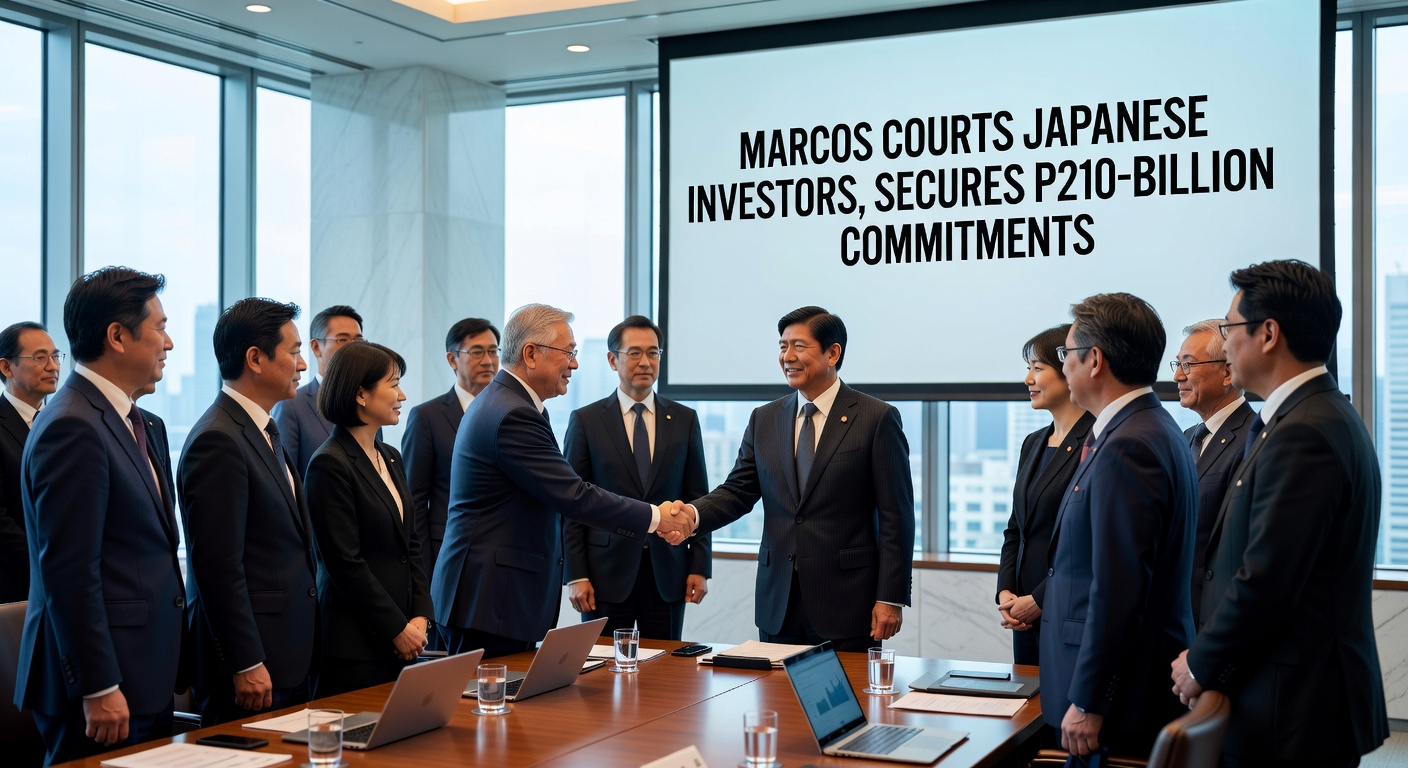
Marcos Secures P210 Billion in Japanese Investment Pledges During Tokyo Roundtable
President Ferdinand “Bongbong” Marcos Jr. returned from Tokyo on Thursday with approximately $3.4 billion or P210 billion in fresh investment commitments from major Japanese firms, marking one of the largest single-trip hauls for the administration since it took office in 2022. The pledges emerged from a high-level business roundtable on May 27 that brought together Philippine economic officials and representatives from 18 Japanese corporations across manufacturing, renewable energy, and logistics sectors.
Details of the Commitments
Officials disclosed that the commitments span five priority areas identified under the Philippine Development Plan 2023-2028. Renewable energy projects account for roughly P85 billion, led by a consortium including Mitsubishi Corporation and Sumitomo Mitsui for offshore wind farms in Ilocos Norte and Guimaras. Manufacturing investments totaling P62 billion focus on automotive components and semiconductor packaging, with Toyota Tsusho and Hitachi Astemo expanding existing plants in Laguna and Cavite. Infrastructure and logistics pledges reach P45 billion, centered on port modernization in Batangas and Subic. The remaining P18 billion targets agribusiness and cold-chain facilities aimed at reducing post-harvest losses in Mindanao.
Marcos described the outcome as validation of the country’s improved investment climate. “Japan has always been a steadfast partner,” he told reporters in Tokyo. “These commitments will translate into thousands of quality jobs and technology transfer that directly benefit Filipino workers and communities.”
Strategic Context of the Japan Visit
The Tokyo meeting formed part of Marcos’ broader diplomatic push to diversify foreign direct investment sources away from over-reliance on any single partner. Japan remains the Philippines’ largest source of official development assistance and ranks among the top three FDI contributors. Bilateral trade reached $23.8 billion in 2024, with Japanese firms employing more than 180,000 Filipinos directly in export-oriented industries. The new pledges build on the 2023 Japan-Philippines economic cooperation agreement that streamlined visa processing for skilled workers and expanded tax incentives for green investments.
Analysts note that timing proved critical. With global supply chains still adjusting after pandemic disruptions and ongoing tensions in the South China Sea, Japanese conglomerates have accelerated “China-plus-one” strategies. The Philippines offers geographic proximity, English-speaking talent, and a young workforce, advantages Marcos highlighted during closed-door sessions with Keidanren, Japan’s largest business federation.
Economic Data and Projected Impact
Philippine Statistics Authority figures show FDI inflows grew 12 percent year-on-year in the first quarter of 2025, reaching $2.1 billion. Japan contributed 28 percent of that total. The new P210 billion commitments, if fully realized over the next three years, could add 0.6 percentage points to annual GDP growth and generate an estimated 45,000 direct jobs, according to Department of Trade and Industry modeling. Indirect employment multipliers suggest another 120,000 positions in supporting industries.
These figures matter in a country where underemployment still hovers near 12 percent. Renewable energy projects alone are projected to lower average household electricity costs by 8 to 11 percent once operational, a concrete gain for low-income families who spend a disproportionate share of income on power.
Expert Perspectives on Inclusive Growth
University of the Philippines economist Dr. Maria Santos emphasized the need for deliberate policy choices to ensure benefits reach ordinary citizens. “Investment announcements are welcome, but we must pair them with enforceable local-content requirements and skills-training programs,” she said. “Otherwise, we risk repeating cycles where profits flow outward while communities absorb environmental and social costs.”
Japanese Chamber of Commerce in the Philippines president Kenji Yamamoto echoed the call for partnership. “Our member companies are committed to community engagement,” he stated. “Past projects have included scholarship programs and health centers. We intend to replicate and expand those models.”
Strengthening Democratic Institutions Through Economic Ties
Marcos’ administration has framed deeper economic integration with democratic partners such as Japan as complementary to safeguarding sovereignty and rule of law. Stable investment flows can reduce fiscal pressures that sometimes tempt governments toward authoritarian shortcuts. The roundtable outcomes also align with ongoing efforts to modernize the armed forces through the Enhanced Defense Cooperation Agreement, indirectly supported by a more resilient economy.
Still, civil society groups caution against complacency. Bayan Muna representative Teddy Casiño noted that past Japanese-funded projects have occasionally faced allegations of labor rights violations. “Transparency in contract implementation remains essential,” he said. “Democracy thrives when citizens can hold both foreign investors and their own leaders accountable.”
Challenges and Next Steps
Realizing the full P210 billion will require swift regulatory approvals and resolution of right-of-way issues that have delayed previous infrastructure initiatives. The Board of Investments has pledged a 60-day processing window for the identified projects, yet local government coordination remains a frequent bottleneck. Currency fluctuations and global interest-rate movements could also affect final capital deployment timelines.
Marcos directed the creation of an inter-agency monitoring task force to track project milestones quarterly, with public dashboards to be launched by September. Such measures respond directly to demands for greater accountability in the use of public incentives granted to foreign investors.
This is Bella Reyes for Global1 News, reporting from Manila. 🇵🇭
This article was produced with AI-assisted research and editorial support. Reporting is based on sources cited in the article.
What's Your Reaction?
 Like
0
Like
0
 Dislike
0
Dislike
0
 Love
0
Love
0
 Funny
0
Funny
0
 Wow
0
Wow
0
 Sad
0
Sad
0
 Angry
0
Angry
0

Philippines/Southeast Asia Correspondent at Global1.News. Manila-based journalist covering Philippine politics, environment, maritime security, and social issues. Passionate about marine conservation and the communities protecting the Philippines' natural heritage.













Comments (0)