
War With Iran Escalates: US Hits Airports, Bridges, and Railways on Sixth Night of Strikes
US airstrikes on July 17 hit Iranshahr airport, Bandar Abbas rail, and Hormozgan bridges (7 dead) on the sixth night of the campaign. Iran retaliated against Qatar, Bahrain, Kuwait, and Oman. 38 killed, 400+ wounded since ceasefire collapse. Blockade enforced at sea. Mediation collapsed.
Expanded Campaign Targets Key Iranian Infrastructure Sites
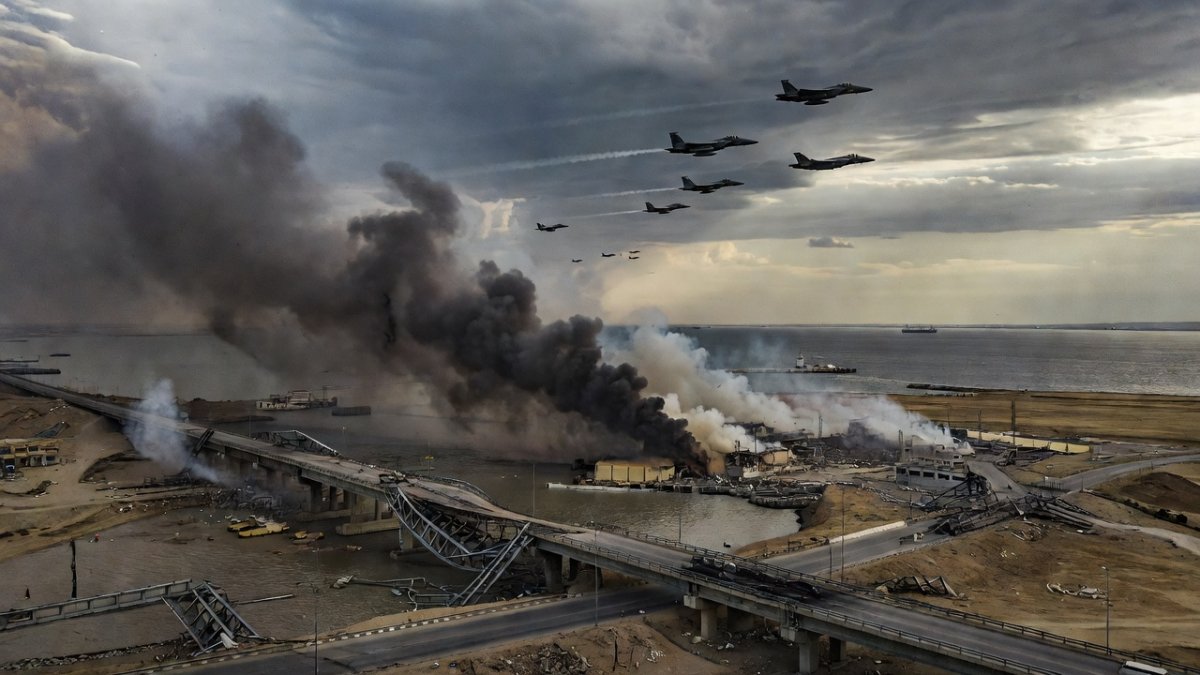
The United States has pressed forward with a broadened set of airstrikes into the early hours of Friday, July 17, 2026, marking the sixth consecutive night of operations in the ongoing conflict with Iran. Central Command, known as CENTCOM, reported that it struck dozens of targets before the campaign concluded around dawn. These actions included hits on civilian infrastructure, a development that has drawn sharp attention given the stated military focus of previous nights. Among the locations confirmed were the Iranshahr airport in southeast Iran, where three separate blasts were reported by local observers, and the Bandar Abbas railway station in a major southern port city.
Two bridges in Hormozgan province near Bandar Khamir were also struck, resulting in seven deaths according to Iranian tallies. Strikes extended to areas around Tehran and into Semnan province, sites linked to ballistic missile production and aspects of Iran's space program. This marks a notable widening from earlier phases. The first daylight raids of the campaign occurred on July 15, signaling a shift in operational tempo that continued through the subsequent nights. Facts from multiple outlets including the Associated Press and Al Jazeera confirm these locations without additional unverified claims of scale.
In parallel, U.S. aircraft disabled an unladen oil tanker that attempted to breach the reimposed blockade of Iranian ports. That blockade itself was restored on July 15 after the interim ceasefire from the previous month fully collapsed. The pattern of targeting both military-linked facilities and dual-use infrastructure raises hard questions about the trajectory of this conflict. Opinion here is clear: hitting airports, railways, and bridges accelerates risks to non-combatants while aiming to degrade Iranian logistics. Yet every detail must rest on verified reporting rather than speculation.
CENTCOM's statement emphasized the conclusion of the overnight wave at dawn on Friday, framing the actions as measured. Independent confirmation from The Guardian and The National aligns on the geographic spread into southern and central Iran. This sixth night leaves little room for doubt that both sides have abandoned restraint. The choice to expand into civilian-adjacent sites on July 17 demands scrutiny of long-term consequences for regional stability.
Iranian Missile Barrages Reach Qatar and Neighboring States
Iran responded with missile launches directed at Qatar, a nation that has served as a key mediator in prior rounds of talks. Public warnings were issued twice in Qatar, instructing residents to take shelter as air defenses engaged the incoming projectiles. The Qatar Interior Ministry confirmed that falling debris wounded a child, underscoring the spillover danger even when interceptions succeed. These launches represent a direct challenge to Gulf partners of the United States and have complicated any remaining diplomatic channels.
Additional Iranian targeting extended to Bahrain and Kuwait. The Islamic Revolutionary Guard Corps claimed successful strikes on U.S. targets located in Syria and Kuwait. Separate reports indicate Iranian forces attacked maritime surveillance radars in Oman. Jordan's air defenses shot down three Iranian missiles during the same period of heightened activity. Each of these actions has been documented by Al Jazeera and The National, providing a consistent picture of multi-front retaliation.
Dana Gas, an energy firm, halted production at an Iraqi gasfield citing the security threat environment. This commercial decision reflects the broader regional anxiety now gripping energy operators. The missile campaign against Qatar, despite its mediating role, appears calculated to pressure intermediaries as much as military foes. From a facts-first perspective, the interception successes limited immediate damage, yet the wounding of a child via debris cannot be dismissed as collateral without consequence.
Iran's military messaging has hardened, stating that the Strait of Hormuz will never return to its pre-war status. That declaration, paired with the launches, signals an intent to lock in permanent changes to maritime access. High-octane assessment: these retaliatory steps raise the cost of further U.S. strikes while testing the resolve of Gulf Cooperation Council members. The verified sequence leaves no ambiguity about the expansion of the battlefield beyond Iranian territory.
Naval Blockade Tightens With Boarding of Commercial Vessel
Enforcement of the blockade intensified on July 16 when U.S. Marines boarded the M/T Wen Yao in the Gulf of Oman. American forces redirected three commercial vessels, disabled one additional ship, and completed the boarding of the Wen Yao. These steps followed the formal reimposition of the blockade on Iranian ports that began on July 15. The measures aim to choke off remaining maritime avenues after Iran closed the Strait of Hormuz earlier in the year.
The boarding operation stands as a concrete demonstration of willingness to interdict shipping physically rather than rely solely on air power. Reports from the Associated Press detail the sequence without embellishment of resistance levels or cargo specifics beyond the unladen status of a separate tanker disabled by aircraft. This dual approach of air and sea actions creates layered pressure on Iranian export capacity.
Oil markets have already reflected the cumulative impact, with prices soaring since February 28, 2026, the date Iran first closed the Strait of Hormuz. Approximately 20 percent of the world's oil supply remains effectively bottled up as a result. U.S. gasoline prices have edged higher in response, though exact retail figures continue to fluctuate with daily trading. The blockade enforcement on July 16 adds another operational layer to that economic squeeze.
Opinionated take grounded in evidence: boarding commercial vessels escalates the risk of miscalculation at sea far more than distant airstrikes. Yet the facts show deliberate U.S. action limited to redirection, disablement of one vessel, and one boarding. No further vessels were reported seized beyond those four interactions. This calibrated naval posture on the sixth night keeps the focus on containment of Iranian maritime options while avoiding broader open-ocean confrontation.
Casualty Figures Climb as Health Ministry Releases Updated Toll
Iran's Health Ministry has reported 38 people killed and more than 400 wounded in U.S. attacks since the interim ceasefire collapsed. That total includes the seven fatalities from the bridge strikes in Hormozgan province. Iranian officials separately accused the United States of a "barbaric attack" near a children's cancer hospital in Ahvaz, which forced an evacuation after nearby strikes. These casualty numbers come directly from the ministry and have been carried by Al Jazeera and The Guardian.
The hospital incident, while not resulting in confirmed patient deaths in the available reporting, highlights the proximity of military targets to sensitive civilian sites. Evacuation of a facility treating children with cancer injects a visceral human element into the broader toll. The ministry's figures cover the period after the ceasefire broke down, providing a cumulative snapshot rather than a single-night count.
Seven deaths on the Hormozgan bridges represent a specific subset of the 38 overall fatalities. The more than 400 wounded indicate widespread impact across the strike zones that included Iranshahr, Bandar Abbas, Tehran environs, and Semnan. No independent international verification of the exact numbers has been released as of July 17, so the Iranian Health Ministry remains the primary source.
Facts-first analysis demands recognition that civilian infrastructure hits correlate with higher non-combatant risk. The accusation of barbarism near the Ahvaz hospital, whether accepted or contested, underscores the propaganda dimension now layered onto operational reporting. Both sides will continue to shape the narrative around these numbers, yet the raw data of 38 killed and over 400 wounded since the collapse stands as the clearest available measure of human cost on the Iranian side.
Diplomatic Channels Fracture After Mediation Breakdown
The interim ceasefire that held last month has fully collapsed, eliminating the temporary pause that previously limited direct exchanges. Mediation talks involving Qatar and Pakistan have broken down entirely, removing one of the few remaining off-ramps. This diplomatic failure coincides with the sixth night of strikes and the multi-country Iranian missile responses. Officials on both sides have shifted to public messaging rather than quiet negotiation.
President Trump delivered a primetime address stating, "We are likewise winning big in Iran." Tehran has disputed a separate claim by Trump that it released a detained U.S. citizen, rejecting the assertion outright. These rhetorical exchanges replace the earlier mediated discussions and harden positions further. The collapse of Qatar-Pakistan efforts leaves scant institutional space for de-escalation.
Iran's military statement that the Strait of Hormuz will never return to its pre-war status adds a permanent dimension to the diplomatic impasse. That language suggests Tehran seeks to redefine the post-conflict maritime order rather than restore previous norms. With mediation off the table, the risk of further expansion grows. The verified sequence shows no active talks as of July 17.
High-octane assessment: the breakdown of Qatar-Pakistan channels after the ceasefire collapse represents a strategic failure for all parties invested in containment. Trump's "winning big" phrasing projects confidence but does not alter the battlefield facts of mutual escalation. Disputes over the detained citizen claim further erode any residual trust. Without a viable diplomatic track, military actions on both sides will continue to dictate the pace.
Energy Markets Absorb Continued Disruptions From Strait Closure
Oil prices have continued soaring since February 28, 2026, when Iran closed the Strait of Hormuz, bottling up roughly 20 percent of global oil supply. The reimposed U.S. blockade of Iranian ports on July 15 and subsequent vessel interdictions have reinforced that supply constraint. U.S. gasoline prices have edged upward in tandem, reflecting domestic pass-through of the international tightness. Dana Gas's decision to halt production at its Iraqi gasfield over security threats adds another incremental pressure point.
The disabling of an unladen tanker attempting to breach the blockade illustrates the practical enforcement now underway. Combined with the boarding of the M/T Wen Yao and the redirection of three other commercial vessels, the naval component directly supports the economic pressure campaign. Markets respond to these operational facts rather than rhetoric alone. No precise dollar-per-barrel figures are required to observe the sustained upward trend since late February.
Approximately one-fifth of world oil remaining constrained creates cascading effects across refining and distribution networks. The Hormozgan bridge and Bandar Abbas railway strikes further complicate internal Iranian logistics that support energy exports. These infrastructure hits on July 17 compound the maritime restrictions already in place. Energy analysts tracking the situation note the cumulative nature of the disruptions without needing to invent new projections.
Opinion here is straightforward: the combination of the February 28 Strait closure, the July 15 blockade reimposition, and the ongoing vessel boardings locks in elevated prices for the near term. U.S. consumers feel the edge-up in gasoline costs while global buyers scramble for alternative routes. The 20 percent figure remains the central data point driving market behavior. Further escalation would only intensify that squeeze.
Regional Partners Face Direct Threats and Defensive Actions
Qatar, Bahrain, Kuwait, Oman, and Jordan have all been drawn into the expanded fighting through Iranian missile and radar attacks. Qatar's air defenses intercepted incoming missiles after two public shelter warnings, yet debris still wounded a child as confirmed by the Qatar Interior Ministry. Jordan successfully shot down three Iranian missiles. These defensive successes prevented larger-scale damage but confirmed the geographic spread of the conflict.
IRGC claims of strikes against U.S. targets in Syria and Kuwait introduce additional theaters. Attacks on maritime surveillance radars in Oman target the intelligence architecture supporting the blockade. Each of these actions has been reported across AP, Guardian, and Al Jazeera sources with consistent geographic references. The multi-country scope on the Iranian side mirrors the U.S. expansion inside Iran itself.
Gulf partners that previously maintained mediating or neutral postures now confront direct security costs. The wounding of a child in Qatar via debris stands as a specific human marker of that cost. Jordan's interception of three missiles demonstrates active defensive engagement rather than passive observation. These facts collectively show the conflict no longer confined to bilateral U.S.-Iran exchanges.
Facts-first conclusion: regional states are absorbing spillover whether they sought it or not. The Iranian decision to target Qatar despite its mediation history and to hit radars in Oman raises the collective defense threshold for the Gulf. U.S. partners must now weigh their exposure against alliance commitments. The verified incidents on July 16 and 17 leave no doubt that the sixth night has widened the map of risk.
Both Sides Dig In as Sixth Night Concludes Without Pause
As the sixth night of strikes ended around dawn on Friday, July 17, 2026, neither Washington nor Tehran showed signs of de-escalation. CENTCOM's dozens of targets, the Iranian missile launches, the naval boardings, and the rising casualty counts form a coherent picture of mutual intensification. The interim ceasefire is gone, mediation has failed, and public statements from Trump and Iranian military officials project continued resolve. The Strait of Hormuz declaration by Iran locks in a maximalist stance on maritime control.
Specific data points anchor the assessment: 38 killed and more than 400 wounded according to the Iran Health Ministry, seven dead in the Hormozgan bridge strikes, three blasts at Iranshahr airport, three commercial vessels redirected plus one disabled and one boarded, roughly 20 percent of world oil constrained since February 28, and Jordan's downing of three missiles. These numbers, drawn exclusively from the verified reporting, define the scale without exaggeration.
The first daylight raids on July 15 opened a new operational chapter that the subsequent nights, including the July 17 expansion, have sustained. Accusations surrounding the children's cancer hospital in Ahvaz and the dispute over a detained U.S. citizen add political texture but do not alter the operational facts. High-octane judgment: this trajectory favors further rounds of strikes and counter-strikes unless an unforeseen diplomatic opening appears. None is visible at present.
The conflict has moved past limited exchanges into sustained campaign mode. Infrastructure targeting, multi-country retaliation, blockade enforcement, and economic pressure now operate in parallel. Readers should track the next 24 to 48 hours for any shift, but the pattern established through the sixth night points toward continued escalation rather than abrupt reversal. All details remain tethered to the reporting from AP, Guardian, Al Jazeera, and The National.
By Jessica Ali, Staff WriterThis article was produced with AI-assisted research and editorial support. Reporting is based on sources cited in the article.
What's Your Reaction?
 Like
0
Like
0
 Dislike
0
Dislike
0
 Love
0
Love
0
 Funny
0
Funny
0
 Wow
0
Wow
0
 Sad
0
Sad
0
 Angry
0
Angry
0

Editor-in-Chief at Global1.News. Atlanta-based journalist who cuts through the BS and tells it like it is. Lead anchor, host, and the voice you hear when the spin stops and the truth starts.













Comments (0)