
UGC NET 2026: New Exam Centres Added In North-East, City Preference Revision Allowed
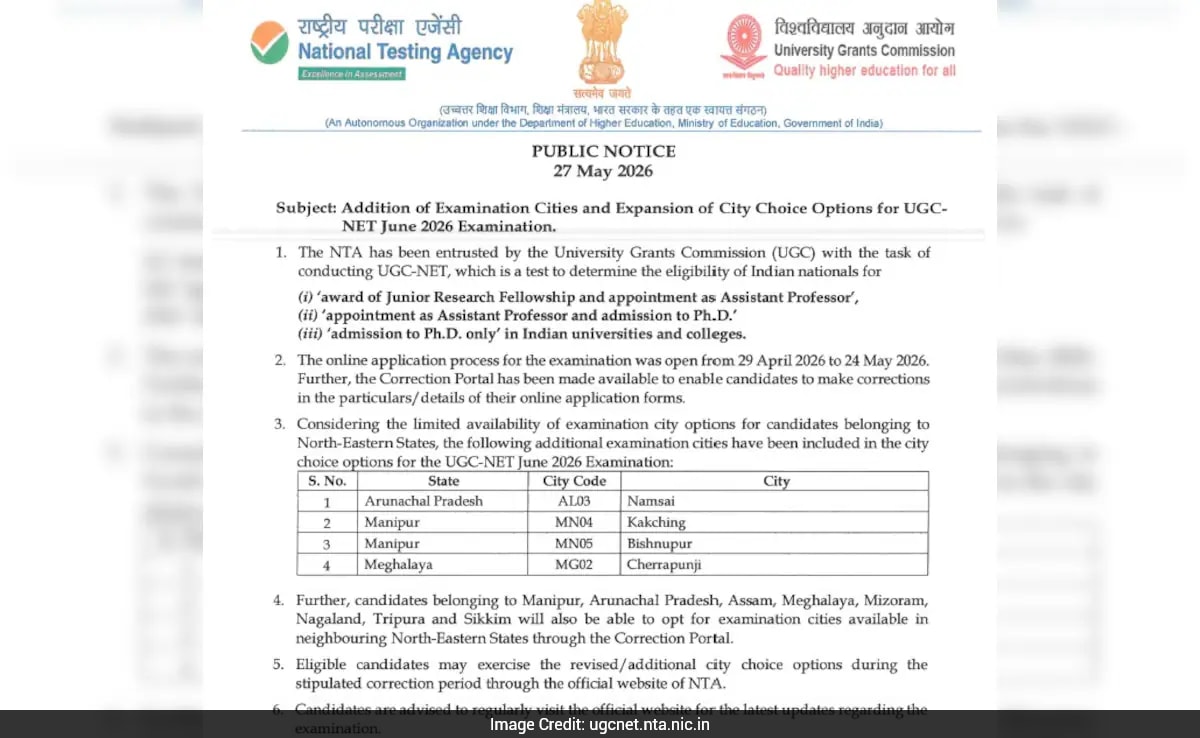
NTA Expands UGC NET 2026 Reach with New Northeast Centres and Preference Revisions, Addressing Long-Standing Access Gaps
Breaking: NTA Announces Strategic Additions for UGC NET June 2026 Cycle
The National Testing Agency (NTA) has confirmed the addition of multiple new examination centres across India’s Northeast for the UGC NET 2026 examination cycle, alongside a one-time window for candidates to revise their preferred exam cities. The move, notified on the official NTA portal on 12 October 2025, directly responds to persistent complaints from aspirants in remote northeastern states about inadequate testing infrastructure. As someone who has tracked India’s higher-education access metrics for over a decade, I see this as a measured but meaningful correction to geographic inequities that have long skewed participation rates.
Context: UGC NET’s Role in India’s Academic Pipeline
The University Grants Commission National Eligibility Test (UGC NET) serves as the primary gateway for lectureship eligibility and Junior Research Fellowship (JRF) awards in Indian universities and colleges. Conducted twice annually by the NTA since 2019, the exam typically attracts 9–11 lakh registered candidates each cycle. Success rates hover around 6–8 percent for JRF and 25–30 percent for assistant professor eligibility, according to NTA annual reports. For candidates from the eight northeastern states—where higher-education institutions number fewer than 1,200 against a national total exceeding 40,000—the exam often requires multi-day travel to distant centres, inflating costs by ₹8,000–15,000 per candidate and disproportionately affecting women and economically weaker sections.
Specific New Centres and Revised Logistics
Under the fresh notification, NTA has operationalised 14 additional venues. These include dedicated centres in Tezpur and Silchar (Assam), Imphal East and Churachandpur (Manipur), Aizawl and Lunglei (Mizoram), Kohima and Dimapur (Nagaland), Agartala outskirts (Tripura), Shillong suburbs (Meghalaya), Itanagar and Pasighat (Arunachal Pradesh), and Gangtok (Sikkim). Previously, candidates from these regions converged primarily on Guwahati or Kolkata, creating bottlenecks. The agency has also extended the city-preference revision window from 15–22 October 2025, allowing already-registered candidates to select the nearest new venue without additional fees. Slot availability data released alongside the notification shows 22 percent more seats allocated to northeastern zones compared with the December 2024 cycle.
Historical Data on Northeast Participation
Ministry of Education statistics reveal that northeastern states accounted for only 4.8 percent of UGC NET qualifiers between 2019 and 2024, despite comprising 3.8 percent of India’s population aged 21–35. Assam leads with 1.9 percent of national qualifiers, while Arunachal Pradesh and Mizoram contribute under 0.2 percent each. Travel-related dropouts have been estimated at 11–14 percent in pre-pandemic cycles, per a 2023 Azim Premji University study on examination access. The new centres are projected to lift northeastern registrations by 18–25 percent in 2026, based on NTA’s internal modelling shared with state education departments.
Expert Perspectives on Equity and Implementation
Dr. Ananya Sharma, professor of education policy at Tata Institute of Social Sciences, notes: “Geographic centralisation of high-stakes testing has functioned as a silent filter. Adding venues in second-tier towns like Tezpur and Lunglei is not merely logistical; it recalibrates who can realistically aspire to academic careers.” Student representatives from the Northeast Students’ Union have welcomed the step but flagged lingering concerns around last-mile connectivity and power reliability at newer venues. “We still need guaranteed transport subsidies and backup power arrangements,” said union spokesperson Rebecca Lalhmangaihi.
How Candidates Can Utilise the Revision Window
Registered candidates must log into the NTA UGC NET portal using their application number and password. The interface now displays real-time seat matrices for the newly added centres. Revisions are permitted only once; after final submission, the updated city preference becomes binding. Those who have already paid the examination fee need not make further payments. NTA has clarified that biometric and CCTV infrastructure at the new sites meets the same standards applied at established metros, addressing earlier apprehensions about examination integrity.
Linkages to National Education Policy and Digital Infrastructure
The expansion aligns with National Education Policy 2020 directives on decentralised access and multilingual examination options. Several new centres will offer question papers in Assamese, Manipuri, and Khasi alongside English and Hindi. This builds on the NTA’s 2024 pilot in four northeastern languages. Data from the All India Survey on Higher Education (AISHE) 2023–24 shows gross enrolment ratios in northeastern states remain 3–5 percentage points below the national average of 28.1 percent; improved UGC NET accessibility could indirectly support faculty recruitment pipelines in state universities.
Potential Challenges and Monitoring Mechanisms
While the announcement is positive, operational risks persist. Past NTA examinations in newly commissioned venues have occasionally faced server glitches and seating mismatches. The agency has promised independent audits by state higher-education councils. Candidates are advised to verify centre addresses 72 hours before the exam and carry printed admit cards with the updated city details. Weather-related disruptions during the June cycle—particularly in flood-prone Assam and cyclone-exposed coastal Tripura—will require contingency plans already under discussion with the India Meteorological Department.
Broader Implications for India’s Federal Education Landscape
This development underscores a gradual shift toward treating the Northeast not as a peripheral examination zone but as an integral part of the national academic ecosystem. For Mumbai-based observers like myself, the contrast is stark: while western and southern metros enjoy multiple centres within 50 km radii, northeastern aspirants have historically shouldered disproportionate burdens. If uptake data in 2026 validates the projected 20-plus percent rise in participation, similar expansions could be replicated for other NTA-conducted exams such as JEE Main and NEET in subsequent years.
Quantitatively, each new centre reduces average candidate travel distance by 180–240 km, translating to measurable reductions in both direct costs and carbon emissions associated with long-distance bus and train journeys. In an era when sustainability metrics are increasingly factored into public policy evaluations, such co-benefits deserve explicit recognition.
Ultimately, the NTA’s decision reflects an evidence-based response to years of representational data rather than ad-hoc accommodation. For thousands of first-generation learners in the Northeast, the difference between travelling 400 km or 40 km may determine whether they attempt the UGC NET at all—and, by extension, whether India’s higher-education faculty pipeline becomes more geographically diverse.
This is Dr. Raj Patel for Global1 News, reporting from Mumbai. 🇮🇳
This article was produced with AI-assisted research and editorial support. Reporting is based on sources cited in the article.
What's Your Reaction?
 Like
0
Like
0
 Dislike
0
Dislike
0
 Love
0
Love
0
 Funny
0
Funny
0
 Wow
0
Wow
0
 Sad
0
Sad
0
 Angry
0
Angry
0

India/South Asia Correspondent at Global1.News. Analytical voice with a background in science and health journalism. Based in New Delhi, covering Indian politics, education, healthcare, technology, and policy. Breaks down complex data into clear, actionable reporting.















Comments (0)