
Stripe and Advent Drop $53 Billion Bomb on PayPal
Stripe and Advent International have made a joint 3 billion offer to acquire PayPal at 0.50 per share — the biggest fintech bid in history. With 439 million PayPal users, a combined entity would rival Visa and Mastercard, but antitrust scrutiny could block the deal.
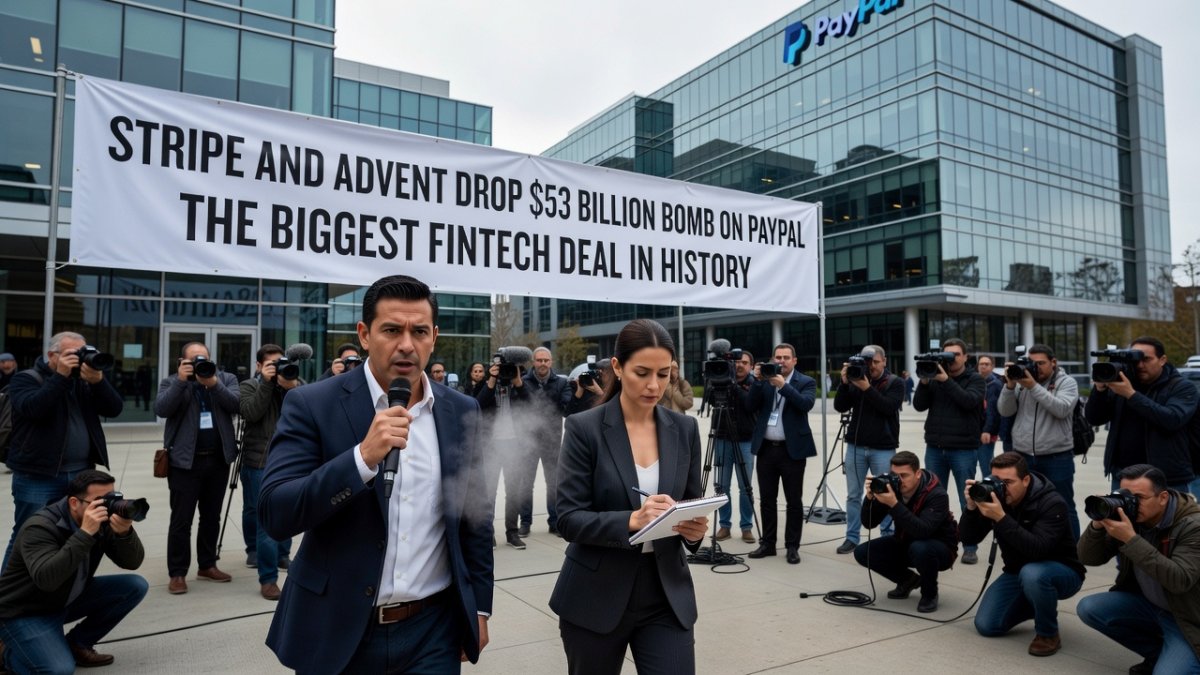
Stripe and Advent Drop $53 Billion Bomb on PayPal — The Biggest Fintech Deal in History
The internet's payment infrastructure is about to get a lot more interesting. Stripe, the privately-held payments juggernaut valued at $159 billion, has teamed up with private equity giant Advent International to make a joint bid to acquire PayPal Holdings for $60.50 per share — a deal that clocks in at over $53 billion. If it goes through, this would be the largest fintech acquisition in history, and it would fundamentally reshape how money moves online.
Stripe and Advent Drop $53 Billion Bomb on PayPal: Fintech's Biggest Deal Ever
San Francisco, CA – July 16, 2026 — It's the kind of story that makes you do a double take. Stripe — the payments company founded by Irish brothers Patrick and John Collison back in 2010 — has reportedly submitted a joint bid alongside private equity firm Advent International to acquire PayPal for roughly $53.4 billion. That's $60.50 per share, representing a roughly 28% premium over PayPal's closing price on Tuesday before Reuters broke the news.
The Numbers That Matter
Let's talk scale. PayPal operates 439 million active accounts worldwide, generated $33.2 billion in annual revenue, and owns some of the most recognizable names in digital payments: Venmo, Braintree, PayPal Credit, and a growing stable of cryptocurrency services. Stripe, by comparison, has roughly half the public brand recognition but processes hundreds of billions in payment volume for companies like Shopify, Lyft, and Amazon. The combined entity would process trillions of dollars in transactions annually — putting it in direct competition with Visa, Mastercard, and even the global banking system itself.
The bid is backed by roughly $50 billion in committed financing from major banks, according to sources familiar with the matter. That's not pocket change — it's a statement of intent. The offer follows a preliminary inquiry Stripe made back in April 2026, and sources say the goal is to finalize an agreement by the end of this month.
The Collison Brothers Play for the Crown
Patrick and John Collison have been quietly building Stripe into a global financial infrastructure giant for sixteen years. The company was most recently valued at $159 billion in a tender offer earlier this year, and the brothers have long resisted taking Stripe public — a stance that has frustrated some investors but given them the flexibility to make bold moves like this one. Acquiring PayPal would instantly give Stripe the consumer-facing brand presence it's always lacked. Stripe is the engine room; PayPal is the face. Put them together, and you've got a financial powerhouse that spans everything from mom-and-pop Shopify stores to Venmo splits between friends to enterprise-level B2B payment processing.
"Stripe has always been about building the infrastructure, not the front-end experience," noted one fintech analyst on X. "Buying PayPal changes that calculus entirely."
What About Antitrust?
Here's where things get complicated. Combining the two largest independent payment processors in the United States is going to attract serious regulatory scrutiny. The Department of Justice under this administration has been aggressive on tech mergers — just ask the companies that tried and failed to consolidate in 2025. The argument for the deal will likely center on global competition: Stripe and PayPal face intense pressure from non-US players like China's Alipay and WeChat Pay, India's UPI ecosystem, and Europe's growing open-banking infrastructure. Whether that argument holds water with regulators is another question entirely.
Some HN commenters have pointed out that the DOJ might demand divestitures — potentially spinning off Venmo or Braintree to preserve competition in the peer-to-peer and merchant services markets. Others argue that the combined entity could actually increase competition with the card networks, which would be a harder argument for regulators to block.
The Street Reacts
PayPal's stock surged roughly 15% in pre-market trading on Wednesday, hitting around $54.96 — still below the $60.50 offer price, which tells you the market sees execution risk. The wide gap between the offer and the trading price suggests investors are pricing in a real possibility that the deal could be blocked, delayed, or renegotiated.
"PYPL at $60.50 is a 28% premium — that's the kind of number that gets shareholder attention. But when your acquirer is a private company backed by PE, and regulators are circling, that premium starts to feel like an option, not a guarantee."
Stripe's own valuation is also a factor. At $159 billion, Stripe is already worth more than PayPal was before the bid. If this deal goes through, Stripe would essentially be absorbing a company with more users but slower growth — a classic case of the disruptor swallowing the disrupted.
Why Now? The Strategic Logic
The timing is no coincidence. The payments industry is at an inflection point. Stablecoins are gaining real traction — PayPal launched its own PYUSD stablecoin in 2023, and Stripe has been integrating crypto payments for years. Central bank digital currencies are moving from pilot to production in multiple countries. And the rise of AI-powered financial agents means payment infrastructure needs to be programmable in ways that traditional rails weren't designed for.
Stripe has been building toward this moment. The company's acquisition of the stablecoin platform Bridge for $1.1 billion in 2025 signaled a serious commitment to blockchain-based payments. Adding PayPal's 439 million users — and Venmo's social payment network — to Stripe's developer-first infrastructure creates a platform that could define the next decade of digital finance. Advent International's involvement brings the PE firepower and financial engineering expertise needed to structure a deal of this magnitude. For Advent, it's a bet on payments consolidation at a moment when scale matters more than ever.
What Happens to Venmo?
For the millions of people who use Venmo to split dinner tabs and pay rent, the question is personal. Venmo is PayPal's crown jewel — a social payments network that has become verbified ("just Venmo me") in American culture. Stripe doesn't have a consumer app. The thinking is that they'd keep Venmo running as a standalone brand while integrating Stripe's backend infrastructure underneath. Think of it like what happened when Google bought YouTube — the brand stays, the tech stack gets a massive upgrade. Venmo could also become a distribution channel for Stripe's broader financial services: instant merchant payouts, crypto wallets, buy-now-pay-later products. The social graph Venmo has built is something Stripe could never replicate from scratch.
What This Means for You
If this deal closes, the average person probably won't notice a change at first. Your PayPal checkout still works. Your Venmo feed still shows your friend's brunch payments. But underneath, the plumbing changes completely. Over time, you'll start seeing Stripe-powered features in PayPal and Venmo — things like instant cross-border transfers, integrated stablecoin payments, and AI-powered financial management tools that talk to both your business and personal accounts. For merchants and developers, the upside is more immediate. Stripe's API-first approach is legendary in developer circles — it's the reason companies like Shopify and Lyft chose it over PayPal's Braintree. If Stripe's developer experience gets applied to PayPal's merchant network, small businesses could suddenly have access to financial tools that were previously only available to enterprise clients.
What This Means — The Bottom Line
This is the kind of deal that defines an era. The $53 billion price tag is eye-popping, but it's the strategic implications that matter more. We're watching the consolidation of the internet's financial layer in real time. Whether regulators let it happen or not, the fact that Stripe — a company that started as seven lines of code in 2010 — is now bold enough to bid $53 billion for a company that predates it says everything about how fast the financial world is moving. The Collison brothers are betting that the future of money is programmable, global, and integrated. PayPal's 439 million users would give them the distribution to make that bet work. All they need now is a green light from Washington.
One thing is certain: the fintech world will not be the same by August.
— Nova Chen, Global 1 News
This article was produced with AI-assisted research and editorial support. Reporting is based on sources cited in the article.
What's Your Reaction?
 Like
0
Like
0
 Dislike
0
Dislike
0
 Love
0
Love
0
 Funny
0
Funny
0
 Wow
0
Wow
0
 Sad
0
Sad
0
 Angry
0
Angry
0

Trend Reporter at Global1.News. Based in San Francisco, tracking the stories crossing from social platforms, forums, and community discussions into mainstream news — tech breakthroughs, cultural shifts, and world events that real people are engaging with right now.















Comments (0)