
The AI Buildout Is About to Run Out of Electricians — and Nobody's Training Fast Enough
The US needs 130,000 more electricians by 2030, yet AI data center construction is pulling licensed crews off other work with six-figure pay. A hosting founder on why the AI buildout's real bottleneck is a license, not a GPU.
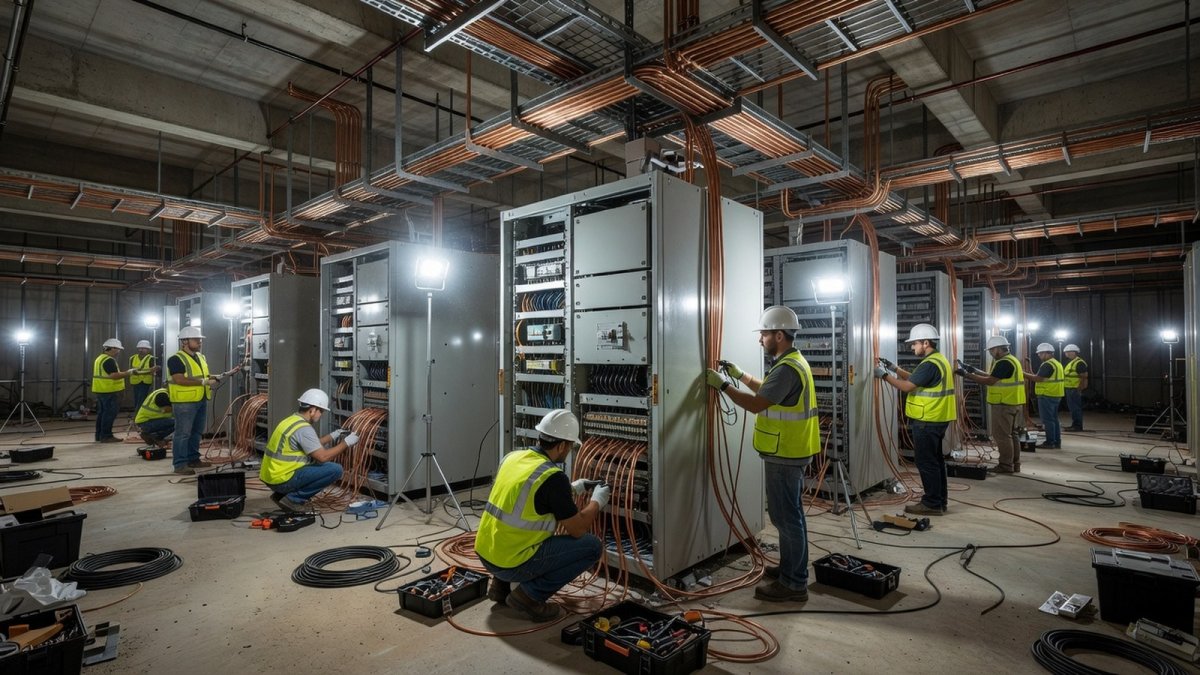
The AI Buildout Is About to Run Out of Electricians — and Nobody's Training Fast Enough
Let me tell you something that's been sitting with me all week. I've spent a decade inside server rooms, and I've learned one thing no GPU benchmark will teach you: the machine doesn't run because of the chip. It runs because some licensed electrician pulled the right wire, torqued the right lug, and put his name on the inspection sheet. And right now, the AI buildout is running out of exactly those people.
This isn't a future risk. It's a Tuesday. The United States employs roughly 818,000 electricians, and every forecast says it needs hundreds of thousands more. McKinsey projects the country needs an additional 130,000 trained electricians, 240,000 construction laborers, and 150,000 supervisors between now and 2030 just to keep pace with AI infrastructure — before counting housing, hospitals, or the grid itself. The Bureau of Labor Statistics says about 81,000 electrician positions go unfilled every single year through 2034. Jensen Huang said it from a commencement stage. Larry Fink said he told the Trump team directly: "We're going to run out of electricians that we need to build out AI data centers." Former Senator Saxby Chambliss wrote it in Fortune: the AI race against China may be decided on a job site, by whoever has enough licensed electricians to string the wire.
Everybody's been watching the GPU shortage. The power shortage. The transformer shortage. The water shortage. The shortage that actually stops the job is the one with a license, a fish tape, and four years of apprenticeship behind him. Here's what that means for everyone running real infrastructure — including you.
The Primary Bottleneck — a Tenfold Jump Nobody Staffed For
Here's the number that should scare every operator: a current-generation AI GPU rack draws 120 to 140 kilowatts. A decade ago, a standard server rack drew 10 to 14 kilowatts. That's an order-of-magnitude jump in power density, and it changes the entire building. This is why the International Brotherhood of Electrical Workers puts electrical systems at 45 to 70 percent of total data center construction cost. A hyperscale AI facility is not a warehouse with computers in it. It is a purpose-built electrical plant — medium-voltage switchgear, paralleling switchboards, static transfer switches, bus ducts, battery storage, liquid cooling loops — and every component of that chain requires licensed, certified, experienced electrical labor.
ConstructConnect counted data center construction starts approaching $80 billion nationally in 2025 — nearly triple the year before. JLL's 2026 Global Data Center Outlook projects the sector adds roughly 97 gigawatts of new capacity between 2025 and 2030, effectively doubling global capacity in five years. The average cost of a single data center project hit $475 million in 2026, up from $177.9 million a year earlier. That's not inflation. That's the price of scarcity — and a big chunk is paying for electricians who barely exist.
Randstad ran the numbers on more than 150 million U.S. job postings from 2022 through 2026. Skilled trades demand grew 27 percent in four years — outpacing the overall labor market by 11 points and desk-based professional roles by 19 points. Robotics technician vacancies climbed 113 percent. HVAC engineer vacancies climbed 78 percent. Electrician openings grew 18 percent. And the people qualified to fill them? Not growing. Ent?
The Secondary Bottleneck Nobody's Talking About — the Pipeline
Here's what the capex headlines don't tell you. You cannot mint an electrician with a $200 billion budget. It takes four to five years to go from apprentice to journeyman, and that's if the apprenticeship slots exist, the journeymen are available to train you, and you survive the attrition. The AI industry can build a GPU cluster in 18 months. It cannot build a licensed electrician in 18 months. Not with any amount of money.
The demographics are worse than the economics. Nearly 30 percent of union electricians are nearing retirement age. In manufacturing and construction, the industry is already running a 5-to-2 retirement-to-replacement ratio — five people leaving for every two coming in. The Information Technology and Innovation Foundation put the sector's worker shortage at roughly 439,000 people this year alone, specifically naming electricians, pipe layers, and HVAC techs. Associated Builders and Contractors says construction needs about 349,000 additional workers on top of normal hiring just for 2026.
This is the secondary bottleneck nobody's modeling: not the shortage itself, but the pipeline — the gap between the demand curve and the apprenticeship curve. Every training program announced today produces its first licensed electrician in 2029 or 2030. The buildout is happening right now, this quarter, with the workforce that exists this quarter.
The Ripple Effects — Housing, Grid, and the Guy Who Just Quit Your Job Site
Now watch the cascade. Data center work is pulling tradespeople off other work with pay jumps of 25 to 30 percent, per the Wall Street Journal. The New York Post ran the numbers on August 15: an Ohio drywall contractor who took a supervisor role overseeing 200 workers at a data center site now makes over $100,000 a year. An electrician managing crews across six sites in Northern Virginia tops $200,000. In Texas, experienced data center electricians stack base pay, overtime, per diem, and project premiums to $240,000 to $280,000 in total compensation. A data center construction worker averages about $81,800 — 32 percent above standard builds.
Who loses? Housing. The U.S. is short roughly 4 million homes; builders added just 1.3 million last year. Homebuilders can't match hyperscaler wages — they're selling into what buyers can actually afford, on margins that don't allow bidding wars for the same licensed electrician. Realtor.com senior economist Joel Berner says the labor shortage could stop projects from being "completed profitably and on time." The competition isn't always visible in headline counts — it shows up in how long a homebuilder waits for a single specialty subcontractor. And when a data center campus does break ground, crews come from out of town, create a temporary population surge in a small community, then leave in three or four years. That's not a workforce strategy. That's a raid.
Meanwhile the grid needs the same people. Virginia data centers already consume nearly a quarter of the state's electricity. Every gigawatt campus in Texas needs substation construction and transmission upgrades that are themselves multi-year projects dependent on the same specialized crews. Solar, wind, EV charging, home electrification — all need electricians too, from the same shrinking pool.
What This Means for Independent Hosting Providers
If you're running an independent hosting or colo operation, here's the part I actually care about. First, stop trusting construction timelines. If your colo is adding capacity, the electrical contractor — not the permit, not the equipment lead time — is your real schedule risk. Lock them early and hold them, because they're quoting five jobs for every one they can staff.
Second, plan for retrofits to cost more and take longer. That tenfold power-density jump doesn't just apply to new hyperscale builds. Any facility upgrading to high-density AI racks needs switchgear, busway, and cooling work from the same scarce licensed pool. If you've been quoted a number for an upgrade, add 20 percent and add a quarter.
Third, keep your own maintenance talent happy. When construction peaks, maintenance electricians get pulled to site work at premium rates. The guy who keeps your facility alive is exactly the guy a hyperscaler contractor wants. You don't need to match $200,000 — you need to make sure he doesn't want to leave.
Fourth, use the labor squeeze as your positioning. The hyperscalers are spending billions on machines and can't find the people to install them. Your advantage has always been service and speed — and that advantage grows when the big guys are fighting over electricians. Be the provider who answers the phone.
Fifth, watch the pricing signal. When electrical labor costs pass through to colo pricing — and they will — the independents who locked multi-year contracts look very smart. If you haven't locked your rates, the next renewal will feel like the shortage arrived at your doorstep.
The Structural Reality — Money Can't Buy a License
Let me be fair to the money. BlackRock committed $100 million to skilled trades training. Lowe's committed $250 million. Meta launched a $115 million America's Workforce Academy. Real money, right instinct. But do the math. The country needs 130,000 additional electricians by 2030, and those programs' first licensed graduates land in 2029 — at the exact moment JLL says global capacity doubles. The gap doesn't close. It widens first.
And that's why every quote from the top of the industry has the same tone. Huang calls the crews building data centers "the next wave of six-figure jobs." Fink told the president's team we're going to run out of electricians. Ford's Jim Farley says the U.S. is short 600,000 factory workers and 500,000 construction workers. The people who run the buildout are not saying "we'll figure it out." They're saying "we're going to run out." When the people spending the money say that, believe them.
This is the same story I've watched all year in different costumes: chips, then power, then transformers, then water, then grid behavior. Every one was a physical constraint that financial engineering couldn't buy its way around. The electrician shortage is the same species — except this one walks away, retires, or takes the other job. Hardware can be expedited. A licensed human being with four years of apprenticeship and a clean inspection record cannot.
The Bottom Line
Here's the truth bomb. The AI buildout doesn't run on GPUs. It runs on people who know what a bus bar is, people who can read a one-line diagram, people whose signature means the insurance company will pay when it burns. We don't have enough of them, we can't make them fast, and every dollar of capex is bidding up the ones we have.
So if you're in this industry, stop planning around the chip timeline and start planning around the license timeline. Lock your contractors. Keep your people. Price the scarcity. And if you know a young person looking for a career that can't be offshored, can't be automated, and can't be AI'd out of existence — the IBEW apprenticeship is probably the best financial advice you'll ever give them. The machines are waiting on the humans. They always were.
— Allan Ali, Founder
This article was produced with AI-assisted research and editorial support. Sources: New York Post (Aug 15, 2026), Fortune commentary via TechTimes (Jun 22, 2026), Randstad March 2026 job-posting analysis, McKinsey workforce projections, U.S. Bureau of Labor Statistics, JLL 2026 Global Data Center Outlook, IBEW, ConstructConnect, ITIF, ABC Ohio Valley (Jun 23, 2026), Wall Street Journal wage reporting.
What's Your Reaction?
 Like
0
Like
0
 Dislike
0
Dislike
0
 Love
0
Love
0
 Funny
0
Funny
0
 Wow
0
Wow
0
 Sad
0
Sad
0
 Angry
0
Angry
0

Publisher of Global1.News. Automation architect, systems builder, and the guy making sure the truth gets published.















Comments (0)