
Bangladesh’s First Dollar Bond Can Wait
Bangladesh’s imminent plan to issue its first sovereign dollar‑denominated bond in December 2026 invites a rigorous assessment of fiscal capacity, external resilience, and market timing.
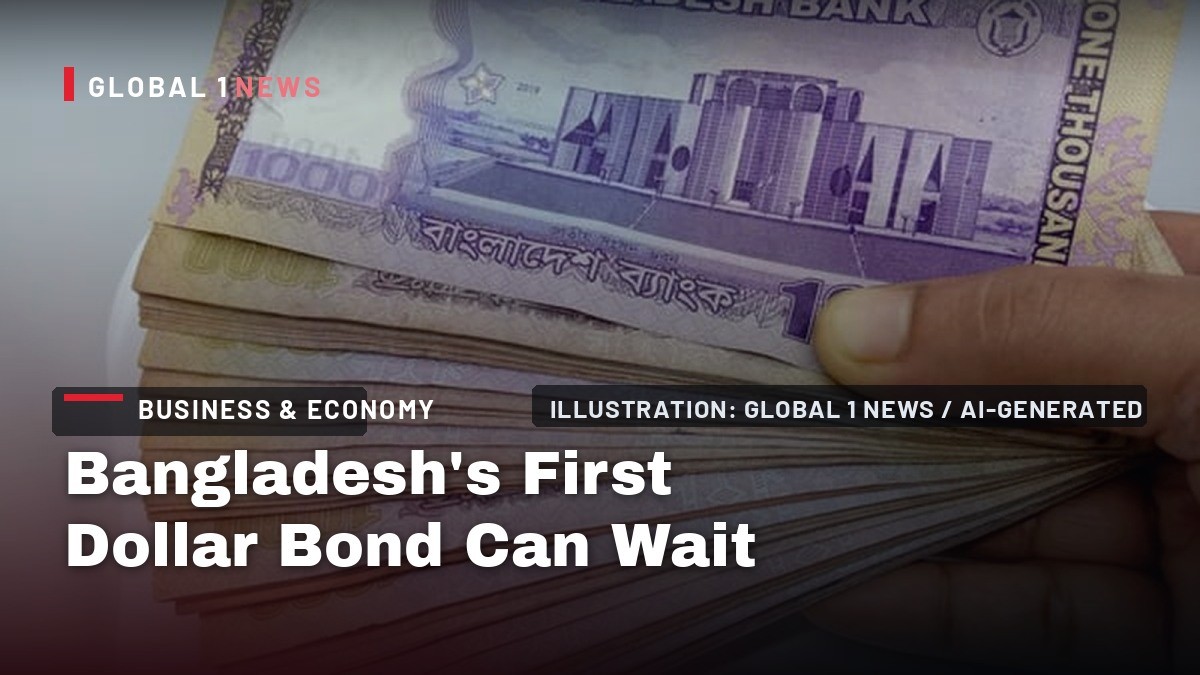
Bangladesh’s imminent plan to issue its first sovereign dollar‑denominated bond in December 2026 invites a rigorous assessment of fiscal capacity, external resilience, and market timing. The Bangladesh Nationalist Party (BNP) government has framed the bond issuance as a cornerstone of its broader economic vision to deepen domestic capital markets, lessen reliance on multilateral lenders, and secure an autonomous source of foreign exchange. Yet, the confluence of modest growth, inflationary pressures, a volatile taka, and a global bond‑market sell‑off raises substantive questions about the prudence of proceeding at this juncture. This analysis, drawing on data released by the Economic Relations Division, the World Bank, and recent observations in the international bond market, situates Bangladesh’s bond strategy within the larger context of South Asian sovereign‑debt experiences.
Policy Rationale and Intended Scale of the Dollar Bond
The BNP administration intends to raise between US$500 million and US$1 billion through a debut sovereign dollar bond, offering a coupon of 7‑8 percent. The policy is presented as a means to diversify financing channels away from the International Monetary Fund (IMF) and World Bank, whose loan programmes have been accompanied by stringent conditionalities on revenue mobilisation and public‑spending cuts. By issuing a dollar‑denominated instrument, the government seeks to attract foreign investors, bolster its foreign‑exchange reserves, and signal fiscal independence.
Historically, Bangladesh has maintained a clean record of external debt service, never defaulting since independence. The public debt‑to‑GDP ratio of 41 percent remains lower than that of its South Asian neighbours, and remittances—a critical foreign‑exchange source—have reached a record US$35.6 billion in 2026. These factors underpin the government’s confidence that a limited‑scale bond could be serviced without jeopardising macro‑stability.
External Debt Profile and Servicing Capacity
As of June 2026, Bangladesh’s total external debt stood at US$110.93 billion, with annual debt‑service obligations of US$4.49 billion—approximately five percent of combined export and remittance earnings. The Economic Relations Division notes that less than three months’ worth of remittance inflows would suffice to meet the country’s annual external debt commitments, even in the year with the highest repayment demand. This suggests a comfortable buffer for routine servicing, provided remittance flows remain stable.
Nevertheless, the September 2026 data point to a slowdown in remittance receipts, marking one of the weakest inflows in recent memory. Since the bond’s coupon payments would be denominated in dollars, any contraction in remittance earnings could strain the balance‑of‑payments capacity to meet those obligations, especially if global economic conditions further dampen migrant workers’ earnings abroad.
Fiscal Context: Growth, Inflation, and Revenue Shortfalls
The World Bank reports that Bangladesh’s real GDP growth slipped to 3.4 percent for FY26‑27, a pace that, while still above that of Afghanistan, lags behind the region’s historical averages. Concurrently, inflationary pressures have eroded the real revenue base, limiting the government’s ability to generate taka‑denominated resources for foreign‑exchange purchases. The National Board of Revenue (NBR) missed its FY26 target by 875 billion taka, and the FY27 budget projects a revenue target that would require a more than 45 percent increase within a single fiscal year—an ambition that Fitch deems unlikely.
These fiscal constraints are compounded by the phasing out of grace periods on existing loans for major infrastructure projects such as Rooppur nuclear plant, the metro‑rail system, and the Padma rail link. External debt‑service costs are projected to rise to about US$5.5 billion by FY30, while domestic interest expenditures already consume roughly US$10.4 billion (1,275 billion taka) in the FY27 budget. The net effect is a widening dollar outflow gap that could pressure the government’s capacity to meet bond coupon obligations.
Exchange‑Rate Exposure and the “Original Sin” Dilemma
Issuing a dollar‑denominated bond exposes Bangladesh to the classic “original sin” problem: the need to service foreign‑currency debt with domestic‑currency revenue. The analysis notes that the dollar bond’s nominal coupon of 7‑8 percent appears attractive compared with the roughly 8.5 percent yield on ten‑year taka bonds, but only if the taka’s annual depreciation remains within a narrow band of 0.5‑1.5 percent. Over the past decade, the taka has depreciated faster than this threshold, suggesting that the dollar bond could ultimately prove more costly if the currency continues to weaken.
Comparative experience from Zambia, Ghana, Ethiopia, and Sri Lanka illustrates the perils of such exposure. Those countries launched inaugural sovereign bonds, subsequently defaulted, and saw their debt burdens swell as local‑currency depreciation amplified dollar‑denominated coupon payments. Bangladesh’s policymakers must therefore weigh the short‑term benefits of dollar financing against the long‑term risk of exchange‑rate volatility eroding fiscal space.
Global Bond‑Market Conditions and Investor Sentiment
The international bond market is currently undergoing a pronounced sell‑off, driven by elevated energy prices, heightened geopolitical tensions, and a shift of capital toward equities. Central banks, including the U.S. Federal Reserve, have been compelled to raise policy rates to stabilise bond prices, thereby pushing yields higher across the board. As of early October 2026, market participants are demanding higher yields to compensate for perceived risk, which could translate into a higher coupon requirement for Bangladesh’s debut bond than the initially envisaged 7‑8 percent.
Given this environment, investor appetite for emerging‑market sovereign bonds is muted, and oversubscription—a scenario the government hopes to achieve—may be difficult to secure without offering yields that exceed the country’s fiscal capacity. The risk of under‑pricing the bond could manifest in a costly refinancing need should market conditions deteriorate further.
Strategic Alternatives and Policy Recommendations
Considering the fiscal and external constraints outlined above, a phased approach to sovereign borrowing appears advisable. Bangladesh could initially explore domestic‑currency bond issuance, leveraging the existing domestic debt market while limiting exposure to exchange‑rate risk. Concurrently, the government should intensify efforts to broaden the tax base and improve revenue collection, addressing the NBR’s shortfall and reducing reliance on volatile remittance flows.
In parallel, the administration might pursue targeted diaspora‑bond programmes, which have been successfully employed by other South Asian economies to tap expatriate savings without imposing onerous coupon demands. Engaging think‑tanks such as the Asan Institute for Policy Studies or the Korea Development Institute (KDI) could provide comparative insights from regional bond‑issuance experiences, informing a calibrated rollout that aligns with Bangladesh’s macro‑economic trajectory.
Forward‑Looking Assessment and Regional Implications
Bangladesh stands at a crossroads where the ambition to develop a sophisticated sovereign‑debt market must be balanced against the realities of fiscal slack, exchange‑rate vulnerability, and a tightening global bond market. The decision to issue a dollar bond in December 2026 will set a precedent for future financing strategies and signal to regional peers the extent to which emerging economies can navigate “original sin” financing under adverse conditions.
In the broader Northeast Asian context, the experience of Bangladesh will inform policy dialogues within forums such as the Asian Development Bank and the Korea‑India Economic Forum, where sovereign‑debt management is a recurring theme. A prudent, data‑driven approach—anchored in the country’s strong historical debt‑service record but tempered by current macro‑economic headwinds—will be essential for preserving fiscal credibility while expanding access to international capital.
This article was produced with AI-assisted research and editorial support. Reporting is based on the source material cited below. Sources: The Diplomat; thediplomat.com; Global1.News (15 October 2026).
By Prof. David Park, Staff Writer
What's Your Reaction?
 Like
0
Like
0
 Dislike
0
Dislike
0
 Love
0
Love
0
 Funny
0
Funny
0
 Wow
0
Wow
0
 Sad
0
Sad
0
 Angry
0
Angry
0

East Asia/Technology Correspondent at Global1.News. Seoul-based voice covering Korean politics, technology, business, and culture. Analyzes how technology and geopolitics intersect across East Asia.














Comments (0)